

When you learn that coffee costs more than tea, and tea costs more than water, you don’t need anyone to tell you that coffee is pricier than water. Your brain automatically fills in this gap, creating a complete picture from partial information. This mental sleight of hand – inferring facts you were never directly taught – is called transitive inference, and it’s one of the hallmarks of intelligent thought.
What makes this ability particularly intriguing to scientists is its universality. Creatures as different as bees, birds, and baboons can all perform transitive inference, suggesting it’s an ancient cognitive toolkit that evolution has preserved across millions of years. Yet despite decades of research, we still don’t fully understand how the brain pulls off this trick. The main obstacle? Traditional methods for studying inference in laboratory animals have been stuck in a rut.
A team of neuroscientists has now cleared this hurdle with an ingenious solution: a fully automated maze that transforms the study of animal reasoning from a painstaking manual process into a high-tech investigation of the neural circuits underlying logical thought.
The Scent of a Problem
If you wanted to test whether a rat could make logical inferences, how would you do it? For years, the standard approach involved filling cups with scented sand. Researchers would train rats to distinguish between odors – perhaps lavender beats vanilla, vanilla beats cinnamon, and so on – with better-smelling options yielding bigger rewards. After extensive training on these “premise pairs,” rats would face the critical test: given a choice between lavender and cinnamon (two scents they’d never encountered together), could they figure out which was more valuable?
This method worked, in the sense that it demonstrated rats could indeed make inferences. But it came with frustrating limitations that hampered deeper investigation. Every single trial required an experimenter to manually set up the scented cups, making the process slow and introducing potential inconsistencies. More problematically, the design offered no clear window into the rat’s decision-making process. When exactly was the animal deliberating? Was it thinking while approaching the cups, while sniffing them, or had the choice already been made?
This ambiguity was particularly vexing because neuroscientists have accumulated vast knowledge about how the hippocampus – a seahorse-shaped brain structure essential for memory – represents spatial information. Specialized neurons fire when an animal occupies specific locations, creating a neural map of its environment. But you can’t easily study spatial representations when your task centers on smelling buckets of sand.
Designing a Maze for the Mind
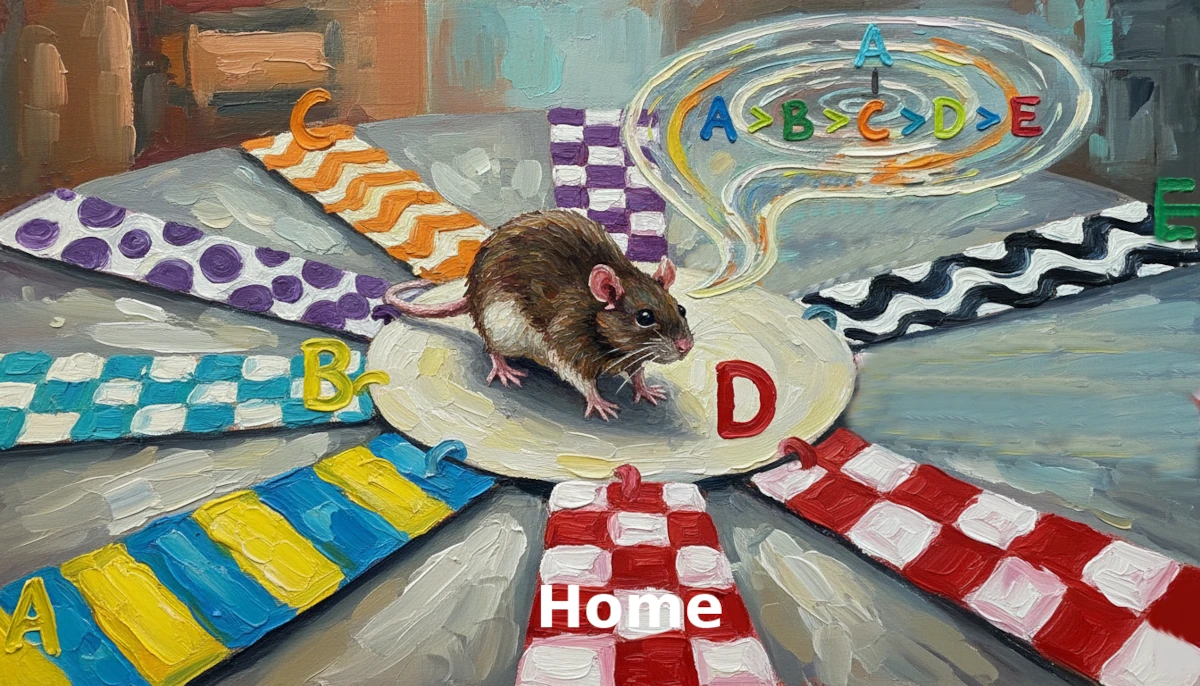
The researchers’ solution elegantly sidesteps these problems. Picture a wagon wheel lying flat, with eight spokes extending from a central hub. Each spoke represents one arm of the maze, and each arm sports distinctive visual patterns – stripes, dots, checkerboards – along with different floor textures. These cues make each arm instantly recognizable.
Computerized barriers control access to the arms, and an automated dispenser delivers liquid rewards, eliminating the need for hands-on management of each trial. Five of the eight arms are designated as items in a value hierarchy, which we can call A, B, C, D, and E, with A being the most rewarding and E the least. A sixth arm serves as “Home,” where every trial begins. The specific arm assignments vary between rats but remain fixed for each individual throughout the study. Thus the maze is an 8-arm radial maze but only six of those arms are actively used.
The genius of this design lies in its central platform. Standing there, a rat can survey all its options, turning its head to examine different arms before committing to a path. This creates a natural “deliberation zone” – a defined time and place where decision-making unfolds, making it possible to observe and measure the cognitive process in action.
Three Phases to Build a Mental Hierarchy
Training doesn’t throw rats into the deep end. Instead, it introduces complexity gradually across three phases, allowing animals to construct their understanding piece by piece.
Phase 1 starts simple: rats learn that arm A is better than arm B, and arm B is better than arm C. On each trial, the barriers open to reveal two options, and the rat must choose. To advance to Phase 2, rats must demonstrate mastery – at least 75% correct choices for two consecutive days.
Phase 2 raises the stakes by introducing a third relationship: C beats D. Now rats face a mixture of three premise pairs (A-B, B-C, and C-D) presented in random order. This addition creates an interesting cognitive challenge. Item C was previously only a “loser” in the B-C pairing. Now it’s also a “winner” in C-D. The rat’s mental model must expand to accommodate this dual role.
Phase 3 completes the picture by adding the final relationship: D beats E. Rats now juggle all four premise pairs, cementing their understanding of the complete five-item hierarchy before they’re ready for the ultimate test.
The reward system encourages exploration while reinforcing correct choices. When a rat chooses correctly – say, selecting A when offered A versus B – it receives a reward (evaporated milk) at the correct arm. Then the barrier to the other arm (B) opens, allowing the rat to visit it for a second, “bonus” reward before heading home. This ensures that even the lowest-ranking item (E) becomes associated with positive experiences.
Make a mistake, though, and there’s no reward at all. The rat must immediately return home to try again. This creates a strong incentive to learn the hierarchy while preventing rats from developing a strategy of simply visiting both arms every time.
The Rocky Road to Mastery
Learning this task isn’t easy, and not all rats succeed. Of 14 animals that started training, 10 made it through all three phases to the inference test – a 28% attrition rate that’s actually typical for five-item hierarchy tasks. This failure rate isn’t a design flaw; it reflects genuine cognitive limitations, just as some students struggle with certain subjects no matter how well they’re taught.
For successful rats, the journey averaged 21 days and required more than 2,200 trials. But the path wasn’t linear. A fascinating pattern emerged: whenever researchers introduced a new premise pair, rats often temporarily regressed on pairs they’d already mastered. When C-D was added in Phase 2, performance on the well-learned A-B and B-C pairs sometimes dipped.
This regression is actually a sign of sophisticated learning. It suggests that rats aren’t just memorizing isolated associations (“pick A when it appears with B”). Instead, they’re building an integrated mental model – a “schema” – of the entire value structure. When new information arrives that doesn’t fit neatly into the existing framework, the whole system must be reorganized. The temporary performance dip reflects this cognitive restructuring, a process psychologists call “accommodation.”
As training progresses and the schema solidifies, new information integrates more smoothly. The addition of D-E in Phase 3 typically causes less disruption than C-D did in Phase 2, suggesting the mental framework is now robust enough to simply slot in the final piece without requiring major reorganization.
The Proof: Rats Show Instant Transitive Inference
After weeks of training, rats faced the moment of truth on a single test day. Mixed randomly among their familiar premise pairs appeared two new combinations: B versus D (the key inference test) and A versus E (a control pairing of the two extreme ends).
The B-D pair was crucial. Rats had learned that B beats C and C beats D, but they’d never seen B and D together. If they’d merely memorized specific pairings without understanding the underlying structure, they’d have no basis for choosing between these two arms. But if they’d constructed a genuine mental hierarchy – an abstract representation of the complete ranking – they should instantly know that B outranks D.
The results were unambiguous. Seven of nine tested rats passed both tests. But the manner of their success was even more impressive than the success itself. From the very first block of B-D trials, rats performed significantly above chance levels. There was no gradual improvement, no trial-and-error fumbling. They simply knew.
Even more striking: rats performed better on their first exposure to the novel test pairs (B-D and A-E) than they had performed when initially learning the premise pairs C-D and D-E during training weeks earlier. Think about what this means. After constructing their mental map of the hierarchy, deducing a new relationship was easier than memorizing a directly-taught one. This is hallmark evidence for schema-based reasoning: the whole becomes more than the sum of its parts, and the integrated knowledge structure enables insights that transcend the individual facts from which it was built.
Reading the Body Language of Thought
While rats navigated the maze, researchers tracked a subtle behavior that offers a rare glimpse into the machinery of decision-making. Faced with difficult choices, rats often pause at the central platform and sweep their heads back and forth between options, as if visually sampling the paths before committing to one. Neuroscientists call this “vicarious trial and error,” or VTE – experiencing, in a sense, the trials vicariously through observation rather than action.
First observed nearly a century ago, VTE has long been interpreted as the behavioral signature of deliberation, a moment when the brain actively simulates different action plans and their potential outcomes. To quantify this behavior objectively, the researchers measured head movement patterns, calculating a metric called zIdPhi that captures both the amount and speed of angular head motion. Higher values indicate more scanning – presumably, more deliberation.
During the training phases, VTE followed an intuitive trajectory. It peaked during the earliest sessions when everything was uncertain and unfamiliar, then gradually declined as rats mastered the premise pairs. Whenever a new pair was introduced, VTE spiked upward again. On the first day the C-D pairing appeared, rats showed significantly more head-scanning on those trials compared to the already-familiar A-B and B-C trials.
But the relationship between VTE and performance revealed something unexpected. You might assume that deliberation leads to better decisions – that rats showing more VTE would be more likely to choose correctly. The data suggested the opposite. For eight out of ten rats, incorrect trials were accompanied by significantly higher VTE than correct trials.
This doesn’t mean deliberation causes errors. Rather, it suggests that in this task, visible VTE reflects uncertainty and indecision more than it reflects productive reasoning. When rats are confident in their knowledge, they move decisively. When they’re unsure, they hesitate and scan – and that uncertainty makes mistakes more likely.
Individual Minds, Individual Strategies
The test day revealed an even more nuanced picture. As expected, rats showed elevated VTE on the novel B-D inference trials compared to the well-learned B-C premise trials. This makes sense: inferring a relationship requires more cognitive work than recalling a memorized one, even if both lead to correct answers.
But when researchers examined individual rat trajectories, they discovered remarkable diversity in problem-solving approaches. Some successful rats made swift, almost ballistic movements toward the correct arm with minimal head-scanning. These animals seemed to extract the answer from their mental hierarchy so effortlessly that no visible deliberation was necessary. Their schemas were apparently so robust that the inference was essentially automatic.
Other equally successful rats displayed high VTE, engaging in prolonged head-scanning before making their correct choices. These animals appeared to actively work through the logic: “I know B beats C, and C beats D, so B must beat D.” Both scanning and non-scanning strategies led to success.
Meanwhile, the rat that failed the inference test often moved quickly and decisively – but toward the wrong arm. Speed without accuracy suggests a different problem: not uncertainty captured by VTE, but rather a weak or incorrectly structured schema.
This individual variability carries an important message: VTE isn’t a simple readout of successful reasoning. Whether an animal needs to engage in observable deliberation depends on the strength and clarity of its internal knowledge representation. A well-consolidated schema enables rapid, accurate inference without effortful deliberation. A weaker or ambiguous schema requires more conscious processing, which manifests as VTE.
A Missing Pattern in Transitive Inference – and What It Reveals
Interestingly, this new task produced a result that differs from traditional transitive inference paradigms. In most studies, rats show a characteristic “V-shaped” performance curve: they’re most accurate on pairs containing end-items (A-B and D-E) and least accurate on middle pairs (B-C and C-D). This new task produced relatively uniform performance across all pairs.
Why the difference? The likely explanation lies in a small but significant design choice. In traditional odor-based tasks, item E never leads to reward – it’s always the wrong choice. This creates a simple rule rats can learn: “Never pick E.” Combined with “Always pick A,” this strategy can yield correct responses on end-item pairs without true understanding of the complete hierarchy.
The new spatial task, by contrast, provides a reward at arm E when rats correctly choose D over E. There’s no absolute “never E” rule to learn. This forces rats to represent E’s position within the hierarchy more accurately, producing more uniform performance across all premise pairs.
This seemingly minor detail illustrates a profound principle: the structure of a learning environment shapes not just what animals learn, but how they represent that knowledge internally. Task design influences cognitive strategy in subtle but powerful ways.
Opening Windows Into the Working Brain
This spatial transitive inference task represents far more than an incremental improvement over previous methods. It’s a new platform that makes previously impossible experiments feasible.
The full automation means researchers can collect thousands of trials per animal without the fatigue, variability, or time constraints of manual testing. The clearly defined deliberation zone provides a specific window – both temporal and spatial – for measuring neural activity during decision-making. And because the task leverages spatial navigation, it connects directly to decades of hippocampal research on place cells and spatial memory.
The real payoff will come from electrophysiological recordings. By implanting electrodes in the hippocampus and prefrontal cortex – two regions known to be essential for transitive inference – researchers can now observe neural ensembles in real-time as rats build schemas, update them with new information, deliberate in the central zone, and execute inferences.
What are hippocampal place cells doing when rats learn the hierarchy? Do they encode abstract value positions (first, second, third) similar to how they encode physical positions in space? How does the prefrontal cortex integrate information across premise pairs to construct a unified schema? What happens during sleep that consolidates this learning? Do neural replay patterns during rest periods strengthen the hierarchical structure?
With over 2,000 trials per rat and clear behavioral markers of learning stages, the dataset will be rich enough to decode complex patterns of neural activity and relate them to specific cognitive operations.
What Rat Reasoning Teaches Us
The fact that rats can build abstract hierarchies and make logical inferences should give us pause. These abilities don’t require language, symbolic thought, or conscious awareness in the human sense. They emerge from neural circuits that rats share, in modified form, with all mammals – including us.
The individual differences observed in this study – in learning speed, deliberation behaviors, and inference strategies – aren’t merely experimental noise. They’re windows into the flexibility of cognitive systems, revealing that the same problem can be solved through different neural implementations. Some brains build rock-solid schemas that enable automatic inference. Others require more effortful deliberation to reach the same correct answers. Both approaches work, suggesting that evolution hasn’t optimized for a single “best” strategy but rather maintains a repertoire of cognitive styles.
This variability could be leveraged in future research. By comparing neural activity in fast learners versus slow learners, in high-VTE versus low-VTE animals, researchers might identify the circuit-level features that distinguish strong schemas from weak ones, or automatic processing from effortful deliberation.
Perhaps most fundamentally, this research reminds us that sophisticated reasoning – the ability to go beyond direct experience and draw logical conclusions – is a deeply conserved biological function. It’s not an evolutionary afterthought tacked onto human brains, but a core capacity implemented in neural architectures we share with creatures that diverged from our lineage tens of millions of years ago.
By understanding how a rat’s brain solves these problems – how it builds knowledge structures, integrates new information, simulates outcomes, and generates inferences – we’re not just learning about rats. We’re uncovering fundamental principles of how neural tissue implements logic, principles that likely operate, in elaborated form, in our own minds every time we reason our way through a problem we’ve never encountered before.
Key Takeaways
This innovative maze paradigm reveals several fundamental insights about reasoning and the brain:
Reasoning is biological, not uniquely human. Rats construct abstract mental hierarchies and make logical deductions without language, demonstrating that inferential reasoning is a deeply conserved cognitive tool implemented in circuits shared across mammals.
Knowledge structures enable flexible intelligence. Rather than memorizing isolated facts, rats integrate information into unified schemas – mental frameworks that let them deduce relationships they were never explicitly taught.
Good decisions don’t always require deliberation. Some rats infer correctly with minimal hesitation while others succeed only after extensive head-scanning, suggesting that well-consolidated knowledge can enable rapid, automatic reasoning.
Individual variability matters. Different rats employ different cognitive strategies to solve the same problem, revealing that evolution has preserved multiple routes to successful reasoning rather than optimizing for a single approach.
Most importantly, this automated spatial task opens the door to unprecedented investigations of the neural circuits underlying reasoning. By recording brain activity while rats build schemas and make inferences, researchers can now address fundamental questions about how neural networks generate intelligent behavior – insights that likely apply, in modified form, to human cognition itself.
Think you’ve mastered it? Test yourself with the 5-question quiz below – it only takes a minute.
Quiz: Can You Crack the Same Logic Puzzles as a Lab Rat?

Source
Study: A Novel Rat Spatial Inference Task Reveals Rapid Deduction of Transitive Relationships Using Schemas and Deliberation
Authors: Blake S. Porter, Catherine Shi, Evgeniia Kozlova, and Shantanu P. Jadhav (2025)
Read the full paper: https://www.biorxiv.org/content/10.1101/2025.08.28.672785v2







Leave a Reply