

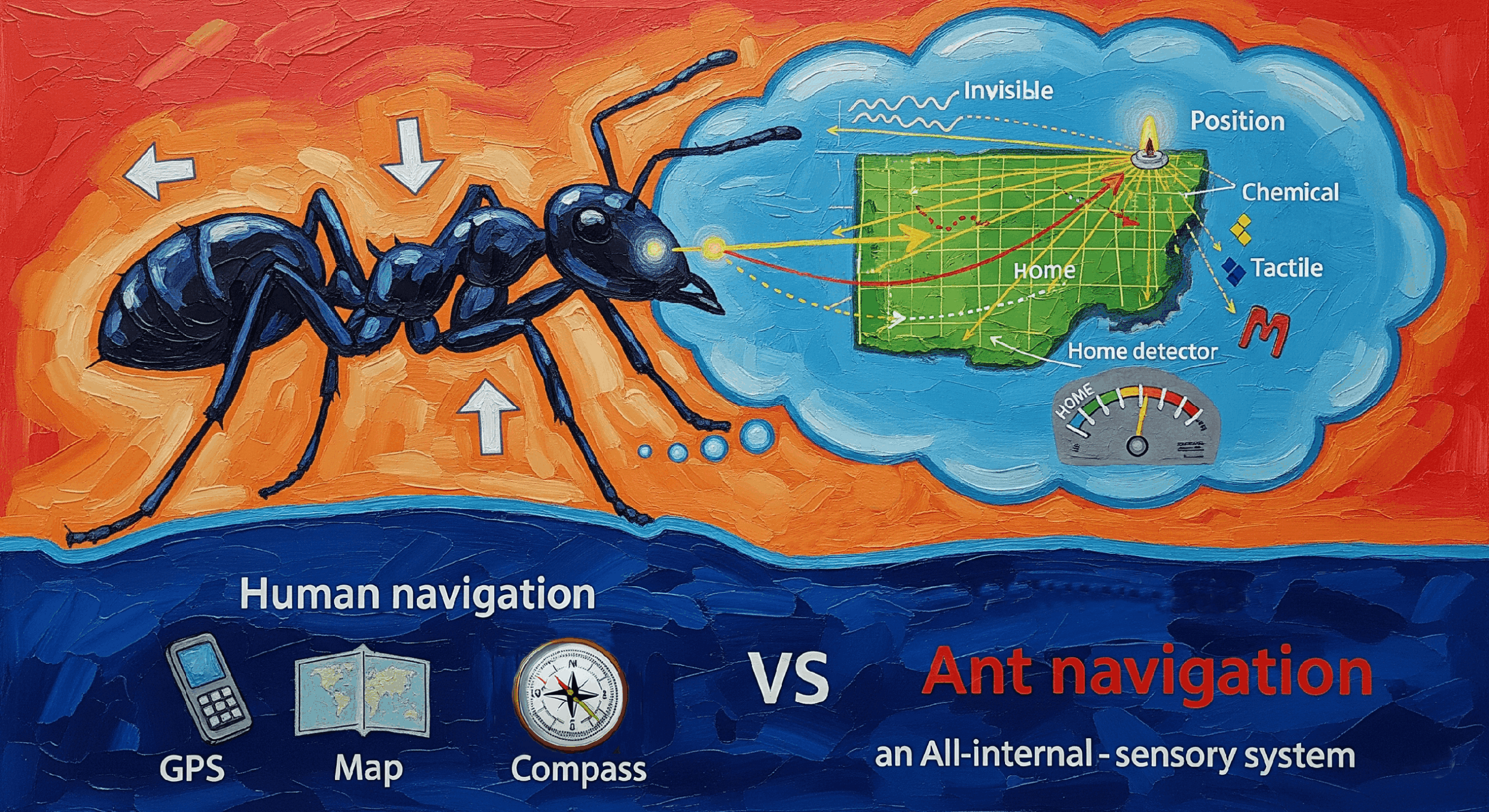
Scientists have uncovered a remarkable secret about one of the world’s most common insects. Black garden ants, the small dark creatures you might barely notice scurrying across your patio, possess navigation skills that rival those of seasoned hikers with compasses. A revolutionary study published in 2025 has overturned everything we thought we knew about how these tiny insects find their way around.
The Myth of Random Walking
For decades, researchers studying black garden ants (Lasius niger) believed these insects were essentially wandering aimlessly when placed in unfamiliar environments. The prevailing scientific wisdom suggested that without obvious landmarks or trails to follow, ants would move in completely random patterns – like leaves blown by the wind.
This assumption made intuitive sense. After all, how could a creature with a brain smaller than a pinhead possibly maintain a sense of direction in a featureless arena? The mathematical models used to describe their movement were based on “random walks” – the same equations used to predict how smoke particles drift through the air.
But sometimes in science, the most fundamental assumptions turn out to be wrong.
The Hidden Logic of Ant Movement
The breakthrough came when a team of researchers decided to ask a different question. Instead of asking “How do ants move through space?” they asked “How do ants move relative to where they started?” This subtle shift in perspective revealed a hidden world of sophisticated behavior that had been invisible to scientists for years.
When the researchers re-analyzed existing data using this new approach, they discovered something extraordinary. The ants weren’t wandering randomly at all. Instead, they were executing a complex navigation strategy that kept them tethered to their starting point like invisible elastic bands.
Decoding the Ant’s Navigation Manual
The study revealed that black garden ants possess an internal compass that constantly tracks their position relative to home base. This compass influences every aspect of how they move:
Strategic Turning: When an ant is facing toward its starting point, it makes small, precise course corrections to stay on track. But when facing away from home, it makes larger, more dramatic turns – as if constantly looking over its shoulder for the way back.
Smart Stepping: Ants heading toward their starting point take confident, longer strides, while those moving away take shorter, more hesitant steps. It’s like the difference between walking toward a familiar destination and cautiously exploring unknown territory.
Speed Control: Counterintuitively, ants slow down slightly when heading home, possibly because they’re being more careful and deliberate in their navigation.
Course Correction: Perhaps most remarkably, when ants are moving sideways relative to their starting point, they consistently bias their movement to curve back toward home – like a magnetic pull drawing them back.
The Light Test
To understand how this navigation system works, researchers conducted experiments under different lighting conditions. They tested ants under normal white light and then under red light, which ants perceive very differently.
The results were fascinating. Even under red light conditions, ants maintained much of their sophisticated navigation behavior. While some aspects were diminished, the core ability to orient toward their starting point remained intact. This suggests that ants don’t rely solely on vision for navigation – they’re likely using multiple senses working together, possibly including touch, chemical gradients, or even subtle magnetic fields.
The Power of Tiny Adjustments
One of the most striking findings was how small behavioral changes add up to dramatic effects. The individual adjustments ants make – slightly longer steps here, marginally smaller turns there – seem almost insignificant when viewed in isolation. But when researchers ran computer simulations based on these tiny adjustments, the cumulative effect was enormous.
Ants using this navigation strategy returned to their starting area in roughly half the time compared to ants moving randomly. At the scale of an entire colony, this efficiency could mean the difference between successful foraging and starvation.
The Anthropocentric Trap: Underestimation of Animal Intelligence
This discovery forces scientists to reconsider fundamental assumptions about insect behavior and intelligence. The research team noted that overlooking an animal’s cognitive abilities when analyzing movement data can lead to completely wrong conclusions – a lesson that likely applies to studies of many other species.
The finding also highlights the danger of anthropocentric thinking in biology. Humans tend to assume that without the tools we rely on – maps, GPS devices, obvious landmarks – navigation becomes impossible. But nature has evolved countless ingenious solutions that work perfectly well without any human-designed technology.
A Hidden World of Intelligence
This research adds black garden ants to an elite group of animals known for exceptional navigation abilities. Desert ants can trek across seemingly featureless sand dunes and return home in perfectly straight lines. Arctic terns migrate from Arctic to Antarctic and back again with pinpoint accuracy. Homing pigeons can find their way across hundreds of miles of unfamiliar territory.
Now we know that even the humble garden ant possesses its own version of these remarkable abilities. The discovery suggests that sophisticated navigation might be far more common in the animal kingdom than we’ve realized – we just haven’t been looking for it in the right way.
Implications Beyond Entomology
Understanding how ants achieve reliable navigation with minimal neural hardware could inspire advances in robotics and artificial intelligence. Engineers designing autonomous drones or robots often struggle with navigation challenges that ants seem to solve effortlessly.
The ant’s approach – making constant small adjustments based on orientation relative to a home point – might offer a more energy-efficient alternative to GPS-based systems, especially for small devices where battery life is crucial.
From Individual to Collective: How Ant Navigation Powers Colony Success
At the colony level, this navigation ability helps explain the extraordinary success of social insects. Instead of sending out scouts who might become hopelessly lost, ant colonies can dispatch workers who maintain reliable connections to home base. This allows for efficient information sharing and resource transport across large territories.
The research also raises intriguing questions about collective intelligence. If individual ants have such sophisticated navigation abilities, how do these skills combine when hundreds or thousands of workers coordinate their activities? The answer could provide insights into everything from crowd behavior to distributed computing systems.
From Discovery to Mechanism: The Quest to Understand Ant Navigation
The research team is planning follow-up studies to uncover the biological mechanisms behind this navigation system. They want to understand exactly which senses ants use, how their tiny brains process spatial information, and whether similar abilities exist in other insect species.
They’re also investigating how this individual skill affects colony-level behaviors. Does having navigationally gifted workers change how colonies explore new territories, respond to threats, or allocate resources?
A New Appreciation for the Ordinary
Perhaps the most profound impact of this research is how it changes our perception of the creatures sharing our world. Black garden ants are so common that most people barely notice them, yet they’ve been carrying around this sophisticated navigation system all along.
The discovery serves as a humbling reminder that intelligence comes in many forms, not all of which are immediately obvious to human observers. Every time we think we understand the limits of animal cognition, nature reveals new depths of complexity and capability.
From Familiar to Extraordinary: The Art of Seeing Differently
This research exemplifies how scientific breakthroughs often come not from expensive new equipment or exotic locations, but from asking familiar questions in new ways. The ants, the experimental setups, and even the basic data had all existed for years. What changed was the perspective – looking at movement relative to the ant’s own reference frame rather than an arbitrary external coordinate system.
It’s a reminder that some of the most important discoveries might be hiding in plain sight, waiting for someone to ask the right question or look from the right angle. In the case of black garden ants, that new perspective revealed an entire hidden dimension of intelligence that had been invisible to science.
The next time you see ants traversing your garden or sidewalk, you might find yourself wondering: Do they know exactly where they’re going? According to this groundbreaking research, the answer is almost certainly yes – and they’re probably better at navigation than you might think.
Think you’ve mastered it? Test yourself with the 5-question quiz below – it only takes a minute.
Quiz: Can You Navigate Like a Garden Ant?

Source
Study: Discovering search behaviour in black garden ant trajectories
Authors: Perrine Bonavita, Marius Albino, View ORCID ProfileJacques Gautrais, Vincent Fourcassié, Maud Combe, View ORCID ProfileSimon Eibner, View ORCID ProfileChristian Jost (2025)
Read the full paper: https://www.biorxiv.org/content/10.1101/2025.06.25.661660v1


Leave a Reply