

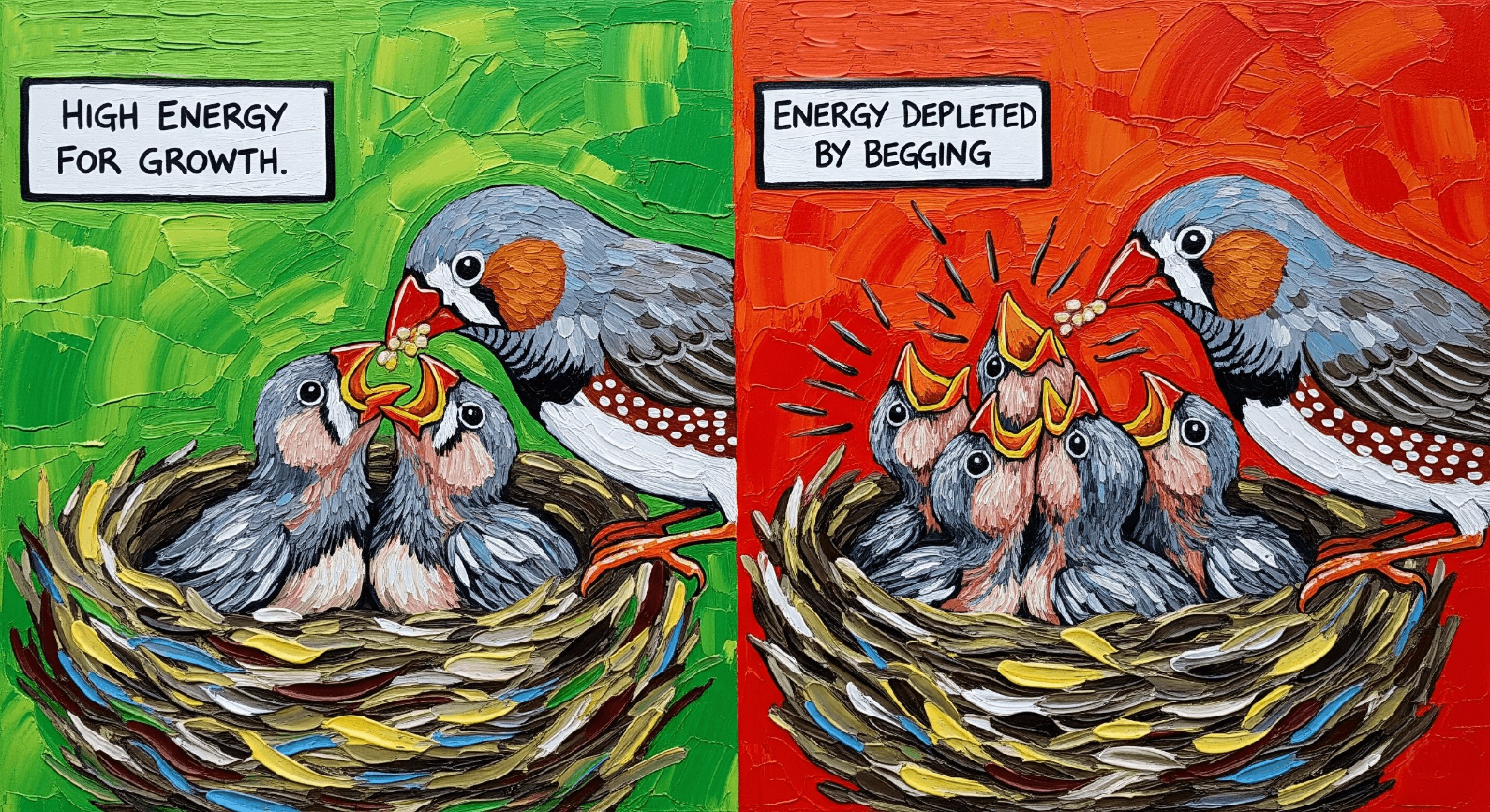
New research reveals that nestling birds in larger families grow slower not because they get less food, but because begging for it is surprisingly exhausting
Anyone who has watched baby birds in a nest knows the scene: mouths agape, wings fluttering frantically, and an endless chorus of demanding chirps whenever a parent approaches. This begging behavior might look simple, but new research reveals zebra finch begging costs are surprisingly steep, an energetic price scientists are only now beginning to understand.
The Puzzle of Large Families
For decades, biologists have observed a consistent pattern in birds: chicks raised in larger broods tend to grow more slowly and often have poorer long-term survival prospects. The conventional wisdom seemed straightforward – more mouths to feed means less food per chick, leading to stunted growth. But a team of researchers led by Marianthi Tangili decided to dig deeper into this assumption, and what they found challenges everything we thought we knew about sibling competition in the nest.
More Food, Slower Growth in Larger Broods
Using zebra finches as their model species, the researchers conducted an ingenious experiment. They moved chicks into artificially created broods of either two (small) or six (large) nestlings, then carefully filmed and analyzed the behavior of both parents and offspring. What they discovered was remarkable: chicks in large broods actually received more food per individual than those in small broods, not less.
“This finding completely overturns our basic assumptions,” explains the research team. Despite getting more food, chicks in larger broods still grew significantly slower – gaining about 0.04 grams less per day and weighing half a gram less by 15 days of age compared to their counterparts in smaller broods.
The Real Culprit Behind Zebra Finch Begging Costs
So if it wasn’t food scarcity, what was causing the growth problems? The answer lies in the begging behavior itself. Chicks in large broods spent about 7% more of their time begging compared to those in small broods. While this might not sound like much, the energetic cost of all that chirping, gaping, and wing-flapping was substantial enough to significantly impact their growth.
Think of it this way: imagine if human toddlers had to perform an exhausting dance routine every time they wanted a snack. Even if they got the food, the energy spent on the performance would leave them with less energy for growing.
Parents Step Up to the Plate
The research revealed another surprising finding about parental behavior. Parents caring for large broods dramatically increased their feeding efforts, spending 7.7% of their time transferring food to chicks compared to just 0.9% for parents with small broods. This shows that bird parents are remarkably responsive to their offspring’s needs, working overtime to ensure all their chicks get fed.
However, this increased parental effort still couldn’t overcome the energy deficit created by the chicks’ own competitive begging behavior.
Honest Hunger: Why Chicks Pay the Price to Beg
This discovery sheds new light on what biologists call “parent-offspring conflict” – the idea that parents and offspring have different evolutionary interests. From a chick’s perspective, it makes sense to beg loudly and persistently to ensure it gets food. But from the parent’s perspective, excessive begging by one chick might mean less energy available for caring for other offspring or for the parent’s own survival.
The result is an evolutionary compromise where chicks engage in costly begging behavior that serves as an “honest signal” of their need. The energy cost ensures that only truly hungry chicks will beg intensively, helping parents allocate food fairly among their offspring.
Beyond Resource Scarcity: The Hidden Begging Costs of Sibling Competition
This research has profound implications for how we think about early-life stress and development in animals. It suggests that the costs of sibling competition go beyond simple resource scarcity – they include the “self-inflicted” costs of competing for those resources.
“The act of begging itself becomes a major factor in determining how well a chick grows,” the researchers note. “It’s not just about getting food; it’s about the energy you spend trying to get it.”
Real-World Implications
The findings also highlight how environmental conditions can affect these dynamics. In this study, parent birds had unlimited access to food, allowing them to increase their provisioning dramatically. In the wild, where food is scarce and parents must spend time and energy searching for it, the balance between begging costs and food received might be even more critical.
Additionally, the loud begging calls that chicks use to attract parental attention can also attract predators, adding another layer of cost to the behavior.
Future Frontiers: Unanswered Questions in Begging Behavior Research
This research opens up new questions about animal behavior and development. Scientists are now interested in understanding exactly how begging behavior drains energy from growing chicks and whether similar patterns occur in other species.
The findings also suggest that early-life experiences – like being raised in a large family – can have lasting effects on an animal’s fitness through mechanisms we’re only beginning to understand. The energy a chick spends begging as a nestling might influence its health, survival, and reproductive success throughout its entire life.
The Hidden Complexity of Family Life: Evolutionary Trade-offs in the Nest
What makes this study particularly fascinating is how it reveals the complexity of family dynamics in nature. It’s not simply a matter of parents dividing resources among offspring – it’s a complex interplay of signaling, competition, and evolutionary trade-offs that can have unexpected consequences.
The next time you see baby birds begging in a nest, remember that what looks like simple hunger might actually be a sophisticated evolutionary strategy – one that comes with hidden costs that scientists are only now beginning to appreciate. In the intricate dance of family life, even in the bird world, every behavior has a price, and every adaptation comes with trade-offs that can surprise us.
This research reminds us that nature is far more complex than it appears on the surface, and that even the most basic behaviors – like a baby bird asking for food – can reveal profound truths about evolution, development, and the hidden costs of survival.
Think you’ve mastered it? Test yourself with the 5-question quiz below – it only takes a minute.
Quiz: Can You Spot the Plot Twist in This Bird Family Drama?

Source
Study: Begging costs rather than food received cause brood size effect on growth in zebra finches
Authors: Marianthi Tangili, Michael Briga, Simon Verhulst (2025)
Read the full paper: https://www.biorxiv.org/content/10.1101/2025.01.29.635459v2





Leave a Reply