

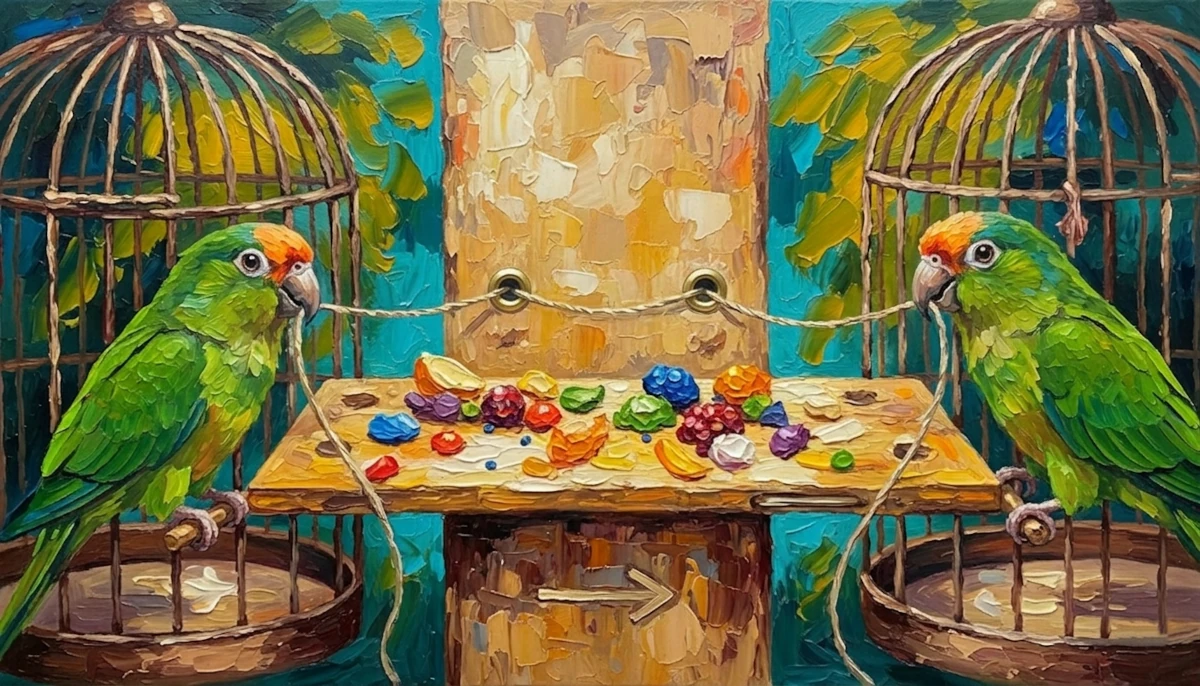
In a laboratory where parrots work together to earn their meals, scientists have documented something that challenges our understanding of animal intelligence: birds deliberately talking to each other to synchronize their actions. This discovery places peach-fronted conures – small, vibrant parrots from South America – in remarkably exclusive company, alongside only bottlenose dolphins, as animals experimentally proven to use vocalizations for intentional task coordination.
The Food Puzzle That Required Teamwork
The experimental setup was deceptively simple. Researchers positioned a sliding platform loaded with food treats between two adjacent cages, each housing a parrot. Threading through the platform was a single string with loose ends dangling into each cage. The physics of the situation created an unavoidable requirement: unless both parrots pulled simultaneously, the string would slide uselessly through the platform, leaving the food tantalizingly out of reach.
Four captive-bred conures – designated as males M1 and M2, and females F1 and F2 – participated in the study, tested in every possible pairing to see how different individuals would approach this cooperative challenge.
Isolating the Role of Communication
The brilliance of the experimental design lay in its systematic manipulation of what information the parrots could access. By creating four distinct scenarios, researchers could pinpoint exactly when and why the birds chose to vocalize.
In the baseline Cooperative Condition, both parrots enjoyed full visual contact and simultaneous release. This was essentially a warm-up – they could watch each other and pull together without sophisticated planning.
The Delayed Condition introduced a temporal challenge while maintaining visual access. One bird gained access to the string five seconds before its partner, testing whether they could coordinate when timing mattered.
The Blind Condition removed visual information but preserved simultaneous release. Hidden behind a barrier, the birds could still succeed through simple simultaneous action without active communication.
Finally, the Blind Delayed Condition combined both challenges: no visual contact and staggered release times. This created a scenario where vocal communication wasn’t just helpful – it was virtually the only way to succeed.
When Words Replace Vision
The data told a compelling story. Across 661 trials producing 2,553 recorded calls, the parrots’ vocal behavior transformed dramatically based on what the situation demanded.
In the Blind Delayed condition – where coordination was essential but vision impossible – the parrots vocalized significantly more than in all three control scenarios. But frequency alone doesn’t prove intentional communication. The crucial finding was correlation: trials with vocalizations succeeded, while silent trials typically failed. This relationship existed specifically in the condition where vocal coordination mattered, not in scenarios where birds could rely on visual cues or fortunate timing.
Analysis of when the calls occurred revealed their strategic nature. In delayed conditions, most vocalizations clustered during the critical five-second window after the first bird was released but before the second bird gained access – precisely when coordination signals would be most useful.
The Vocabulary of Cooperation
Using hierarchical cluster analysis, researchers categorized the parrots’ calls into nine acoustically distinct types, each with different patterns of usage. The diversity itself was revealing: in the Blind Delayed condition, parrots employed a significantly broader range of call types than in simpler scenarios, suggesting they were drawing on their full communicative repertoire to solve a difficult problem.
But not all calls contributed equally to success. “Soft harmonics” emerged as the star performer, associated with successful trials at a rate that yielded an odds ratio of 19.71 – meaning these calls made success nearly twenty times more likely. Their prevalence during the coordination phase suggests they may communicate something like readiness or intent.
Conversely, “High harmonics” and “Intense” calls predicted failure. Whether these represented frustration, impatience, or simply poor coordination signals remains unclear, but their consistent association with unsuccessful trials was statistically unmistakable.
In the control conditions, these patterns dissolved. Calls that meant one thing when coordination mattered lost their predictive power when simpler strategies sufficed.
The Innovator
Among the four test subjects, female F1 distinguished herself through innovation. She developed what researchers termed a “readiness-call” – an acoustically unique vocalization that appeared nowhere in the standard repertoire and that she produced exclusively in the Blind Delayed condition when assigned the role of first bird.
Linear Discriminant Analysis, a statistical technique for identifying patterns in acoustic data, correctly identified this novel call type 84% of the time, confirming its distinctiveness. More remarkably, F1’s success rate jumped 84% in trials where she deployed this call.
This wasn’t learned from other birds or reinforced by researchers – F1 apparently invented a solution to a communicative problem she’d never faced before. The specificity of its use suggests genuine understanding: this call meant something particular in this particular context.
Repairing Relationships Through Imitation
Beyond task coordination, the researchers discovered vocalizations serving a second function: social maintenance. They measured instances of “rapid vocal convergence,” where one bird quickly modified its next call to more closely resemble its partner’s most recent vocalization.
This mimicry occurred more frequently after failed trials than successful ones – a pattern that held across all experimental conditions. The timing suggests these convergent calls function as a bonding mechanism, perhaps analogous to reconciliation behaviors observed in primates after conflicts. After the frustration of a failed attempt, making your voice more like your partner’s might communicate continued cooperation and shared identity.
Individual Voices
An additional finding underscored the sophistication of these birds’ vocal systems: each parrot possessed an acoustically distinct voice. When researchers used Linear Discriminant Analysis to classify calls by individuals, they achieved 83% accuracy. Interestingly, the two females’ calls were more distinct from each other than the two males’ calls were, though the reason for this sex difference remains unexplored.
This individual distinctiveness matters because it enables parrots to know who’s calling – potentially crucial information when deciding how to respond during coordination attempts.
Implications Beyond the Laboratory
This research accomplishes something rarely achieved in animal cognition studies: it provides unambiguous experimental evidence for a sophisticated cognitive ability in a natural context. The parrots weren’t trained to associate arbitrary sounds with rewards. They spontaneously increased vocalization, diversified their repertoire, and even innovated new calls when faced with a coordination problem.
The findings position avian intelligence in a new light. Parrots are already ranked among the most cognitively advanced animals, with problem-solving abilities rivaling great apes and cetaceans. But this study demonstrates their communication systems possess qualities we associate with human language: intentionality, flexibility, context-sensitivity, and capacity for innovation.
The evolutionary implications are equally intriguing. Birds and mammals diverged hundreds of millions of years ago, yet both lineages independently evolved complex vocal coordination abilities. This convergent evolution suggests that certain ecological and social pressures – the benefits of cooperation, the cognitive capacity to track shared goals, and the neural architecture for vocal learning – reliably produce sophisticated communication systems regardless of taxonomic heritage.
Questions Remaining
The study opens as many questions as it answers. Do wild parrots use similar coordination strategies during natural foraging or predator avoidance? How long does it take for innovations like F1’s readiness-call to spread through a group? Can parrots generalize these coordination abilities to novel tasks, or is learning situation-specific?
Perhaps most fundamentally: what are these birds actually communicating? Are Soft harmonics truly conveying readiness, or do they serve some other function researchers haven’t identified? Does F1’s readiness-call have semantic content, or does it work through some other mechanism – perhaps emotional signaling that happens to correlate with successful timing?
A Window Into Other Minds
What makes this research compelling isn’t just what it reveals about parrots, but what it suggests about the diversity of intelligence itself. For decades, scientists sought human-like capacities in our closest relatives – great apes, dolphins, elephants. Yet here, in birds whose brains are structured entirely differently from mammalian brains, we find sophisticated communication, intentional coordination, and creative problem-solving.
These peach-fronted conures, working together in their cages, negotiating timing through invented signals and repairing relationships through vocal convergence, remind us that minds can take many forms. The cognitive abilities we once thought unique to our lineage – or at least to mammals – may be far more widespread, waiting to be discovered in species we’ve overlooked.
As researchers continue investigating vocal behavior across the animal kingdom, they may find that conversations – intentional exchanges of information toward shared goals – are less rare than we imagined. They just don’t always sound like language as we know it. Sometimes they sound like parrots, calling across a barrier, coordinating actions through calls we’re only beginning to understand.
Source
Study: Vocally mediated coordination during a cooperative task in parrots
Authors: Sara Torres Ortiz, Thorsten Johannes Skovbjerg Balsby, Wesley Webb, Matthew Pawley, Ole Næsbye Larsen (2025)
Read the full paper: https://www.biorxiv.org/content/10.1101/2025.10.10.681640v1
Leave a Reply