

When Genetics Speak Louder Than Emotions
Every farmer knows that sheep have distinct personalities – some are clingy and anxious when separated from the flock, while others seem content to wander off alone. But groundbreaking new research reveals that these personality differences run much deeper than anyone imagined. Scientists have discovered that a sheep’s genetic makeup actually shapes the sound of its voice, creating what researchers call “vocal fingerprints” that reveal more about breeding and personality than about immediate emotions.
This finding turns decades of animal communication research on its head, suggesting that the sounds farm animals make aren’t just expressions of how they feel – they’re genetic signatures that have been quietly shaped by thousands of years of selective breeding.
The Sheep Personality Experiment
To understand this phenomenon, researchers at universities across Europe conducted an elegant experiment using 42 female lambs from a unique breeding program. For over 11 years, scientists had been selectively breeding sheep based on one key trait: how they responded to being separated from their flock.
This wasn’t random selection. The researchers were specifically creating two distinct “lines” of sheep:
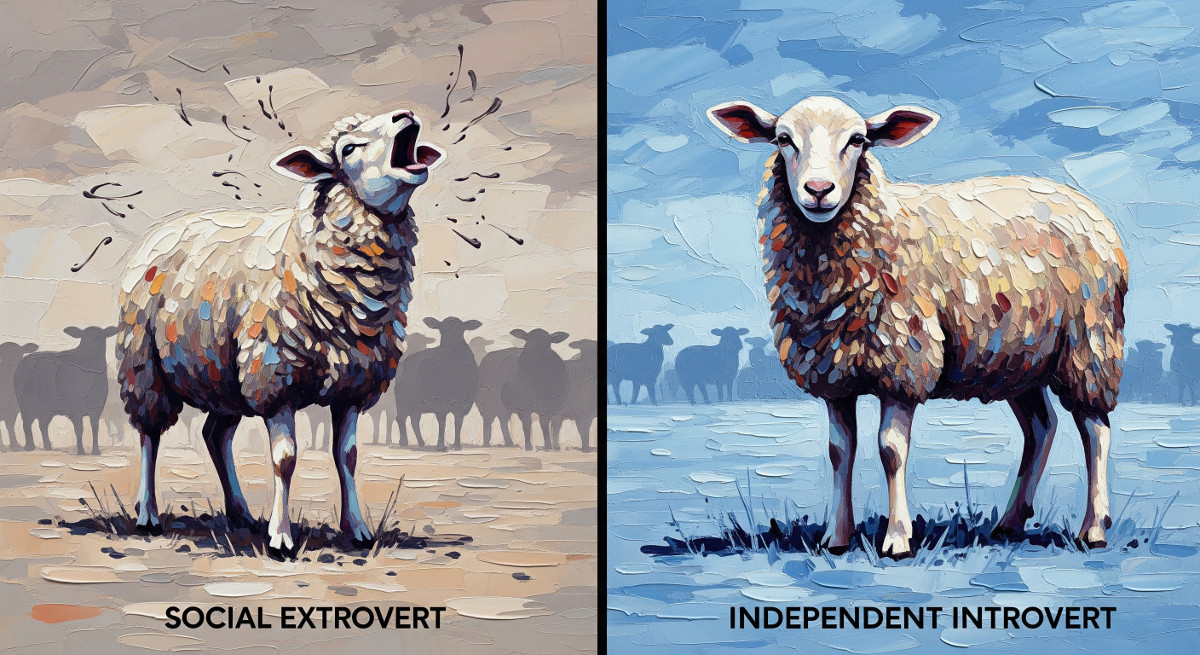
The Social Butterflies (S+ line): These sheep became highly distressed when separated from their flock. They would bleat frantically, pace around, and desperately try to get back to their companions. Think of them as the extroverts of the sheep world.
The Independent Types (S- line): These sheep remained relatively calm when isolated. They showed little distress and seemed more comfortable being alone. These are the introverts.
The key insight was that these personality differences weren’t just learned behaviors – they were inherited traits that could be passed down from parents to offspring through genes.
Sheep Speak: The Hidden Complexity of Flock Communication
Sheep are highly vocal animals that communicate through bleats – their characteristic vocalizations that serve as a sophisticated communication system within their flocks. These bleats aren’t just random sounds; they’re structured calls that carry different types of information depending on the situation and the sheep’s emotional state.
Sheep produce two main types of bleats: “high bleats” and “low bleats.” High bleats are produced with an open mouth during times of higher stress or arousal, particularly when sheep are separated from their flock mates or feeling distressed. These calls tend to be louder, more urgent, and have higher frequencies. Low bleats, on the other hand, are quieter vocalizations made with a closed mouth during calmer moments, like when a mother sheep is communicating with her lamb at close range.
Two Tests, Two Different Emotions
The researchers wanted to answer a crucial question: Do sheep voices change because of their emotions in the moment, or because of their inherited personality? To find out, they recorded sheep bleats in two very different situations:
The Isolation Test: Sheep were completely cut off from seeing or hearing their flock mates. For these naturally social animals, this was deeply stressful – like being locked in solitary confinement.
The Treat Test: Sheep were recorded while eagerly anticipating a barley snack they’d learned to expect. This was a happy, exciting moment – the equivalent of hearing the dinner bell.
By comparing how the two personality types sounded in these different emotional contexts, the researchers could determine what was really driving the differences in their voices.
The Stunning Discovery: Personality Wins
The results were remarkable and unexpected. While scientists had long assumed that emotions were the primary driver of animal vocalizations, this study revealed something entirely different.
The Birth of “Socio-Acoustic Co-Selection”
The research team coined a new term: “socio-acoustic co-selection.” This describes what happens when you breed animals for personality traits – you accidentally change their voices too. It’s as if selective breeding creates a package deal: when you select for social behavior, you also select for specific vocal characteristics.
The highly social sheep (S+) didn’t just act differently – they sounded different. When isolated from their flock, they produced bleats that were:
- More urgent-sounding: Higher pitched frequencies that conveyed distress
- Longer-lasting: They bleated for extended periods
- More acoustically complex: Their calls had distinctive sound patterns that set them apart
But here’s the kicker: these vocal differences weren’t primarily caused by how stressed or emotional the sheep were in the moment. Instead, the sheep’s genetic “sociability score” and their actual social behavior were much better predictors of how they sounded.
The Context Clue
Perhaps most tellingly, these genetic vocal signatures only emerged clearly during social separation – not during the happy treat anticipation. This was the smoking gun that proved the connection between genetics and voice was specifically tied to social situations.
When anticipating food, both personality types sounded relatively similar. But when faced with social isolation – the very context used to breed these different personality types – their genetic differences became vocally apparent.
The Individual Identity Paradox
One of the most intriguing discoveries was completely unexpected. Normally, sheep can recognize each other by their individual vocal signatures – like humans recognizing friends by their voices. But the researchers found that highly social sheep actually became less individually recognizable when they were distressed by isolation.
This seems backwards at first. Wouldn’t highly social animals want to be easily identified by their group? But the researchers propose a fascinating explanation: when highly social sheep are panicked by separation, their distress calls might be designed to alert anyone who can help, rather than to communicate their specific identity.
Think of it like the difference between calling out “Help, it’s me, Sarah!” versus just screaming “HELP!” When you’re in genuine distress, getting anyone’s attention might be more important than being specifically identified. The researchers suggest that highly social sheep use a similar strategy – their isolation calls become general alarms rather than personal signatures.
Decoding the Science of Sheep Sounds
The researchers used sophisticated computer analysis to examine the acoustic properties of thousands of sheep bleats. They measured everything from basic pitch to complex frequency patterns that give each sound its unique character.
What they found was that certain acoustic features consistently differed between the two genetic lines:
- Fundamental frequency: The basic pitch of the voice
- Formants: Specific frequency bands that create the sound’s character
- Duration: How long the bleats lasted
- Spectral patterns: The complex mix of frequencies that makes each call unique
Some of these differences appeared in both emotional contexts, suggesting that the physical structure of the vocal apparatus itself might be influenced by genetic selection for sociability. It’s as if breeding for personality also subtly changes the anatomy of the voice box and throat.
What This Means for Modern Farming
These findings have immediate practical applications for farmers and animal welfare specialists. The discovery that vocalizations can reveal genetic temperament traits opens up new possibilities for:
Better Animal Management: Farmers could potentially identify which animals are more sensitive to separation stress and adjust their management practices accordingly. Highly social sheep might need special care during transport or when moved to new groups.
Welfare Monitoring: Voice analysis could become a non-invasive way to assess animal well-being. Instead of relying solely on visual observation, farmers might use acoustic monitoring to identify stressed animals.
Breeding Decisions: Understanding that personality traits directly affect communication could help farmers make more informed breeding choices, considering not just production traits but also temperament and welfare.
Reduced Stress: Knowing which animals are genetically predisposed to separation anxiety could help farmers minimize stress during routine farm operations.
Implications Beyond the Farm
This research raises profound questions about animal communication and human influence on animal evolution. For thousands of years, humans have been selectively breeding animals for desired traits – larger size, better wool, more milk production. This study suggests that every time we breed for behavioral traits, we might also be inadvertently changing how animals communicate.
Consider the implications:
- Pet breeding: Are we changing how dogs and cats communicate when we breed for specific temperaments?
- Conservation: How might captive breeding programs be affecting communication in endangered species?
- Wild populations: Have centuries of hunting pressure or habitat changes affected animal communication systems?
The Bigger Picture of Animal Communication
This research challenges the traditional view that animal sounds are simply expressions of current emotions. Instead, it suggests that vocalizations are complex signals that encode multiple layers of information simultaneously:
- Immediate emotional state: How the animal feels right now
- Genetic background: The animal’s inherited personality traits
- Individual identity: Who the animal is (though this can be modified by other factors)
- Social context: The specific situation calling for communication
The interplay between these different types of information can be complex. In some cases, genetic factors might override emotional expression. In others, the need for group alarm might trump individual identification.
A New Understanding of Our Relationship with Animals
Perhaps the most profound implication of this research is what it reveals about the depth of human influence on animal evolution. We often think of selective breeding in terms of visible traits – coat color, size, milk production. But this study shows that our breeding decisions reach into the very essence of how animals communicate and express themselves.
Every time we choose which animals to breed based on their behavior, we’re not just changing future generations’ actions – we’re potentially changing their voices, their ability to communicate individually, and their social dynamics. This is a responsibility that deserves careful consideration.
Conclusion: Listening to the Voices of Evolution
The next time you hear a sheep bleat, you’re listening to something far more complex than a simple expression of hunger or distress. You’re hearing the voice of evolution in action – thousands of years of selective breeding encoded in sound waves. You’re hearing genetics speaking through vocal cords, personality expressed through pitch and frequency.
This research reminds us that animals are not just biological machines responding to immediate stimuli. They are complex beings with inherited personalities, genetic predispositions, and communication systems that have been quietly shaped by their relationship with humans for millennia.
For farmers, this knowledge offers new tools for understanding and caring for their animals. For scientists, it opens up entirely new fields of research. For all of us, it provides a deeper appreciation for the hidden complexity of animal communication and the profound ways that human actions ripple through the natural world.
The sheep in the field aren’t just making noise – they’re speaking a language that carries the history of their species, the signature of their genes, and the story of their relationship with humanity. We’re only just beginning to learn how to listen.
Think you’ve mastered it? Take the quick 5-question quiz – it only takes a minute.
Take the Quiz →Source
Study: Socio-acoustic co-selection? Vocal encoding of sociability prevails over emotions in sheep bleats
Authors: Avelyne S. Villain, Alain Boissy, Gaetan Bonnafé, Christian Durand, Sébastien Douls, Paul Renaud-Goud, Marie-Madeleine Mialon, Dominique Hazard, Elodie F. Briefer (2025)
Read the full paper: https://www.biorxiv.org/content/10.1101/2025.06.28.662115v2
Leave a Reply