

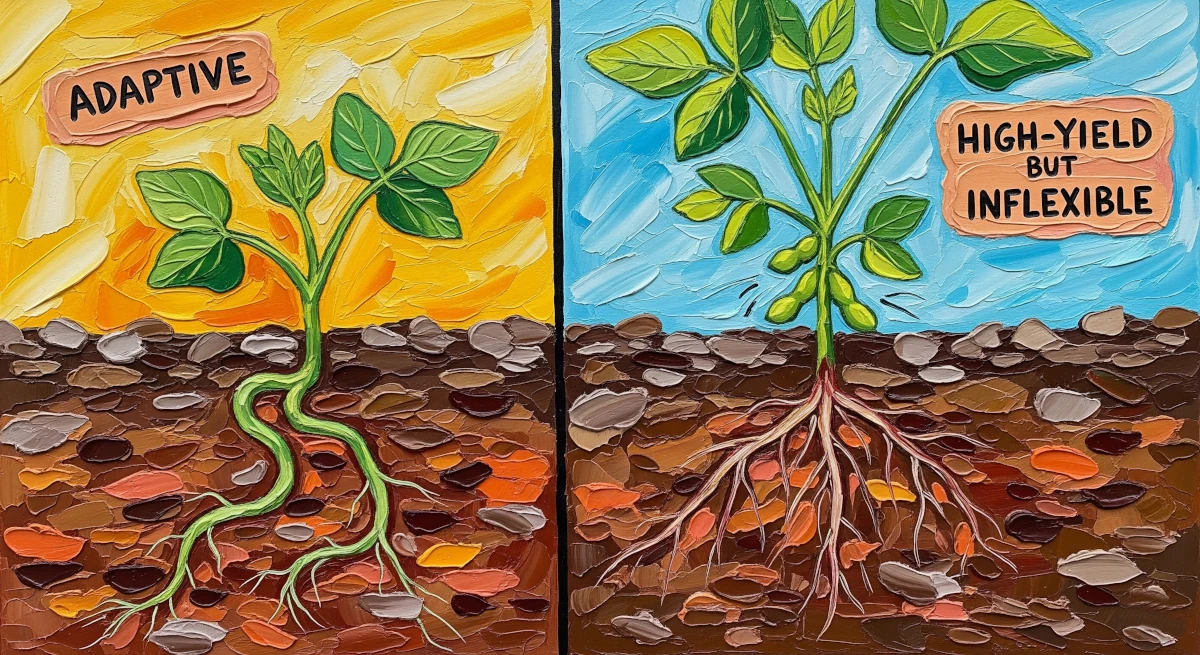
New research reveals that decades of breeding for bigger yields may have cost soybean plants their ability to adapt their roots to challenging conditions – a discovery with profound implications for feeding a changing world.
Imagine you’re a plant breeder in the 1950s, tasked with creating the perfect soybean. You focus on the obvious: bigger beans, taller plants, higher yields. Decade after decade, you succeed brilliantly. Today’s soybeans dramatically outproduce their ancestors.
But what if, in pursuing this success, something crucial was lost along the way – something invisible, underground, and potentially vital for the future?
That’s exactly what scientists at Purdue University discovered when they decided to dig deeper, literally, into how modern soybean breeding has changed not just what we see above ground, but what’s happening in the hidden world of roots.
The Great Root Divide
The research team compared 24 different soybean varieties, split into two fascinating groups. On one side: eight elite “breeding lines” – the modern varieties that represent the pinnacle of agricultural achievement, bred specifically for high-yield farming in America’s heartland. On the other: sixteen “diversity lines” – traditional varieties from around the globe, the agricultural equivalent of heirloom tomatoes, carrying genetic wisdom accumulated over centuries.
Growing these plants side by side in Indiana’s diverse soils, the researchers made a discovery that has significant implications for how we think about crop improvement.
The modern varieties had done exactly what breeders intended: they grew bigger root systems. More root length, more root volume, more root mass. By most measures, they appeared superior underground just as they were above ground.
But appearances can be deceiving.
The Flexibility Factor
When the researchers changed the growing conditions – switching from well-draining sandy soil to nutrient-rich but dense clay soil – something remarkable happened. The traditional varieties responded like seasoned travelers, quickly adapting their root architecture to match their new environment. The modern varieties, despite their impressive size, barely budged.
The numbers tell the story starkly. When traditional varieties encountered sandy soil, they extended their lateral root branches nearly 8% longer than in clay soil, spreading out to search for nutrients in the less fertile ground. The elite varieties managed only a 0.5% adjustment – essentially no change at all.
It was as if the modern plants had become specialists, highly effective in ideal conditions but inflexible when faced with something different. The traditional varieties remained generalists, able to reconfigure themselves for whatever challenges they encountered.
The Roots of the Problem
This trade-off didn’t happen by accident – it’s the predictable result of how plant breeding works. When you select plants based on their above-ground performance year after year, you’re indirectly shaping their roots too. Plants that allocate resources efficiently to maximize yield under optimal conditions gradually lose the genetic machinery needed for adaptation.
Think of it like urban evolution. City-dwelling animals often lose traits they needed in the wild because city life doesn’t require them. Similarly, soybeans bred for high-input farming systems – with reliable irrigation, fertilization, and pest control – gradually shed the adaptability their ancestors needed to survive in unpredictable environments.
The research revealed this pattern across multiple root characteristics. Traditional varieties didn’t just change branch length – they also adjusted their main root diameter by nearly 10% between soil types, while modern varieties showed virtually no flexibility. It’s a comprehensive loss of adaptability, not just a single trait.
When Bigger Isn’t Better
The soil environments themselves told an important story. The clay loam soil, despite being more fertile, actually constrained root growth. Plants growing in clay developed root systems that were 18% lighter, 23% smaller in volume, and had 14% shorter tap roots compared to those in sandy soil.
This makes intuitive sense – clay soil is physically harder to penetrate, creating a natural barrier to root expansion. But here’s where the traditional varieties’ flexibility became crucial. While both types of plants struggled with clay soil, the traditional varieties were far better at adjusting their growth strategies to cope with the challenge.
It’s a preview of what climate change might bring: more variable conditions, more challenging soils, more situations where adaptability matters more than raw performance under ideal conditions.
The Timing of Adaptation
The researchers tracked plants through three distinct growth phases, from early seedlings to mature, seed-producing plants. They discovered that genetic differences between varieties mattered most when plants were young, but environmental adaptation became increasingly important as plants matured.
This timing has profound implications. Young plants can coast on their genetic programming, but mature plants face the complex challenge of reproduction while managing environmental stress. Traditional varieties’ superior flexibility may be most valuable precisely when it matters most – during the critical period when plants are producing the next generation.
The 3D Revolution
One of the study’s innovations was testing new 3D imaging technology to better understand root systems. Traditional root analysis relies on 2D photographs, which can miss important details about how roots spread through three-dimensional soil space.
The new 3D approach, using photogrammetry to create detailed point-cloud models of root systems, revealed patterns invisible in flat images. This technology could revolutionize how breeders select for root traits, making it possible to identify and preserve the flexibility that’s been inadvertently lost.
A Genetic Insurance Policy
The traditional varieties in this study came from the USDA Soybean Germplasm Collection – a vast genetic library containing thousands of soybean varieties from around the world. These collections represent one of humanity’s most valuable insurance policies, preserving genetic solutions to problems we haven’t yet encountered.
The research demonstrates why this genetic diversity matters. Each traditional variety represents thousands of years of evolution and farmer selection under specific local conditions. Some survived droughts, others thrived in poor soils, still others adapted to specific climates or pests. Collectively, they contain genetic tools for challenges we can’t yet imagine.
Lessons for an Uncertain Future
Agriculture today faces unprecedented challenges. Climate patterns are shifting, water is becoming scarcer, and we need to produce more food on increasingly marginal land. The traits that made plants successful in the stable, high-input systems of the 20th century may not serve them well in the more chaotic conditions of the 21st.
This research suggests a path forward that doesn’t abandon the gains of modern breeding but builds upon them. Instead of choosing between high performance and adaptability, future breeding programs could work to combine both. The challenge is identifying which genes control root flexibility and figuring out how to reintroduce them without sacrificing yield.
The Hidden Half of Agriculture
Plant scientists sometimes call roots “the hidden half” of agriculture – arguably as important as shoots and leaves, but far less understood because they’re buried from view. This study illuminates that hidden world and reveals how much we may have changed it without realizing.
The implications extend beyond soybeans. If similar trade-offs have occurred in other crops – and preliminary evidence suggests they have – then much of our food system may be more vulnerable to changing conditions than we realized. But the same genetic repositories that revealed the problem also contain the solutions.
As we face an uncertain agricultural future, the wisdom stored in traditional crop varieties – including their underground secrets – may prove more valuable than we ever imagined. Sometimes looking backward is the key to moving forward, and sometimes the roots of innovation lie buried in the genetic heritage we’ve almost forgotten.
The challenge now is learning to see clearly what has been hidden and to value adaptability as much as we’ve prized productivity. In a changing world, the plants that bend may prove stronger than those that are merely large.
Source
Study: Divergence of root system traits in soybean between breeding and diversity lines
Authors: Sujata Bogati, Joshua Carpenter, Jinha Jung, Sam Schafer, Jairam Danao, Ellen Woods, Qijian Song, Michael Kantar, Jianxin Ma, Diane R. Wang (2025)
Read the full paper: https://www.biorxiv.org/content/10.1101/2025.05.05.651701v1


Leave a Reply