

How 6,753 American dogs are helping scientists crack the code of memory loss – and what it means for all of us
The Moment Everything Changed
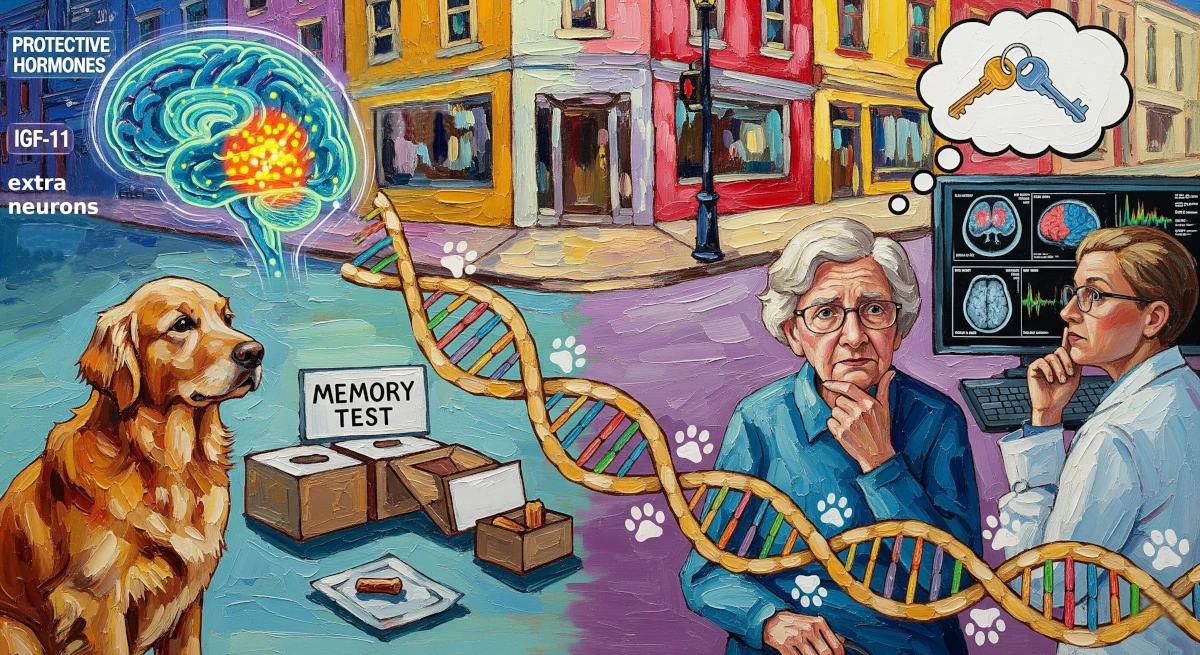
Sarah noticed it first during their daily walk. Max, her 8-year-old Golden Retriever, stood confused at the corner where they turned toward the park – the same corner they’d navigated together for years. He looked left, then right, his tail wagging uncertainly. For just a moment, this familiar route seemed foreign to him.
Sarah’s experience isn’t unique. Across America, dog owners are witnessing similar moments – their beloved companions seeming momentarily lost in familiar places, forgetting learned commands, or struggling with once-simple tasks. What many don’t realize is that these moments represent something profound: the early stages of cognitive aging, a process that mirrors human memory decline in remarkable ways.
Now, thanks to the largest study of its kind, we’re finally beginning to understand what’s happening in aging minds – both canine and human.
Why Study Dogs to Understand Human Aging?
At first glance, studying dogs to understand human brain aging might seem unusual. But companion dogs share remarkable similarities with humans that make them ideal research subjects. They live in the same environments we do, breathe the same air, face similar stressors, and receive sophisticated medical care. Most importantly, they develop many of the same age-related diseases we do, including a condition called Canine Cognitive Dysfunction that closely resembles Alzheimer’s disease in humans.
The practical advantage is clear: dogs live shorter lives than humans, allowing researchers to observe entire aging processes within manageable timeframes. What might take decades to study in humans can be observed in just a few years with dogs.
A Scientific Revolution in Your Living Room
Traditional medical research happens in sterile laboratories with carefully controlled conditions. But the Dog Aging Project threw out that playbook entirely. Instead of bringing dogs to the lab, they brought the lab to the dogs – enlisting nearly 7,000 pet owners across America to become citizen scientists in their own homes.
The concept was brilliantly simple: develop memory tests so straightforward that any dog owner could administer them using items found in their kitchen pantry, yet sophisticated enough to detect the earliest signs of cognitive change. The result? The most comprehensive picture of aging minds ever assembled.
The Great Memory Experiment
Picture this scene playing out in living rooms from Maine to California: owners arranging cardboard boxes on their floors, hiding treats, and carefully observing as their dogs navigate simple but revealing challenges.
Test One: The Three-Box Challenge. Imagine watching your dog as someone places treats in three boxes, one after another. Your dog gets to enjoy the first two treats immediately, but the third box is closed before they can reach it. After a short wait, the box opens. The question: does your dog remember which box holds the treasure?
This isn’t just a party trick – it’s a precise measurement of spatial memory, the same type of mental ability that helps you remember where you parked your car or find your keys.
Test Two: Treat Hide & Seek. In the second challenge, dogs watch as a treat disappears into one of two boxes. Then comes the hard part: waiting. Some dogs wait just seconds, others wait up to 40 seconds – which can feel like an eternity in dog time. When finally released, can they still remember which box holds their reward?
These simple scenarios reveal something profound: how well a brain can hold onto and retrieve spatial information, one of the fundamental building blocks of memory.
The Shocking Truth About When Memory Starts to Fade
The results shattered assumptions about when aging really begins. Scientists expected to see memory problems only in elderly dogs – the canine equivalent of humans in their 80s and 90s. Instead, they discovered something unsettling: cognitive decline begins much earlier than anyone imagined.
The data tells a clear story: a typical 3-year-old dog succeeds at these memory tasks about 72% of the time. By age 13, that success rate drops to 62%. But here’s the critical insight – this decline isn’t sudden. It’s gradual, steady, and begins in what we’d consider middle age for dogs.
For many dog owners, this revelation is both troubling and enlightening. Those subtle changes they noticed – a moment of confusion here, a forgotten routine there – aren’t just quirks of an aging pet. They’re early markers of the same cognitive aging process that affects humans.
The Size Paradox That Changed Everything
The study’s most stunning discovery challenges everything scientists thought they knew about aging. Here’s the puzzle: large dogs typically live shorter lives than small ones. A massive Saint Bernard might live 8 years while a tiny Yorkshire Terrier could live 16. Since big dogs age faster in almost every measurable way – developing arthritis sooner, getting gray fur earlier – logic suggested their brains would age faster too.
The data said otherwise.
When researchers analyzed memory performance across thousands of dogs of all sizes, they found something extraordinary: large and small dogs showed virtually identical patterns of cognitive aging relative to their age. A 10-year-old Great Dane (quite elderly for its breed) performed similarly to a 10-year-old Poodle (middle-aged for its breed).
This finding turns conventional wisdom upside down. While large dogs may race through their physical lives more quickly, their minds appear to be protected by something special.
The Hidden Advantages of a Bigger Brain
Why might larger dogs have cognitive advantages? The answer lies in two fascinating biological mechanisms:
The Hormone Connection. The same hormone that makes a Great Dane tower over a Chihuahua – Insulin-like Growth Factor 1 (IGF-1) – also acts as a powerful brain protector. In the brain, IGF-1 works like a molecular maintenance crew: it helps grow new brain cells, builds connections between neurons, shields existing cells from damage, and clears away toxic proteins that accumulate with age.
Essentially, nature’s recipe for creating large dogs includes built-in brain protection.
The Numbers Game. Large dogs don’t just have bigger brains – they have dramatically more brain cells. While a Chihuahua’s brain might contain millions of neurons, a German Shepherd’s brain houses billions. This abundance creates what scientists call “cognitive reserve” – extra mental resources that can compensate when some brain cells inevitably fail with age.
Think of it like having a large savings account. You can weather financial setbacks better not because you spend money more wisely, but because you have more resources to draw upon when times get tough.
What Every Dog Owner Needs to Know
These scientific discoveries translate into practical wisdom for the millions of Americans who share their lives with dogs:
Watch for Early Signs. Memory changes can begin years before you might expect them. A dog who suddenly seems confused in familiar places, forgets learned behaviors, or takes longer to solve problems they once handled easily might be showing early cognitive changes. Recognizing these signs early creates opportunities for intervention.
Mental Fitness Matters. Just as physical exercise keeps bodies strong, mental challenges appear crucial for brain health. Dogs who regularly encounter new experiences, learn new tricks, and solve puzzles may maintain sharper minds longer. The brain, like any organ, benefits from regular exercise.
Size Isn’t Destiny. While large dogs may have certain biological advantages, dogs of all sizes can maintain good cognitive health with proper care. The research suggests that genetics matter, but they’re not the whole story. Environmental factors – mental stimulation, social interaction, proper nutrition, and regular veterinary care – likely play crucial roles for dogs of every size.
A Window into Human Aging
Perhaps the most profound implication of this research extends beyond dogs to humans themselves. Dogs naturally develop Canine Cognitive Dysfunction (CCD), a condition that mirrors human Alzheimer’s disease in disturbing detail: similar behavioral changes, comparable brain pathology, and parallel disease progression.
The discovery that brain size and growth factors might protect against cognitive decline in dogs offers tantalizing hints about human brain health. If larger brains provide cognitive reserve, and if growth factors help maintain mental function, these insights might guide new approaches to preventing or treating human dementia.
Consider the implications: understanding why some dogs maintain sharp minds while others develop memory problems could illuminate why some humans age gracefully while others struggle with cognitive decline.
The Citizen Science Revolution
The success of recruiting thousands of pet owners as research partners represents a revolutionary approach to scientific investigation. By engaging regular people as collaborators rather than just subjects, researchers accessed a scale and diversity of data previously impossible to achieve.
This model works because it recognizes a simple truth: the people who know dogs best are those who live with them daily. Pet owners notice subtle changes that might escape detection in brief laboratory visits. They understand their dogs’ personalities, habits, and normal behaviors in ways that no researcher could match.
The validation that pet owners could collect data as reliably as trained professionals opens exciting possibilities for future research. Imagine studying not just cognition but behavior, health, and environmental factors across thousands of animals living normal lives in diverse conditions.
Looking Forward: The Next Chapter
The Dog Aging Project continues following these thousands of dogs as they navigate their lives, collecting ongoing data about their health, genetics, environment, and mental abilities. This longitudinal approach will eventually reveal which dogs maintain sharp minds longest, what factors predict healthy brain aging, and whether interventions can preserve cognitive function.
But the implications extend far beyond individual dogs. This research is building a comprehensive understanding of aging that could benefit both species. Every dog owner who notices their pet’s memory changes, every researcher analyzing the resulting data, and every person facing their own cognitive challenges contributes to a growing understanding of how minds age.
The Bonds That Teach Us
There’s something profoundly moving about the realization that our dogs, in their shorter lives, are teaching us about our longer ones. They experience in years what we experience in decades, compressed lives that offer accelerated insights into the aging process we all face.
When Max hesitated at that familiar corner, when thousands of other dogs across America struggled with boxes and treats, when pet owners carefully recorded their observations – all of these moments contributed to a larger understanding of memory, aging, and the remarkable similarities between species we often consider vastly different.
The Dog Aging Project reminds us that scientific breakthroughs don’t always happen in gleaming laboratories with expensive equipment. Sometimes they happen in living rooms, with cardboard boxes and dog treats, guided by the careful observations of people who love their pets enough to help them contribute to something larger than themselves.
In studying how our dogs age, we’re not just learning about them – we’re learning about ourselves, about the nature of memory, and about the possibility that understanding aging might help all of us age better. And perhaps most importantly, we’re discovering that the bonds between humans and dogs run deeper than companionship – they extend into the realm of scientific partnership, where our shared experiences of growing older become the foundation for hope, understanding, and progress.
As we face our own cognitive futures, we can take comfort in knowing that our four-legged friends aren’t just walking beside us on life’s journey – they’re helping light the way forward.
This research represents more than just an interesting finding about dogs – it offers a new model for conducting large-scale health research while strengthening the scientific bond between humans and their companions. As we continue to unlock the secrets of cognitive aging, our dogs may prove to be not just our best friends, but also our best teachers about how to age gracefully.
Source
Study: Functional assessments of short-term spatial memory in the Dog Aging Project identify strong associations with age that are not moderated by body mass
Authors: Stephanie H. Hargrave, Amber J. Keyser, Emma Kristal, Gene E. Alexander, Theadora A. Block, Emily E. Bray, Laura E. L. C. Douglas, Brenda S. Kennedy, Daniel E. L. Promislow, David A. Raichlen, Evan L. MacLean (2025)
Read the full paper: https://www.biorxiv.org/content/10.1101/2025.06.30.662397v1
Leave a Reply