

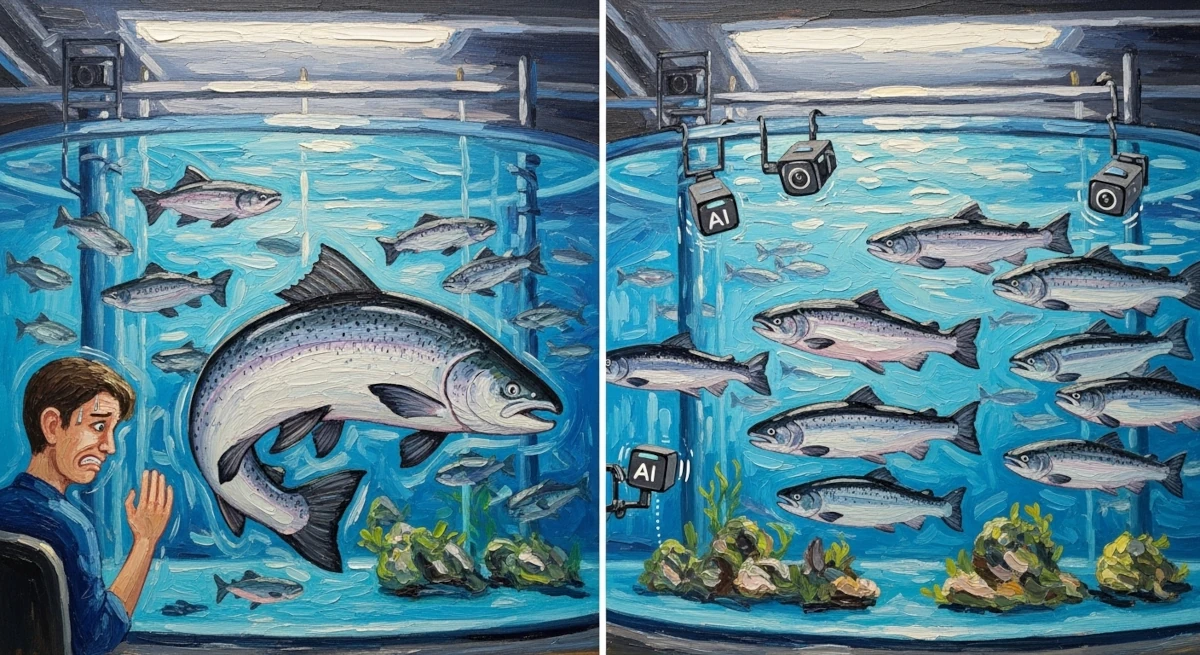
Imagine trying to monitor the health and happiness of 1,000 fish swimming in a tank 24 hours a day. It sounds impossible, but Norwegian researchers have implemented FishProx, an AI fish farm monitoring system that watches like a digital lifeguard, instantly spotting when something is wrong.
The Challenge of Modern Fish Farming
Fish farming has exploded in recent decades as wild fish populations decline and global seafood demand soars. Today’s aquaculture facilities are massive operations housing thousands of fish in sophisticated recirculating systems that filter and reuse water continuously. These Recirculating Aquaculture Systems (RAS) are environmental game-changers – they are highly water-efficient compared to traditional farms, and protect fish from diseases and parasites.
But there’s a catch: how do you keep tabs on fish welfare in such large-scale operations? Traditional fish farming relied on experienced workers walking around tanks, watching for signs of distress or illness. With modern facilities running cameras around the clock and housing exponentially more fish, this approach has become completely inadequate. The sheer volume of video footage generated would require armies of people to analyze – and even then, human observers can miss subtle behavioral changes or can’t be watching every tank simultaneously.
Enter FishProx: The AI Fish Whisperer
Scientists have developed an ingenious solution called FishProx that essentially teaches computers to understand fish body language. The system is based on a simple but profound observation: healthy fish swim together in coordinated groups, while stressed or sick fish break formation and swim erratically.
Think of it like watching a school of children walking to lunch. When everything’s normal, they move in loose groups, chatting and walking in roughly the same direction. But if something startles them – a fire alarm, a bee, or a playground bully – suddenly everyone scatters in different directions. Fish behave similarly, and FishProx has learned to recognize these patterns.
The beauty of FishProx is that it works right out of the box. Fish farms don’t need to spend months training the system or feeding it thousands of labeled examples. It uses a pre-trained AI called the Segment Anything Model (originally developed by Meta) that’s already learned to identify objects in images. The researchers then built specialized software on top of this foundation to understand fish-specific behaviors.
The Digital Fish Observer at Work
Here’s how FishProx transforms endless hours of fish tank footage into actionable welfare insights:
Stage One: Breaking Down the Video
When new video files arrive (typically from cameras mounted above fish tanks), FishProx automatically chops them into individual frames for analysis. This happens lightning-fast using parallel processing – imagine having dozens of assistants each examining different parts of the video simultaneously.
Stage Two: Spotting Every Fish
Each frame gets fed into the Segment Anything Model, which creates digital outlines around every object it sees – fish, equipment, shadows, reflections, you name it. It’s like having an incredibly detailed coloring book where every single object has its own outlined section.
Stage Three: Separating Fish from Everything Else
Since the AI identifies everything, FishProx needs to figure out which outlined objects are actually fish. It does this cleverly by looking at size patterns. Fish in the same tank are typically similar sizes, so the system groups objects by their pixel area and keeps only those matching expected fish dimensions. It also automatically excludes anything outside the tank’s water boundary.
Stage Four: Reading Fish Body Language
For each confirmed fish, FishProx calculates two critical pieces of information:
- Where is it? The tank gets divided into eight pie-slice sections, and each fish gets tagged with its current location
- Which way is it facing? Using mathematical analysis, the system determines each fish’s swimming orientation. Cleverly, it treats swimming left-to-right the same as swimming right-to-left, since the key factor is alignment with neighbors, not absolute direction.
Stage Five: Finding the Troublemakers
Here’s where the magic happens. FishProx groups nearby fish into 16 clusters and analyzes whether fish in each cluster are swimming in harmony or if some are going rogue. Fish swimming significantly differently from their immediate neighbors get flagged as “anomalous,” while those moving in sync are marked “normal.”
Three Numbers That Tell the Whole Story
From all this analysis, FishProx distills fish welfare down to three key metrics that facility managers can understand at a glance:
Detection Count is simply how many fish are visible. This might seem basic, but it reveals important behaviors – during feeding, for example, many fish crowd around feeders and become temporarily invisible to overhead cameras.
Fish Cohesion Score shows what percentage of visible fish are swimming normally with their peers. High scores (close to 100%) indicate calm, coordinated behavior, while low scores suggest widespread stress or agitation.
Cluster Alignment Score measures how many of the 16 fish groups show perfect harmony, with zero members swimming anomalously. This captures group-level coordination and can detect subtle behavioral shifts that might not show up in individual fish metrics.
These three metrics form a complete picture: Detection Count tells us where the fish are, Cohesion Score tells us how they’re behaving as individuals, and Cluster Alignment Score tells us how they’re coordinating as a group.
Interestingly, these metrics work together in predictable ways. When fewer fish are visible (lower detection count), the remaining visible fish often show higher cohesion and alignment scores, simply because smaller groups find it easier to coordinate.
Proof of Concept: Eight Hours That Changed Everything
The researchers tested FishProx using video from a state-of-the-art facility in Sunndalsøra, Norway. The setup was impressive: octagonal tanks holding 1,000 Atlantic salmon each, monitored by high-definition infrared cameras recording 30 frames per second. On May 12, 2023, they captured eight hours of footage that would validate their entire approach.
The Feeding Frenzy (9:00 AM)
When automatic feeders activated at 9:00 AM, FishProx immediately detected the behavioral shift:
- Fish detection counts plummeted by 50% in sections near the feeder as salmon crowded around the food source
- Cluster alignment scores spiked dramatically and stayed elevated for 30 minutes
- Fish cohesion scores rose modestly
- Everything returned to baseline within an hour
This pattern perfectly matched what fish biologists would expect: intense interest in food leading to crowding (invisible to cameras) and highly coordinated swimming among visible fish as they respond to the feeding stimulus.
The Cleaning Crisis (11:17 AM)
But FishProx’s real moment of triumph came during an unplanned event. When facility staff began routine tank cleaning, the system registered what researchers described as “the most prominent spike” in both cohesion and alignment scores. This represented a synchronized stress response as fish rapidly evacuated the cleaning area – exactly the kind of acute welfare event that farm managers need to know about immediately.
The system successfully distinguished between normal operational events (feeding) and genuine stressors (disturbance), proving it could serve as an early warning system for fish welfare issues.
Why AI Fish Farm Monitoring Matters for the Future of Food
The implications extend far beyond just fish farming. As the global population approaches 10 billion by 2050, we need more efficient, sustainable ways to produce protein. Aquaculture already supplies more than half the world’s seafood, and that percentage is growing rapidly.
FishProx addresses several critical industry challenges:
Labor Efficiency: Instead of requiring staff to constantly monitor tanks, the system provides automated surveillance that never sleeps, never gets distracted, and never misses subtle behavioral changes.
Welfare Standards: Consumer demand for humanely-raised food is driving stricter welfare requirements. FishProx provides objective, quantifiable measurements that can verify compliance and identify problems before they escalate.
Economic Benefits: Stressed fish grow slower, get sick more often, and die at higher rates. Early detection of welfare issues can prevent costly losses and improve overall production efficiency.
Environmental Responsibility: Better fish welfare typically correlates with more sustainable operations. Healthy fish require less medication, produce less waste, and have lower environmental impacts.
Current Constraints and the Road Ahead
The researchers are refreshingly honest about FishProx’s limitations. The system requires substantial computing power (they tested it on high-end gaming graphics cards), which could make it expensive to deploy across multiple tanks simultaneously. It also depends on consistent video quality and camera positioning – major changes to tank setup or lighting could disrupt the analysis.
Perhaps more fundamentally, the system currently requires that cameras can see the entire tank volume, which may not be feasible for very large or deep tanks.
The next phase of development focuses on real-time integration. Currently, FishProx analyzes recorded video after the fact. The goal is connecting it directly to live camera feeds and sensor networks, creating dashboard systems that farm managers can monitor in real-time. Imagine getting smartphone alerts the moment fish in Tank 7 start showing stress behaviors, complete with specific metrics and recommended actions.
A Window into Precision Aquaculture
FishProx represents the cutting edge of what experts call “precision aquaculture” – using technology to monitor and optimize every aspect of fish farming operations. Just as precision agriculture has revolutionized crop farming with GPS-guided tractors and sensor networks, aquaculture is undergoing its own technological transformation.
Other emerging technologies in this space include:
- Underwater cameras that can identify individual fish and track their growth rates
- Water quality sensors that continuously monitor oxygen, temperature, and chemical levels
- Automated feeding systems that adjust portions based on fish appetite and behavior
- Genetic monitoring that can detect disease outbreaks before symptoms appear
FishProx fits into this ecosystem as the behavioral monitoring component, providing insights that sensors measuring water chemistry or fish growth rates simply can’t capture.
The Bigger Picture: Technology Meets Biology
What makes FishProx particularly exciting is how it bridges the gap between cutting-edge AI technology and fundamental animal biology. The system doesn’t require fish to wear sensors or undergo any invasive monitoring. Instead, it leverages millions of years of evolution that programmed fish to swim in coordinated groups when calm and scatter when threatened.
This biomimetic approach – where technology learns from natural behaviors – often proves more robust and reliable than systems that try to impose artificial monitoring methods. Fish don’t need to learn new behaviors or adapt to new equipment; the technology adapts to understand their existing behavioral patterns.
Looking Forward: The Next Decade
The research, funded by Norway’s Research Council through the RAS4.0 project, positions the country at the forefront of aquaculture innovation. But the applications extend globally, particularly as other nations develop their own intensive fish farming operations.
Within the next decade, systems like FishProx could become as standard in fish farms as automated feeding systems are today. The ultimate vision is fully integrated facilities where AI continuously monitors fish behavior, water quality sensors track environmental conditions, and automated systems respond to problems in real-time without human intervention.
This isn’t just about making fish farming more efficient – it’s about making it more humane, sustainable, and capable of feeding a growing world population. In an era where we’re asking technology to solve increasingly complex problems, FishProx offers a compelling example of AI being used not to replace human judgment, but to extend our capacity for compassion and care to thousands of animals simultaneously.
For the millions of people whose livelihoods depend on aquaculture and the billions who rely on it for affordable protein, innovations like FishProx represent hope for a future where technology serves both human needs and animal welfare.
Think you’ve mastered it? Test yourself with the 5-question quiz below – it only takes a minute.
Quiz: Can You Spot a Stressed Salmon Before FishProx AI Does?

Source
Study: FishProx: Proximate conspecific interaction of Atlantic salmon (Salmo salar) for behavioural analysis through instance segmentation masks
Authors: I-Hao Chen, Nabil Belbachir, Lars Ebbesson, Antonella Zanna Munthe-Kaas, Lars Erik Solberg, Gaute Alexander Nedberg Helberg, David Izquierdo-Gomez, Santhosh K. Kumaran, Jelena Kolarevic, Chris Noble (2025)
Read the full paper: https://www.biorxiv.org/content/10.1101/2025.07.07.659286v1








Leave a Reply