

A Natural Mystery Hiding in Plain Sight
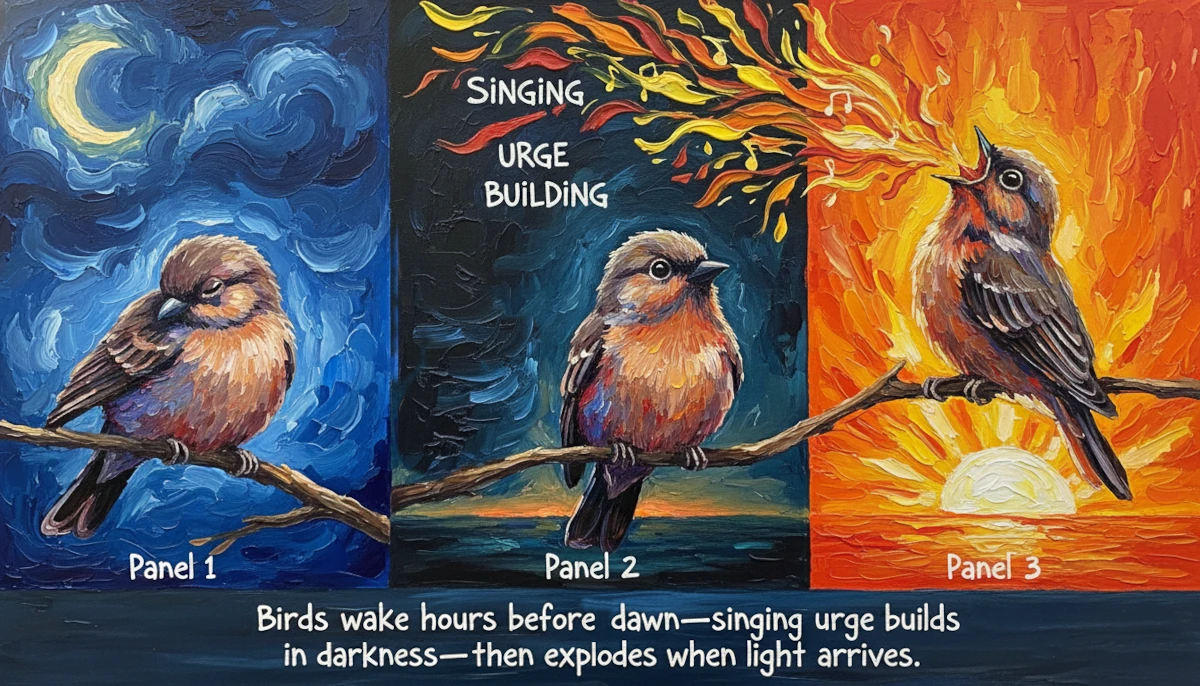
Anyone who has spent time outdoors at daybreak knows the experience: the world transitions from the quiet stillness of night to a sudden eruption of birdsong so intense it seems almost coordinated. This daily phenomenon, occurring in backyards and wilderness areas across the globe, is called the dawn chorus – it has confounded scientists for generations. While the full complexity of the wild dawn chorus involves many factors, a new study using zebra finches has isolated a key biological mechanism that helps explain why these morning vocalizations are so uniquely intense.
The answer lies in a precise interaction between internal timing and external light: when a bird’s internal clock wakes it up well before sunrise, the resulting ‘rebound singing’ is far more explosive. The longer they wait in the dark, the higher the pressure builds.
The Challenge of Studying Dawn in the Wild
Part of the reason the dawn chorus remained mysterious for so long comes down to practical limitations. Studying wild birds in their natural habitats provides valuable information about ecology and behavior, but it makes controlled experimentation nearly impossible.
You can observe that birds sing intensively at dawn, but you can’t manipulate when dawn occurs. You can note that temperature, food availability, and social factors all seem to play roles, but you can’t isolate and test each variable systematically. Field research can describe patterns but often struggles to reveal underlying mechanisms.
This new study took a fundamentally different approach by bringing the question into the laboratory. Using captive zebra finches – small Australian songbirds that have become a standard model organism in behavioral neuroscience – researchers could control every variable: temperature, food, social environment, age, and most critically, the precise timing of darkness and light.
This level of control allowed them to ask questions that would be impossible to answer in the wild: What happens if we delay dawn? What if we make it come earlier? Can we measure exactly when birds wake up and what they’re motivated to do while waiting for sunrise?
Unraveling the Rebound Effect
The central discovery of this research is that the dawn chorus results from a specific sequence of events, each of which can be experimentally demonstrated and measured.
The Hormonal Alarm Clock
The sequence begins in complete darkness, hours before actual sunrise. Birds don’t sleep until the sun wakes them – instead, they have an internal biological mechanism that rouses them from sleep while night still blankets the world.
This wake-up call is triggered by a sharp decrease in melatonin, a hormone that regulates the sleep-wake cycle in vertebrates. In zebra finches, melatonin levels remain high throughout the night but begin dropping precipitously in the hour or two before the normal time when light would appear. This hormonal shift, controlled by an internal circadian clock, pulls the bird out of sleep and into a state of alertness.
To confirm this mechanism, researchers used a drug called luzindole, which blocks melatonin receptors in the brain. Birds treated with luzindole began their morning singing significantly earlier than control birds, demonstrating that the natural pre-dawn drop in melatonin is indeed the key trigger for early awakening.
Awake in Darkness: The Suppression Period
Now comes the crucial phase. The bird is awake and alert, its body primed for activity. Under normal circumstances, this would be the time to start singing – but there’s a fundamental problem. Birds don’t sing in the dark. Darkness acts as a powerful suppressant on vocal behavior, preventing the bird from engaging in what would otherwise be a natural, spontaneous activity.
This creates a peculiar psychological state. The bird isn’t sleeping, isn’t resting, and isn’t simply waiting passively. Instead, it’s experiencing active suppression of a strong behavioral drive. It wants to sing but cannot.
The researchers demonstrated this through multiple lines of evidence. First, they used infrared cameras to monitor birds in complete darkness. When the morning lights-on time was delayed by three hours, the birds were visibly active for those entire three hours before dawn, moving around their cages and showing all the behavioral signs of being fully awake. When lights came on early, by contrast, the birds showed minimal movement beforehand – they were still asleep.
But the most compelling evidence came from an ingenious operant conditioning experiment. Researchers trained birds to press a lever that would illuminate their cage for just ten seconds. Since zebra finches only sing when light is available, lever-pressing became a direct window into their motivation.
The results were unambiguous. During the hours before a delayed lights-on time, birds pressed the lever repeatedly, essentially creating brief opportunities to satisfy their urge to sing. In the early lights-on condition, lever pressing was rare. The birds weren’t just awake during those pre-dawn hours – they were actively, desperately motivated to sing.
The Explosive Release
When dawn finally arrives and light floods the environment, the suppression vanishes instantly. All the motivation that has been accumulating during those hours of enforced silence is suddenly unleashed. The result is an intense, concentrated burst of singing – the dawn chorus.
This rebound effect is remarkably similar to a concept in behavioral psychology called the psychohydraulic model, first proposed by the ethologist Konrad Lorenz. The model envisions motivation as something like water building up behind a dam. The longer the buildup continues, the more powerful the release when the barrier is finally removed.
Manipulating Dawn: The Experimental Evidence
The most striking experimental evidence came from systematically manipulating when “dawn” occurred in the laboratory.
Creating an Artificial Dawn Chorus
When researchers delayed the morning lights-on time by three hours, the birds’ response was dramatic. The moment the lights came on, the birds erupted into intensive singing that closely mimicked what researchers observe in wild dawn choruses. The singing rate was markedly elevated, and the birds began vocalizing almost immediately, even while light levels were still quite low.
Furthermore, in a separate experiment using gradual light increases (mimicking the natural progression of dawn), birds in the delayed condition started singing at significantly dimmer light levels than control birds. This early onset under dim conditions is one of the defining characteristics of the natural dawn chorus, and the researchers had successfully induced it in the laboratory simply by extending the period of dark-induced suppression.
The Control: Early Dawn
The flip side of the experiment was equally informative. When lights came on three hours earlier than the birds’ normal schedule, there was almost no increase in singing intensity. The birds sang a little, but showed none of the explosive, chorus-like behavior seen in the delayed condition.
This makes perfect sense through the lens of the rebound hypothesis. When lights came on early, the birds were still asleep – their melatonin levels hadn’t yet dropped, their circadian clocks hadn’t yet triggered awakening. There was no period of being awake and suppressed, so no motivation had accumulated, and consequently, no rebound occurred.
The contrast between these two conditions – identical birds in identical cages, differing only in the timing of light – provided powerful evidence that it’s the duration of motivated wakefulness in darkness, not some other factor, that determines the intensity of dawn singing.
More Than Just Singing: The Warm-Up Function
Understanding the mechanism of the dawn chorus naturally leads to a deeper question: why would evolution favor such a system? Singing intensively requires considerable energy and could potentially attract predators. There must be significant adaptive benefits that outweigh these costs.
The research provides compelling evidence for what’s known as the “warm-up hypothesis” – the idea that the dawn chorus serves as essential vocal exercise after a night of disuse.
Songs Need Tuning
This intense morning activity – often called a ‘diel’ (daily) pattern – isn’t unique to birds; similar bursts of behavior are seen in primates, frogs, and even insects. In zebra finches, as in other songbirds, however, these songs are complex motor behaviors Bird songs, particularly in species like zebra finches that learn their songs through practice, are complex motor behaviors requiring precise coordination of respiratory muscles, syrinx (the avian vocal organ), and neural control circuits. Like an athlete’s muscles after a period of rest, these systems don’t operate at peak efficiency without warm-up.
To test whether the dawn chorus actually serves this warm-up function, researchers conducted detailed acoustic analyses of individual song syllables. They measured how the structure of these syllables changed over the course of the morning – essentially tracking how the birds’ vocal performance evolved as they sang.
The results were striking. In both the delayed and early lights-on conditions, song structure did gradually change and stabilize over the first hour of singing. However, this refinement process happened significantly faster when birds were engaged in the intensive singing of the delayed condition.
Practice Makes Perfect – Fast
Here’s where the research revealed something particularly important: when the researchers reanalyzed their data, they found that the speed of vocal refinement was correlated with the number of syllables sung, not simply with the passage of time. When they plotted the acoustic changes against syllable order rather than clock time, the differences between conditions largely disappeared.
This demonstrates conclusively that it’s the physical act of singing – the repetitive exercise of the vocal system – that drives optimization. The dawn chorus allows birds to rapidly accumulate the repetitions needed to bring their song performance back to peak quality. An intense burst of singing accomplishes in minutes what scattered singing might take hours to achieve.
Why Peak Performance Matters
This rapid vocal optimization has direct implications for reproductive success:
Mate Attraction: In many songbird species, females show strong preferences for males with high-quality songs. A precisely executed song with proper acoustic structure signals good health, favorable genetics, and overall fitness. By ensuring their songs are optimized early in the morning, males are prepared for critical courtship opportunities throughout the day.
Territorial Communication: For territorial species (though zebra finches themselves are not territorial), song serves as a primary means of establishing and defending boundaries. A well-tuned, powerful song more effectively communicates strength to rivals and may deter challenges. Since many territorial interactions occur in the early morning, being vocally prepared is crucial.
Honest Signaling: The intensity of a male’s dawn chorus may itself communicate information about his quality. Only a bird in good physical condition can sustain such energetically demanding singing, and only a highly motivated individual – presumably one in good health with strong drives – would build up sufficient motivation during the pre-dawn period to produce an intense rebound.
Confirming the Findings Beyond the Laboratory
A common critique of laboratory research is that artificial conditions might not reflect what actually happens in nature. To address this concern, the researchers extended their work into more naturalistic settings.
They studied a group of zebra finches housed in a social aviary with access to natural sunlight through windows. Unlike the stark on-off lighting of the experimental cages, these birds experienced genuine, gradually changing dawn conditions that varied day by day with weather and seasons.
The results beautifully confirmed the laboratory findings. The aviary birds exhibited a clear dawn chorus, with vocal activity increasing markedly around dawn. More importantly, on days when dawn came later (as measured by when light levels crossed a defined threshold), the birds’ vocal activity was more intense and began earlier relative to that dawn time – exactly as the rebound singing hypothesis predicts. A longer period of darkness before dawn led to more intense singing, just as it had in the controlled experiments.
The Eclipse Connection
The researchers also noted that their findings align remarkably well with observations from solar eclipses. During these astronomical events, when the moon temporarily blocks the sun and creates midday darkness, birds often exhibit dawn chorus-like singing when light returns. This unplanned natural experiment provides additional evidence that the transition from darkness to light – not the specific time of day or other circadian factors – can trigger the rebound effect.
Integrating Competing Theories
One of the most satisfying aspects of the rebound singing hypothesis is that it doesn’t simply replace previous theories – it provides a mechanistic foundation that can incorporate and explain many of them.
The Honest Signal Hypothesis: Earlier researchers proposed that intense dawn singing serves as an honest signal of male quality to potential mates. The rebound mechanism supports this idea: a more intense rebound likely reflects higher underlying motivation and better physiological condition, making it difficult to fake and thus an honest indicator of fitness.
The Inefficient Foraging Hypothesis: Some scientists suggested that birds sing at dawn because low light makes foraging inefficient, so they might as well sing until conditions improve. The rebound model doesn’t contradict this but adds depth: even if foraging is possible, birds might still prioritize singing at dawn because that’s when the rebound effect maximizes singing motivation.
The Territory Defense Hypothesis: For territorial species, the dawn chorus has been interpreted as a daily reestablishment of boundaries and social relationships. The warm-up function identified in this research ensures that when a bird needs to engage in these crucial territorial interactions, its vocal performance is optimized for maximum effect.
The Unpredictable Conditions Hypothesis: This theory suggested that because overnight conditions (weather, predation risk, mate fidelity) are uncertain, birds sing intensively at dawn to advertise their survival and status. The rebound mechanism could amplify this signal: variations in overnight conditions that affect sleep quality or wake-up timing could modulate the intensity of the rebound, making it an even more informative signal.
The Circadian-Environmental Dance
A particularly elegant aspect of this research is how it shows the dawn chorus emerges from an interaction between internal and external timing systems.
The circadian clock – an internal, genetically programmed rhythm – controls when melatonin levels drop and the bird wakes up. This system can anticipate dawn even in constant darkness and is synchronized to the daily light-dark cycle over time.
Environmental light cues – the actual presence or absence of light – control when singing suppression is lifted. These are immediate, external signals that vary day by day with weather and season.
The genius of the system is that these two timing mechanisms are offset from each other. The bird wakes up before light appears. This temporal gap – the lag between awakening and dawn – is what allows singing motivation to accumulate and the rebound effect to occur.
Earlier researchers sometimes presented circadian and environmental factors as competing explanations for the dawn chorus. This research shows they’re not competitors but collaborators, each playing an essential role in a single integrated mechanism.
Questions for Future Research
While this study provides a comprehensive explanation for the dawn chorus, it also opens new avenues for investigation.
Species Differences: Zebra finches are non-territorial, opportunistic breeders – quite different from the territorial songbirds like thrushes, robins, and wrens that produce some of the most spectacular dawn choruses in temperate regions. Do these species show the same rebound effect? Does territoriality add additional layers to the phenomenon?
Seasonal Variation: How does the intensity of the dawn chorus vary across the breeding season? Does the rebound effect change as territorial boundaries become established and pair bonds solidify?
Individual Variation: What causes some individuals to have more intense dawn choruses than others? Is it differences in circadian timing, in baseline motivation, in physical condition, or in vocal system quality?
Ecological Context: In wild populations, how do factors like predation risk, food availability, and weather conditions modulate the rebound effect? Can birds adjust their wake-up timing or singing intensity in response to these factors?
Comparative Biology: The rebound mechanism might apply not just to birds but to other animals with time-of-day specific behaviors. Could similar suppression-and-release dynamics explain dawn or dusk activity patterns in other taxa?
A Deeper Connection to Nature’s Rhythms
The dawn chorus is more than just a beautiful acoustic experience – it’s a window into the intricate biological machinery that governs animal behavior. This research reveals that what might seem like a simple celebration of daybreak is actually a sophisticated interaction between hormones, neural circuits, motivation, environmental cues, and evolutionary pressures.
The next time you find yourself awake at dawn, listening to that explosive symphony of birdsong, you can appreciate it with new depth. Those birds have been awake in the darkness, their internal clocks having roused them hours earlier. They’ve been moving about in silence, experiencing a strong drive to sing but physically unable to do so. Their motivation has been building, accumulating like pressure behind a dam.
When the first light breaks over the horizon, that pressure is finally released. What you’re hearing isn’t just sound – it’s the acoustic signature of relief, the vocal expression of pent-up drive, a biological rebound that serves the crucial function of preparing the birds’ vocal instruments for the day ahead. It’s a warm-up routine, a fitness display, and a territorial announcement all woven into a single, intensely concentrated behavior.
This research reminds us that even the most familiar natural phenomena often conceal surprising complexity. The dawn chorus, which has been part of the human experience since our ancestors first evolved consciousness, turns out to be driven by mechanisms that researchers are only now beginning to fully understand. It’s a humbling reminder that nature still holds countless mysteries, even in the everyday events we might take for granted.
Science, at its best, doesn’t diminish wonder – it amplifies it. Understanding that the dawn chorus emerges from the interplay of hormones, darkness, motivation, and light doesn’t make it less magical. If anything, it makes it more so. The beauty we hear is also the beauty of biological systems that have been refined over millions of years of evolution, tuned to perfection for survival and reproduction in a world governed by the reliable rhythm of sunrise and sunset.
The dawn chorus is nature’s daily reminder that complexity and beauty are not just compatible – they’re often inseparable.
Think you’ve mastered it? Test yourself with the 5-question quiz below – it only takes a minute.
Quiz: Can You Pass the Dawn Chorus Challenge?

Source
Study: A rebound from pre-dawn singing suppression drives intense morning singing in captive zebra finches
Authors: Ednei B. dos Santos, Chihiro Mori, Yunbok Kim, Joowon Kim, Ryosuke O. Tachibana, Ok-Yi Jeong, Juyeon Lee, Satoshi Kojima (2026)
Read the full paper: https://www.biorxiv.org/content/10.1101/2025.09.29.679172v5










Leave a Reply