

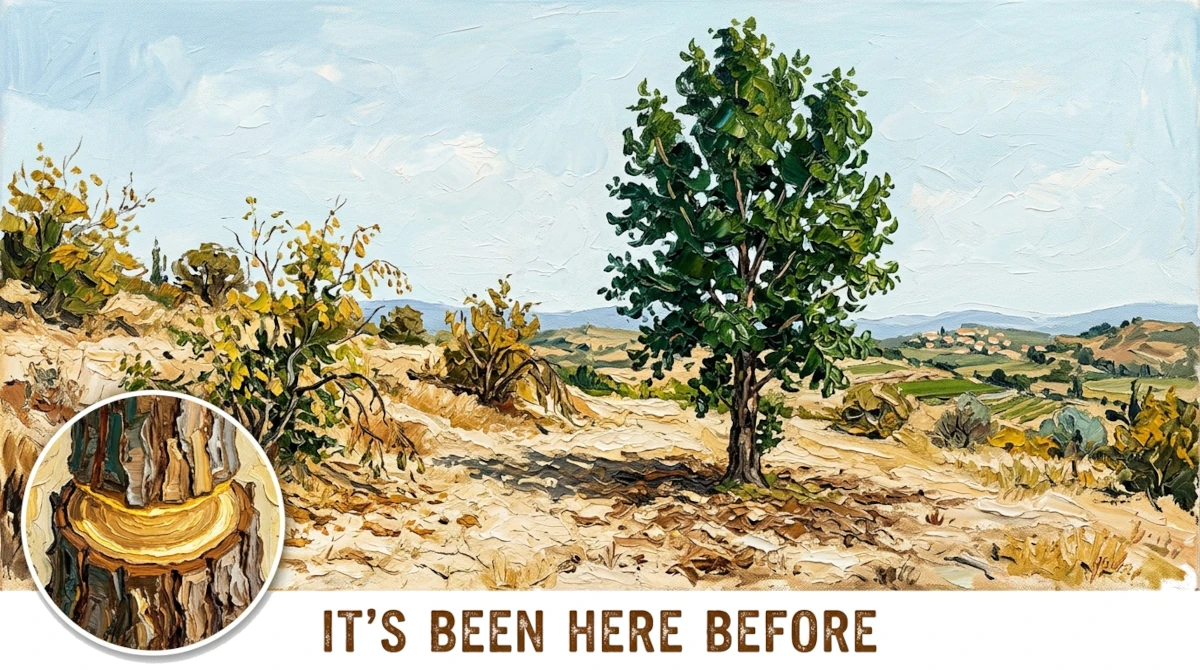
On a hillside in southern France, a poplar tree is doing something scientists are only beginning to understand. It is, in a very real sense, taking notes.
The drought that gripped the region last summer is over. The rains have returned, the soil is wet, and to all appearances the tree has recovered. Its leaves are green. Its trunk is thickening. The crisis has passed. But inside the thin ring of tissue just beneath the bark – a layer of cells no wider than a few sheets of paper – a molecular record of that drought is still being written. Chemical tags are being placed on the tree’s DNA. Genes are shifting into new patterns of activity. Hormonal signals are reorganizing the tree’s internal priorities.
This is tree drought memory in action: when the next drought arrives, the tree will not face it as a stranger. It will have been here before.
The Forgotten Layer
Most people, if asked to describe the inside of a tree, would mention rings. Every year a new ring of wood is laid down, the wide ones marking good years, the narrow ones marking hard ones. What most people don’t know is that all that wood is made by a single, extraordinarily thin layer of living cells called the vascular cambium.
The cambium is essentially a sleeve of stem cells wrapped around the woody core of the trunk. On one side it produces wood; on the other, the inner bark that carries sugars down from the leaves. It is the engine of the tree’s radial growth, and it never really stops working. As long as the tree is alive, these cells keep dividing.
That continuous division is exactly what makes the cambium such an effective memory system. Every time a stem cell divides, it doesn’t just pass on a copy of its DNA – it passes on a copy of the chemical modifications sitting on that DNA. Experiences encoded in the parent cell are inherited by its daughters. Over years and decades, the cambium accumulates an epigenetic record of everything the tree has lived through.
Epigenetics – the science of how genes are switched on and off without any change to the underlying DNA sequence – is one of the most active frontiers in biology. In the context of trees, it offers an answer to a question that foresters and ecologists have long struggled to explain: why do some trees handle repeated droughts far better than their genetics alone would predict? And why does a tree that survived last year’s drought often seem to cope more capably with this year’s?
The answer, it turns out, is written in the wood.
Molecular Notes
To understand how tree memory works, it helps to picture the DNA inside a cell not as a static blueprint but as a vast library – millions of books arranged on shelves, most of them closed. What epigenetics does is decide which books are open and which are shut. The main tool for this is DNA methylation: the attachment of a tiny chemical tag, called a methyl group, to specific points along the DNA strand.
These tags don’t change the words in the books. They change which ones are readable. A heavily methylated gene is one that’s been put on a high shelf, out of reach. A demethylated gene has been pulled down and opened.
Plants use three distinct types of methylation, each with a different personality. The first – called CG methylation – is the most stable. When a cell divides, enzymes faithfully copy CG methyl tags onto the new DNA strand, so the pattern is preserved with high fidelity across generations of cells. This is the molecular ink of long-term memory. The second type, CHG, is moderately stable. The third, CHH, is highly dynamic, responding quickly to stress and mostly involved in silencing “jumping genes” – rogue sequences that try to copy themselves to new locations in the genome during the upheaval of a drought.
When a poplar experiences a drought, thousands of these methyl tags shift position. Some genes get shut down; others get opened up. The tree’s internal programming is literally rewritten. And many of those rewrites don’t get undone when the drought ends.
The Experiment
A team of plant scientists decided to test just how far this memory extends – and the results were striking enough to reshape how researchers think about tree resilience.
The experiment used two varieties of black poplar with very different temperaments. DRA-038, from a river valley in south-east France, is sensitive to drought: it suffers more, loses more growth, and struggles more to recover. PG-31, from central Italy, is naturally tough – it weathers drought with less visible distress and bounces back more readily. By studying both, the researchers could observe how a tree’s genetic character shapes its memory strategy.
They also worked with a set of engineered poplars in which the DNA methylation machinery had been deliberately altered – some with methylation turned down, some with demethylation turned up – to see what happened when you changed the way the tree writes and erases its molecular notes.
In Year 1, some trees were subjected to five weeks of water deprivation, then given a week of rewatering before the scientists analyzed what had changed. The findings were immediate and clear: even after a week of recovery, the trees’ hormone profiles were still altered, hundreds of genes were still behaving differently than before the drought, and thousands of methylation tags across the genome had shifted. The drought had left a fingerprint that water alone couldn’t wash away.
Year 2 was where it got genuinely surprising.
Before the second growing season began, the scientists cut every tree back to its stump. New stems grew up entirely from the root system – fresh wood, fresh leaves, fresh cambium. Whatever memory existed had to have survived in the roots. Then some trees were droughted again, and the responses of previously stressed trees were compared to those experiencing drought for the first time.
The trees that had been through drought before were different. Not dramatically, not visibly – but molecularly, unmistakably. The chemical fingerprint of the first drought was still present in the new tissue, having traveled from the roots into the regenerated stems. And when the second drought hit, previously stressed trees responded differently than drought-naive ones. In the sensitive DRA-038 variety, the number of methylation changes in Year 2 was 22 times higher than in Year 1 – as if the tree, having learned that droughts were a recurring feature of its environment, was doing far more thorough record-keeping the second time around.
Perhaps most importantly, trees that experienced drought in both years did not suffer more than trees only droughted in Year 2. If anything, they coped better. The first drought had primed them – prepared them at a molecular level for what was coming.
The Price of Tree Drought Memory
There is a cost to all of this. Trees that survived a drought in Year 1 and then enjoyed a perfectly watered Year 2 still grew less than trees that had never been stressed at all. Scientists call this a physiological debt – a hidden tax on future growth levied by past suffering. Even when conditions were ideal, the tree was still, in some sense, catching up.
This happens because drought forces the tree into a difficult trade-off. During water shortage, a tree cannot afford to invest energy in rapid growth. Instead, it diverts resources toward protecting its most precious asset: the stem cells of the cambium. If those cells die, the tree loses its capacity for future growth entirely. So the tree essentially goes into lockdown, sacrificing its annual rings to protect its long-term survival engine.
Two genes, called SRO1 and UBP13, appear to be key switches in this decision. SRO1 helps keep stem cells in a kind of holding pattern, preventing them from committing to active growth while the crisis is ongoing. UBP13 helps manage the hormonal signals that put growth on pause. In sensitive trees, these genes come on strong during drought – a conservative, survival-first response that leaves a growth debt in its wake.
But here is where the memory pays off. In trees that had been droughted before, this lockdown response was less extreme the second time around. The molecular preparation laid down in Year 1 seemed to give the tree a more nuanced playbook – less panic, more strategy. The sensitive DRA-038, after two years of drought experience, began to behave more like the naturally tolerant PG-31.
Experience, it seems, is a good teacher – even for trees.
The Champion
Among all the trees in the experiment, one stood out. The engineered line known as OX-dml – trees in which the enzymes that remove methyl tags are overactivated — was exceptional by almost every measure. It grew faster than the others under normal conditions. It maintained that growth advantage under drought. And it was significantly more resistant to the internal hydraulic failure – a process called embolism, where air bubbles form in the water-conducting vessels – that is one of the leading causes of tree death during severe drought.
What OX-dml revealed is that methylation isn’t always protective. Sometimes the tags that pile up on DNA are getting in the way – muffling genes that the tree actually needs in order to grow and respond to stress. By running the demethylation machinery at higher capacity, OX-dml effectively lifts that molecular fog, giving the tree freer access to its own toolkit.
This is a counterintuitive but important insight. We might assume that more methylation – more annotation, more record-keeping – would always be beneficial. OX-dml suggests the opposite: that the ability to erase is just as important as the ability to write. A tree that can selectively remove outdated or counterproductive tags may be more adaptable than one that accumulates them without editing.
What This Means for the Forests of Tomorrow
Climate projections are grim reading for anyone who cares about forests. Droughts are becoming longer, hotter, and more frequent across much of Europe, North America, and beyond. Tree mortality events that once occurred once a generation are now occurring every few years. Forests planted today will face conditions their designers did not anticipate.
Against this backdrop, the discovery of robust, trans-annual epigenetic memory in trees is not just scientifically interesting – it is potentially transformative for how we manage and grow forests.
Nursery priming is one of the most immediate applications. Because methylation marks are stable through cell division and dormancy, it may be possible to deliberately expose young saplings to mild, controlled drought stress before they are planted in the field. The molecular memory laid down during this pre-treatment could make them more resilient when they face real conditions. It is, in effect, a form of training – and the research suggests the lessons stick.
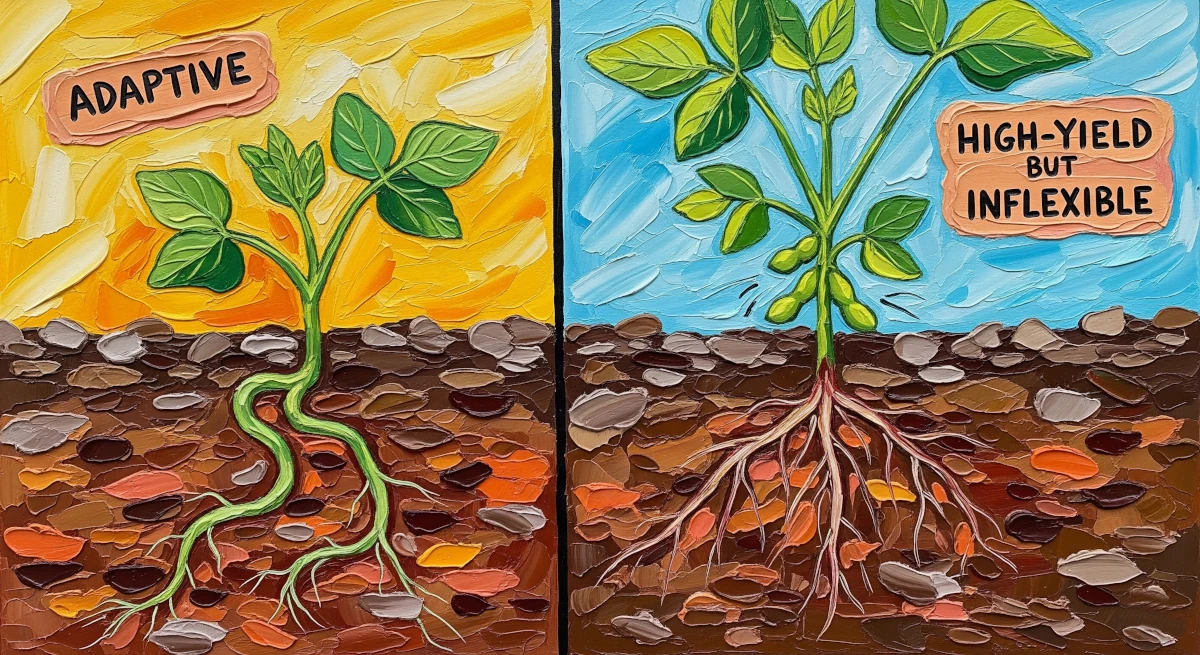
Genotype selection takes on a new dimension too. Foresters have always selected trees for traits like height, straightness, and disease resistance. Now there is an argument for selecting based on methylation profile – choosing trees whose epigenetic machinery gives them the right balance of stability and adaptability for the conditions they will face. A highly stable genotype like PG-31 might be ideal for a reliably drought-prone region. A more plastic type, one capable of dramatic molecular reprogramming, might be better suited to an environment where drought frequency is still unpredictable.
Coppicing and regeneration must also be rethought. Many traditional forestry systems involve cutting trees back to the stump – sometimes repeatedly – and harvesting the regrowth. This research shows clearly that such cutting does not reset the tree’s molecular memory. The roots remember. A stand that has been droughted before will carry that history into its next rotation, for better or worse. In practical terms, this means foresters need to account for epigenetic history when forecasting growth after harvest.
A Different Kind of Intelligence
There is something almost vertiginous about sitting with these findings. Trees are often invoked as symbols of stoic passivity – rooted, immovable, at the mercy of whatever the sky delivers. This research suggests something more dynamic.
The vascular cambium is not merely building wood. It is building a record. Every drought, every flood, every warm winter that disrupts dormancy – these experiences are being written into the tree’s cellular architecture in a form that persists, replicates, and influences the future. A tree doesn’t just endure its environment. It studies it.
None of this constitutes consciousness. Trees don’t feel or think in any sense we would recognize. But they do – through the blind, elegant logic of chemistry – accumulate experience and act on it. They are, in the most literal molecular sense, learning organisms.
That realization doesn’t just change how scientists think about trees. It changes what we owe them – and what, in a climate crisis, we might be able to learn from them.
Think you’ve mastered it? Test yourself with the 5-question quiz below – it only takes a minute.
Quiz: Can You Think Like a Tree in a Drought?

Source
Study: Drought-Induced Epigenetic Memory in the Cambium of Poplar Trees persists and primes future stress responses
Authors: Alexandre Duplan, Yu-Qi Feng, Gwenvaël Laskar, Bao-Dong Cai, Vincent Segura, Alain Delaunay, Isabelle Le Jan, Christian Daviaud, Anouar Toumi, Francoise Laurans, Mamadou Dia Sow, Odile Rogier, Patrick Poursat, Harold Duruflé, Véronique Jorge, Leopoldo Sanchez, Hervé Cochard, Isabel Allona, Jörg Tost, Régis Fichot, Stéphane Maury (2026)
Read the full paper: https://www.biorxiv.org/content/10.1101/2025.10.14.681991v2




Leave a Reply