

There’s a fox in London that your wheelie bin is no match for.
It doesn’t just nudge at the lid and give up. It bites the edge to test the material, hooks a paw under the hinge, pulls with both front paws simultaneously, and tries again from a different angle if the first approach fails. When it finally gets the lid up, it doesn’t look surprised. It looks like it expected to.
This isn’t a fluke. It’s a masterclass in urban fox problem solving – a trait that has become a hallmark of the urban foxes in London. It’s the product of roughly ninety years of urban evolution – and new research tracking fox behaviour across 284 locations in Great Britain has finally started to explain how it happened.
Three skills, very different timelines
The study gave wild foxes eight different types of novel puzzle feeders (locked containers with food inside) at sites ranging from rural woodlands to residential gardens and urban parks. The devices required foxes to manipulate, push, pull, or otherwise interact with an unfamiliar object to retrieve a food reward.
Foxes showed up at nearly every site where they were detected. At 27% of locations, at least one fox physically touched the puzzle. But actually solving it? That happened at only 12% of sites.
That gap – between touching and solving – is the whole story.
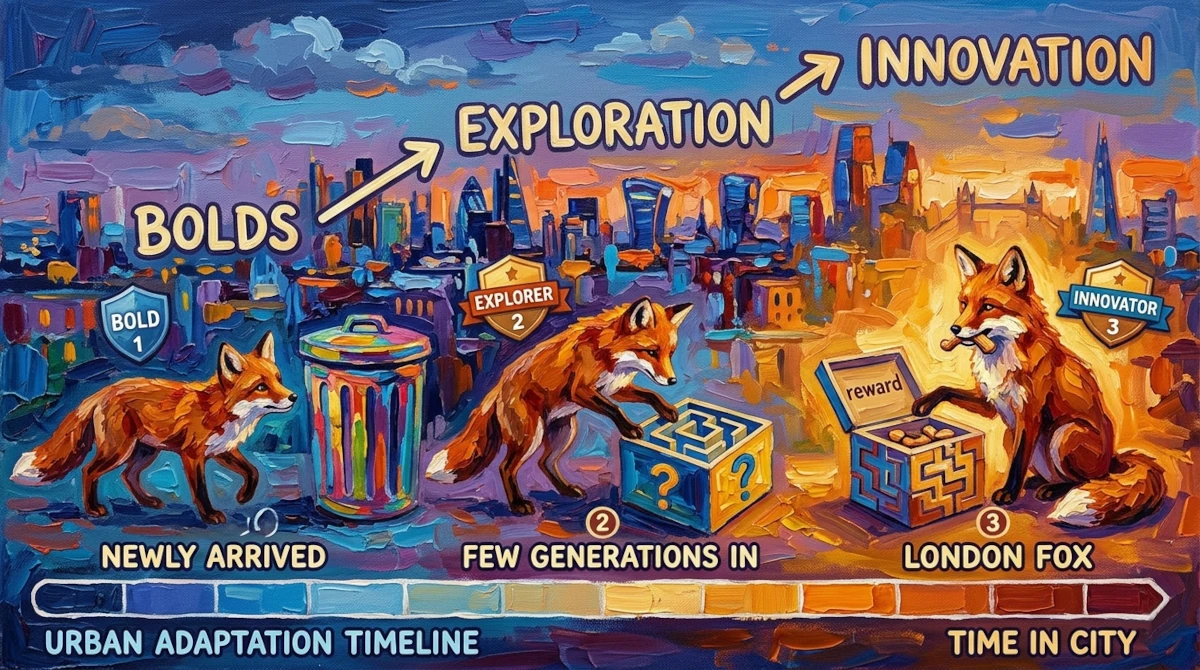
To understand it, the researchers broke fox behaviour into three distinct categories. First, boldness: the willingness to approach an unfamiliar human-made object and make contact with it. Second, exploration: the variety of physical behaviours directed at the object – biting it, pawing it, pulling it, licking it. Third, innovation: successfully solving the problem and extracting the food.
The data showed these three traits don’t emerge at the same time. Not even close.
The 40-year threshold
The researchers split fox populations into two groups based on a 1986 national survey. “Older” populations were those already established in urban areas before 1986 – meaning they’d had at least four decades of continuous city life by the time the study ran. “Newer” populations had colonised their locations more recently.
Both groups were equally bold. Urban foxes from newly colonised areas were just as willing to approach and touch the puzzles as foxes from long-established city populations. Boldness, it turns out, develops quickly – probably within a generation or two of arriving somewhere new.
Innovation was a completely different story. Foxes from newer urban populations achieved a problem-solving success rate of 0%. Foxes from older populations cracked the puzzles at a rate of 26.1%.
That’s not a small difference. That’s the difference between a species that pokes at things and a species that figures them out.
Critically, the rate of urbanisation – how fast an area had been built up between 1994 and 2020 – had no predictive power at all. A fast-growing city full of new construction doesn’t produce clever foxes. What produces clever foxes is simply time. The researchers estimate that building a population capable of consistent innovation takes somewhere between 40 and 90 years of continuous urban exposure.
What the cleverest foxes actually do differently
The ethogram – the catalogue of physical behaviours – gives a vivid picture of what high-performing foxes look like up close.
Less successful foxes tended to repeat the same one or two actions: a sniff, maybe a single paw swipe, then they’d walk off. The innovative foxes did something fundamentally different. They cycled through their entire physical repertoire. They’d nip the surface to test the material. Bite and hold to check whether it could be pierced. Hook with a single paw, then try both paws together in a simultaneous scratching motion. Pull with their teeth. Push with their snout. Then start the whole sequence again from a different angle.
This “exploratory diversity” – the sheer variety of approaches tried – was the single strongest predictor of whether a fox would eventually solve the puzzle. It wasn’t intelligence in any mysterious sense. It was methodical, relentless variation. Try everything, and eventually you try the thing that works.
Older urban populations showed dramatically higher exploratory diversity. Newer ones typically stuck to a single behaviour type, quickly gave up, and moved on.
How does it actually happen?
The study cannot definitively prove how generations of urban living produce more innovative foxes, but the researchers point to three plausible mechanisms likely working in combination.
The first is individual learning. A fox that grows up near humans encounters novel objects routinely. Each encounter is an opportunity to learn that unfamiliar things can be safe – or rewarding, or both. Over a lifetime, an urban fox accumulates a richer library of experience with novelty than a rural fox ever would.
The second is cultural transmission. Foxes are not purely solitary. Cubs observe their parents and other adults, and if an experienced adult knows how to open a certain kind of container, a younger fox watching may learn the technique. Behaviour can spread through a population this way, and persist across generations as long as that population remains stable.
The third is dispersal patterns. The historical movement and settlement patterns of foxes across different landscapes over many decades play a role in how these adaptive behaviors are distributed and established within specific urban clusters.
All three mechanisms predict the same outcome: the benefits of urban life compound over time, they are partly social rather than purely individual, and they can be lost if a population is sufficiently disrupted.
Also there is developmental plasticity. Growing up in a busy, unpredictable urban environment appears to shape the developing brain in ways that make an animal more flexible and persistent when faced with new challenges. This isn’t about genetics – it’s about the effect the environment has on an individual while it’s still developing. And crucially, it’s slow. Boldness may emerge within a generation or two of a fox population arriving in a city, but the richer problem-solving and exploratory diversity seen in places like London are thought to be the product of this gradual process compounding across many generations – somewhere between 40 and 90 years of continuous urban life before it fully takes hold.
The London effect
When the researchers mapped their results geographically using a statistical clustering technique called LISA (Local Indicators of Spatial Association), one location dominated: London.
London is the oldest recorded urban fox habitat in the UK. Animals were documented living in the city’s gardens and parks as far back as the 1930s. By the time this study was conducted, the London population had been navigating human streets, buildings, and waste systems for nearly a century.
The results showed it. London emerged as a clear high-high cluster – meaning high rates of both touching and solving the puzzles – with no comparable rival elsewhere in the country. London foxes weren’t just better problem-solvers; they were more persistent explorers, spending longer with each object and trying a wider range of approaches.
There’s a physical dimension to this too. Long-established urban fox populations in cities like London have shown measurable shifts in skull morphology – subtle changes in bone structure that parallel patterns seen in domesticated animals. The city has not just changed how these foxes behave. It appears to have begun changing what they look like.
Bristol: a cautionary tale about resets
If London is the study’s star, Bristol is its plot twist.
Bristol has a long urban history and, by the simple logic of population age, should produce innovative foxes. It doesn’t. Bristol foxes showed neither elevated problem-solving nor particularly high exploratory diversity – results more consistent with a recently colonised city than an ancient one.
The explanation lies in a sarcoptic mange outbreak in the 1990s that devastated Bristol’s fox population. As the local animals died, the empty territory was recolonised – primarily by foxes moving in from surrounding rural areas. Rural foxes, bold enough to survive but carrying none of the accumulated urban behavioural repertoire.
In a single outbreak, Bristol effectively lost decades of adaptation. The foxes living there now are not the descendants of the population that spent generations learning the city. They’re the descendants of countryside animals that arrived after the crash and have been starting over ever since.
This is arguably the study’s most important data point. It proves that the cleverness of urban fox populations isn’t a fixed species-wide trait – it’s a local inheritance, specific to a community’s unbroken history in a place. It can be built. And it can be lost.
What this means for living with urban foxes
The research invites a fundamental shift in how we think about foxes in our cities. Rather than framing their growing innovation as a problem to be resisted, we might recognise it as something we helped create – a slow co-evolution that has been unfolding for nearly a century. A fox that can open your bin is not a pest that has defeated you; it is a neighbour that has spent generations learning the same streets you live on.
That reframing has practical teeth. Wildlife managers have focused on density – how many foxes are there? This research suggests age matters more. A small, long-established population may pose more of a challenge to waste management than a large, recently arrived one, because the older animals are better at solving the problem of getting into things.
So protecting stable, long-established fox populations turns out to be smarter than disrupting them. Bristol shows what happens when decades of adaptation are erased in a single outbreak. In new urban fox areas, standard interventions – better-secured bins, public education – may prevent sophisticated behaviours from developing. But in cities like London, infrastructure genuinely needs to be designed to accommodate persistent, creative, multi-tactic problem-solvers.
The city made these animals. The least we can do is design for them thoughtfully.
The city as an evolutionary engine
Put all of this together and a striking picture emerges. Cities are not just habitats that foxes happen to occupy. They’re slow-motion selection environments – decades-long crucibles that reward certain cognitive traits and, over generations, produce animals meaningfully different from those that stayed in the fields.
The process isn’t fast. A fox population that arrived in a city twenty years ago is bolder than its rural cousins, but no cleverer at opening things. Give it another fifty years of continuous urban residency, and something shifts. Exploratory diversity increases. Problem-solving success climbs. The population begins to behave, at a statistical level, more like London.
Every city with a fox population is somewhere on that curve. The boldness comes first – it’s already there, in newly colonised suburbs across the country. The innovation is building, quietly, generation by generation, in the animals you see crossing the road at night.
Your bin, for now, is probably safe. Give it a few decades.
Think you’ve mastered it? Test yourself with the 5-question quiz below – it only takes a minute.
Quiz: Are You as Street-Smart as a City Fox?

Source
Study: Time in the city: Long-term urban exposure predicts greater exploration and problem-solving in wild red foxes
Authors: F. Blake Morton, Dylan Thompson-Jones, Kristy A. Adaway, Koko M. Sutter, Catia Matos, Georgia B. Freer, Georgia A. A. Fletcher, Carl D. Soulsbury. (2026)
Read the full paper: https://www.biorxiv.org/content/10.1101/2025.09.26.678765v2

Leave a Reply