

How a cardboard card and a free app are bringing precision agriculture within reach of every farmer on earth
Here is a problem that doesn’t get nearly enough attention: a rice farmer in rural Thailand has no reliable way of knowing whether her crop is hungry.
She can look at the leaves. She can compare them to a color chart. She can draw on thirty years of experience. What she almost certainly cannot do is pull out a precision instrument, clip it to a leaf, and get a scientifically valid reading of her plant’s nitrogen status – because that instrument costs more than many smallholder farmers earn in months.
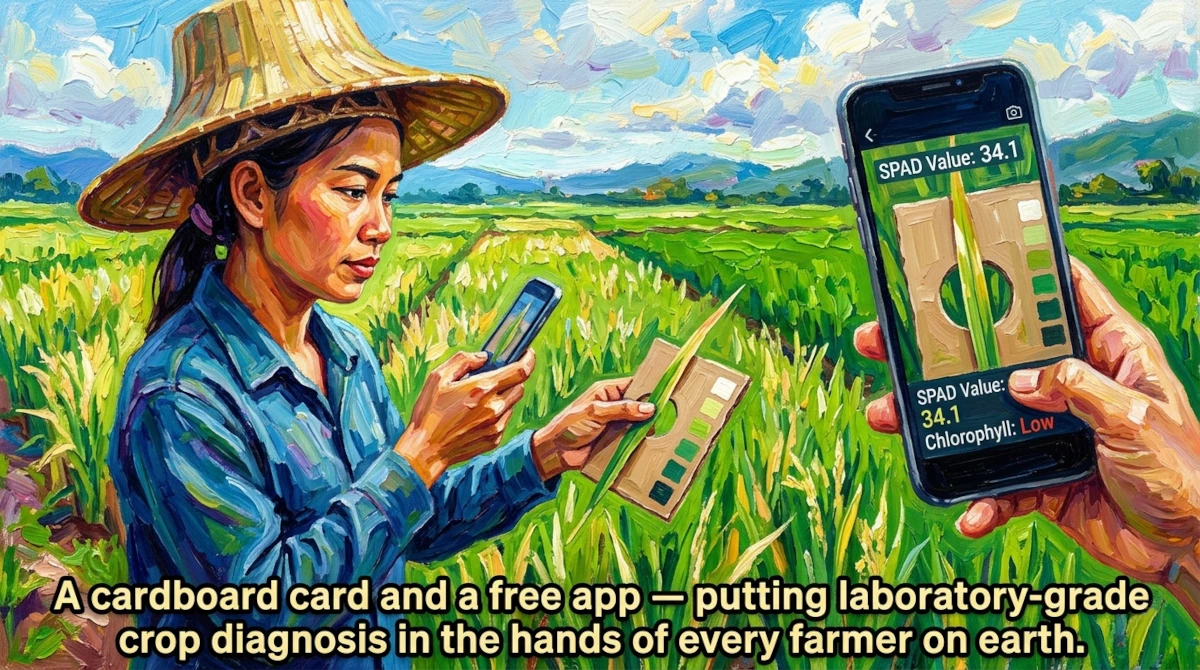
A research team from the University of Sussex and Mahidol University has changed that. Their mobile application, called PhotoFolia, analyzes a photograph of a plant leaf and returns a chlorophyll reading with near-laboratory accuracy. The tool required to do this costs almost nothing to produce. The device it runs on is already in hundreds of millions of farmers’ pockets.
Why Chlorophyll Is the Number That Matters
Leaves are green because of chlorophyll – the pigment that captures sunlight and powers photosynthesis. Chlorophyll is also, crucially, a molecule that requires nitrogen to build. This means the depth of green in a leaf is essentially a readout of how nitrogen-rich the plant is. A deep, vibrant green says I’m well-fed. A pale, yellowing leaf – a condition agronomists call chlorosis – is a plant in distress.
Agronomists have known this for a long time. The science of reading leaf color to infer nitrogen status is decades old. The problem was never the concept. The problem was the measurement.
The human eye can catch severe chlorosis, but it cannot detect the subtle gradations in greenness that allow early intervention – acting before visible damage sets in, applying targeted fertilizer rather than blanket spraying. That precision requires instruments. And instruments cost money that most of the world’s small-scale farmers simply do not have.
The Old Options and Their Painful Compromises
Until now, farmers and researchers had three main tools for measuring chlorophyll, each involving a real trade-off.
Laboratory assays are the gold standard. Leaf tissue is dissolved in a chemical solvent and analyzed with a spectrophotometer – a device that measures how much light the solution absorbs at specific wavelengths. The results are highly accurate. The process is also slow, expensive, destructive to the plant, and completely useless for real-time field decisions.
Portable SPAD (Soil and Plant Analysis Development) meters are the field workhorse. The most widely used model, the Minolta SPAD-502+, clips onto a leaf and shines light through it, measuring how much red and infrared passes through to estimate chlorophyll content. It is fast, accurate to within ±1.0 SPAD unit, and genuinely useful. It is also expensive enough that for most smallholder farmers across Asia, Africa, and Latin America, it might as well be on the moon.
Color reference cards – laminated sheets with green patches a farmer compares visually to leaves – are cheap and simple. But asking a human eye to make that judgment consistently, across different lighting conditions and levels of fatigue, produces results you’d expect: variable and unreliable.
Software-only smartphone apps had already been tried, with disappointing results. The core problem: a camera’s reading of “greenness” depends enormously on the lighting conditions and the specific camera sensor. An app that cannot correct for these variables is measuring the environment as much as it is measuring the leaf.
The Solution: A Cardboard Card Changes Everything
The insight at the heart of PhotoFolia is elegantly simple. If the problem with smartphone cameras is that different devices in different lighting produce wildly different readings of the same leaf, give the camera a fixed reference point it can use to calibrate itself.
That reference point is a small cardboard card printed with patches of color whose precise reflectance values are already known to the system. When a farmer photographs a leaf, the card must appear in the same frame. The software looks at how those known patches appear under the current lighting, on this particular phone’s sensor – and uses that information to reverse-engineer the true color of the leaf. Strip out the lighting and sensor effects, and what remains is an objective, consistent measurement, whether you’re standing in bright Thai sunshine or under an overcast English sky, whether you’re using a budget Android or the latest iPhone.
The image is then sent to a cloud server, where a mathematical model converts the corrected color data into a SPAD value and a chlorophyll concentration estimate. Results return to the phone within seconds. The physical setup also includes bamboo forceps holding the leaf against a small circular aperture in the card – low-tech in the best possible sense: simple materials solving a complex problem.
How the Science Actually Works
When light hits a leaf, three things can happen. It can be absorbed by the chlorophyll (exactly what the plant wants, since it uses that energy for photosynthesis). It can pass straight through. Or it can bounce back – that reflected light is what a camera sees.
Chlorophyll absorbs red and blue light very efficiently. The green light it reflects less efficiently is why leaves look green to us. Counterintuitively, a healthier, more chlorophyll-rich leaf actually reflects less green light – because it is absorbing so much red and blue so efficiently. The green channel of a camera image can decrease as a leaf becomes more deeply green.
In theory, measuring chlorophyll should be a simple matter of measuring reflected red light. In practice, a leaf is nothing like a clear solution in a laboratory cuvette. It is a complex three-dimensional structure packed with cells, air gaps, water channels, and veins. Light bounces around inside before exiting or being absorbed. To model this realistically, the researchers drew on two established physical frameworks: the Beer-Lambert Law, which describes light absorption in a medium, and Kubelka-Munk theory, which models light transport in scattering materials.
There is also a complication called the sieve effect. Chlorophyll is not evenly distributed across a leaf – it concentrates in the soft mesophyll tissue between veins and is much less dense in the veins themselves. This creates a patchwork that violates the assumptions of ideal optical models. Nitrogen-deficient leaves compound this by developing visible striping – bands of different colors within a single leaf blade – making consistent sampling harder still.
To handle the mathematical challenge of converting correlated camera signals (red, green, and blue are not independent of each other) into a stable chlorophyll estimate, the system uses ridge regression – a technique that finds reliable relationships even when the input signals are messy and overlapping. And although theory suggests the relationship between camera signal and chlorophyll should be logarithmic, empirical testing found a simpler linear model performed better in practice: the log transformation introduced errors at low chlorophyll concentrations, making it less reliable across the full range a farmer might encounter.
What the Research Found
The system was tested on four commercial Thai rice varieties – Khao Dawk Mali 105, RD6, RD47, and Pathum Thani 1 – grown under different nitrogen conditions to produce a realistic range of plant health states.
For SPAD values, PhotoFolia achieved a Mean Absolute Error of ±1.2 units. The professional Minolta SPAD-502+, the industry benchmark, is accurate to ±1.0 unit. That 0.2-unit gap sounds meaningful until you realize it is smaller than the natural variation between two leaves on the same plant. The statistical fit of the model (R²) reached 0.97 – meaning the software’s predictions closely track actual measurements across the full range of nitrogen conditions tested.
For chlorophyll concentration expressed in standard laboratory units, the system achieved a Mean Absolute Percentage Error of 7.2% – within about seven cents of every dollar of the lab result. Scientists generally consider anything below 10% acceptable for commercial agricultural use. The app doesn’t just clear that bar; it clears it comfortably.
A tool that costs almost nothing, runs on hardware millions of farmers already own, and requires no specialist training is producing results a professional agronomist could act on with confidence.
The Critical Catch: It Has to Know What It’s Looking At
It would be too good if there were no complications, and there are.
The system works well only when it knows which crop variety it is analyzing. Different rice varieties have subtly different internal leaf structures. Two leaves that look the same shade of green to a camera can have quite different chlorophyll concentrations if one variety has thicker, denser leaf tissue than the other. An optical signal measures pigment per unit of leaf area; laboratory results are expressed per gram of tissue. Converting between these requires knowing the specific variety’s structural characteristics.
The numbers make the stakes plain. Using a generic model across all four rice varieties, the chlorophyll concentration error jumped from 7.2% to 22.5% – and the correlation between the app’s estimates and actual lab measurements effectively collapsed entirely, producing an R² of -2.11. Not just less accurate: for practical purposes, useless.
Feed the system the correct variety-specific calibration data, and accuracy snaps back to near-professional levels. This is a manageable engineering and data-collection challenge – not a fundamental scientific barrier – but it means the app is only as useful as the library behind it. A farmer growing a local variety not yet in the reference database would get poor results.
Encouragingly, SPAD estimation is much more forgiving. Even with generic calibration, error only rose to around ±2.0 units – still useful for many field decisions.
Practical Advantages Beyond the Headline Numbers
Beyond accuracy, the smartphone approach carries several practical advantages over even a good handheld meter.
You can see what you’re measuring. A SPAD meter is essentially a black box – clip it to a leaf and get a number, with no record of exactly where on the leaf or what condition it was in. With PhotoFolia, you have a photograph. If the image shows you’ve accidentally measured over a leaf vein, or the lighting is uneven, you can see that and retake it. This eliminates an entire category of measurement error that plagues field data collection.
Location data comes free. Every reading automatically carries GPS coordinates. A farmer or agronomist can build a spatial map of nutrient levels across a field over time – the kind of data that would normally require expensive drone surveys or manual grid sampling.
The economics are transformative. The cardboard color card costs almost nothing to produce. The phone is already there. For a smallholder farmer who cannot afford a SPAD meter, this is not a compromise – it is something close to the real thing.
Honest Limitations
No technology comes without caveats, and the researchers are admirably candid about the remaining challenges.
The requirement for variety-specific calibration means the system is only as good as its database. Currently it covers four Thai rice varieties; scaling to the hundreds of varieties grown globally – let alone to other crops – requires substantial additional work.
Cloud dependency is a genuine constraint. The heavy computation happens on a remote server, requiring an internet connection. This is fine in many parts of the world and a real limitation in others – somewhat ironic given that the farmers most in need of affordable precision tools often live in areas with the spottiest connectivity.
Consistent sampling also demands training and discipline. The researchers specify measuring the middle third of the third leaf from the growing tip – a protocol that experienced agronomists follow but casual users might not. The wrong leaf, the wrong part of the leaf, introduces errors that no algorithm can correct.
And a transparency note worth acknowledging: two of the study’s authors are co-inventors of the patent on this technology and co-owners of the PhotoFolia application. The science appears rigorous, but it is a conflict of interest that merits consideration when evaluating the findings, and makes independent verification particularly important as the technology develops.
The Bigger Picture
Step back from the technical details and the significance becomes clear.
Precision agriculture has been transforming farming in wealthy countries for years – GPS-guided tractors, drone surveys, satellite imaging, soil sensors. For a smallholder rice farmer in Southeast Asia or sub-Saharan Africa, almost none of that is accessible. Not because the need isn’t there, but because the cost of entry has always been prohibitive. Precision agriculture, in practice, has largely been a rich-world technology.
What this research demonstrates is that the fundamental barrier – accurate, affordable measurement – is now a software and calibration problem rather than a hardware one. The sensors capable of doing the job are already in billions of pockets. Building the calibration libraries, refining the field protocols for non-expert users, and bridging connectivity gaps: those are the remaining challenges. They are solvable. The proof of concept is solid.
The cardboard card that makes it work costs almost nothing to produce. The phone is already there. The satellite it communicates with is already overhead.
Sometimes the most important technologies aren’t the ones that seem most impressive. Sometimes they’re the ones that take something that used to require a lab and put it in the hands of someone standing in a paddy field, squinting at a yellowing leaf, wondering if she’s already left it too late.
Research conducted by scientists at the University of Sussex and Mahidol University. Testing was performed on four Thai rice varieties (Khao Dawk Mali 105, RD6, RD47, and Pathum Thani 1) under varying nitrogen conditions. Benchmarked against the Minolta SPAD-502+. Conflict of interest: authors Daniel Osorio and John Anderson are co-inventors of the patent covering this technology and co-owners of the PhotoFolia application.
Think you’ve mastered it? Test yourself with the 5-question quiz below – it only takes a minute.
Quiz: Can You Spot a Hungry Plant Before It’s Too Late?

Source
Study: Image-based leaf SPAD value and chlorophyll measurement using a mobile phone: enabling accessible and sustainable crop management
Authors: John Anderson, Kulaporn Boonyaves, Haruko Okamoto, Netiya Karaket, Wannisa Chuekong, Miguel Garvie, Napason Chabang, Daniel Osorio, Kanyaratt Supaibulwatana (2026)
Read the full paper: https://www.biorxiv.org/content/10.1101/2025.07.08.663527v2

Leave a Reply