

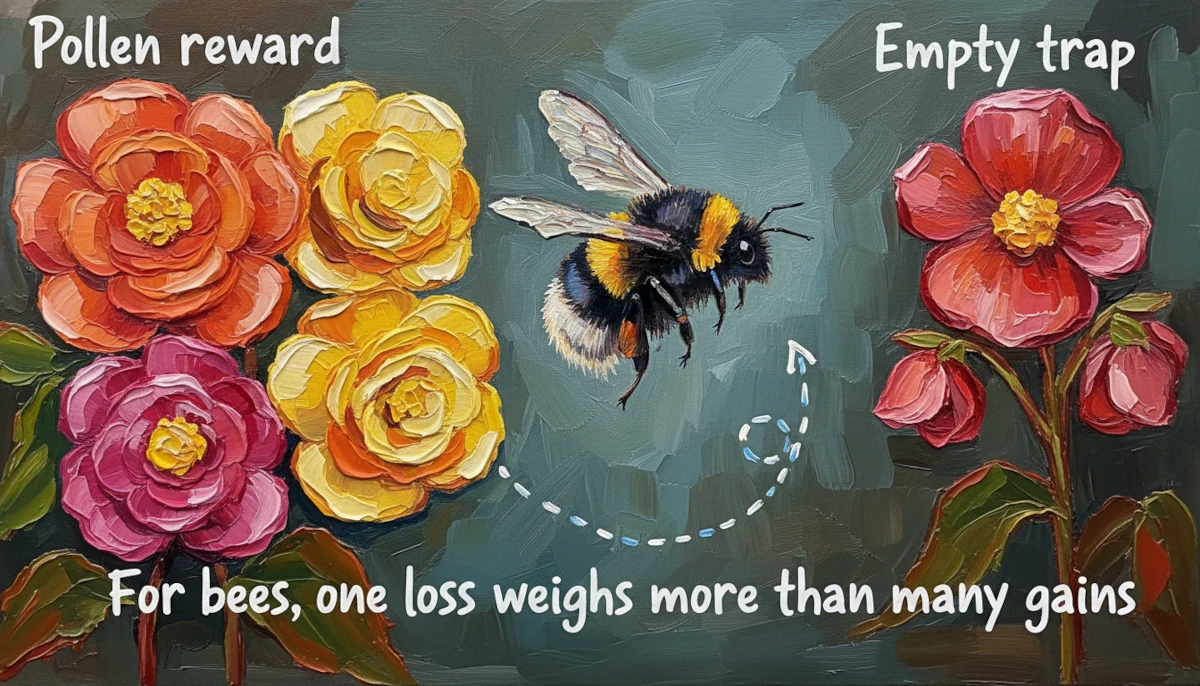
Picture a bumble bee hovering near a cluster of bright flowers. To us, it might look like she’s simply choosing where to eat lunch. But for the bee, each moment of hesitation represents a high-stakes calculation – one she’ll repeat thousands of times before the day ends. Time is energy, energy is survival, and some of these flowers are liars.
Scientists studying how bees navigate this deceptive world have uncovered a surprising truth about bumblebee loss aversion: when uncertainty looms, bees are far less motivated by the possibility of reward than by the threat of punishment.
Nature’s Oldest Scam
Across the plant kingdom, thousands of species have mastered the art of the free ride. Through a strategy called Batesian floral mimicry, these plants produce flowers that look delicious but deliver nothing. They’ve evolved to impersonate their more generous neighbors – plants that actually provide pollen or nectar – tricking pollinators into providing pollination services without payment.
This con has worked spectacularly well. Over 7,500 plant species across more than 32 families now employ some version of floral deception.
For their research, scientists focused on Begonia odorata, a plant with a particularly clever setup. Each plant produces two types of flowers: male flowers packed with nutritious pollen, and female flowers that look nearly identical but contain nothing a bee wants. The male flowers are the “honest merchants” of the flower world. The female flowers are convincing knockoffs.
From a bee’s perspective, every flower is a mystery box until she gets close enough to inspect it – or makes the mistake of landing.
Four Doors, Four Outcomes
Behavioral scientists have a tool for analyzing these kinds of choices under uncertainty: Signal Detection Theory. Originally developed to understand how radar operators distinguished real threats from false signals, it applies beautifully to the bee’s dilemma.
When a bee encounters a Begonia flower, she faces four possible outcomes based on her decision to land or fly past:
If she lands on a male flower: Success! She’s made a correct detection and earns a pollen reward.
If she lands on a female flower: Mistake! She’s fallen for a false alarm and wasted precious time and energy.
If she skips a male flower: Error! She’s missed a detection and passed up available food.
If she skips a female flower: Smart! She’s made a correct rejection and avoided a worthless detour.
The theory predicts that animals should adjust their decision threshold based on what’s at stake. Higher rewards should make them bolder. Higher costs should make them more cautious. But do bees actually follow these rules?
An Experiment in Risk and Reward
To find out, researchers recruited 97 bumble bee workers – all flower virgins with no prior foraging experience – and created four different foraging scenarios.
The Jackpot Group encountered male flowers enhanced with more than double the normal pollen content. Would this windfall make bees more willing to take risks?
The Punishment Group found female flowers dusted with quinine, the bitter compound that makes tonic water pucker-inducing. Would the threat of an unpleasant experience make bees more discriminating?
The High-Stakes Group faced both scenarios simultaneously: bigger rewards on males, bitter punishment on females.
The Baseline Group experienced flowers in a relatively natural state, serving as the experimental control.
The scientists then meticulously recorded three key behaviors: how often bees approached flowers (flying within 3 centimeters), how often they landed, and how often they “buzzed” – performing the energetically demanding vibration that bees use to extract pollen from flowers.
When Punishment Talks, Bees Listen
The results painted a clear picture of bee psychology.
When female flowers carried the bitter quinine penalty, bee behavior transformed. These bees became noticeably more selective, correctly rejecting fake flowers at higher rates. But their caution came with a cost: they also started skipping more male flowers, missing legitimate foraging opportunities.
The wariness ran even deeper. Bees in the punishment conditions dramatically reduced their buzzing behavior – not just on the penalized female flowers, but on the rewarding male flowers too. The mere possibility of encountering something unpleasant made them hesitant to fully invest effort, even when they’d made the correct choice.
This is the hallmark of what researchers call a “conservative bias”: prioritizing the avoidance of bad outcomes over the pursuit of good ones.
When Rewards Whisper, Bees Shrug
But what about the bees that found the pollen jackpot? Surprisingly, doubling the reward on male flowers barely changed their behavior. These bees didn’t become risk-takers. They didn’t start visiting every flower in sight, hoping to hit the bonus pollen more often. They didn’t adopt the “liberal bias” that theory predicted.
The extra pollen did help somewhat – bees with supplemented flowers made better overall decisions than those with completely unmodified flowers, possibly because the extra pollen provided a stronger scent cue. But even this improvement didn’t make them more adventurous.
The asymmetry was stark: potential costs reshaped behavior. Potential benefits barely registered.
The Education of a Bee
Experience mattered, but in revealing ways. Across all experimental groups, bees showed one consistent improvement: they got progressively better at rejecting female flowers. Visit after visit, their ability to correctly avoid the fakes increased.
This pattern held regardless of whether the female flowers were punishing, simply unrewarding, or paired with super-rewarding males. The bee’s natural learning trajectory seems to favor developing a sharper “no” rather than a more enthusiastic “yes.”
When punishment was on the table, this conservative learning accelerated. Bees in the high-cost conditions learned quickly that investing full effort – the energetically expensive buzz – was a gamble not worth taking.
Why Bumblebee Loss Aversion Shapes Ecosystems
This behavior pattern mirrors something psychologists and economists have observed across animal species, including humans: we’re all loss-averse. A potential loss of $100 typically feels more significant than a potential gain of $100, even though the objective magnitude is identical.
For bees, this psychology has ripple effects through entire ecosystems. Because bees don’t dramatically increase their visits to highly rewarding flowers, the deceptive mimics continue receiving enough pollination visits to survive and reproduce. The bee’s inherent caution creates ecological space for dishonesty to persist.
It’s a stable equilibrium – but a fragile one. The research suggests that if deceptive flowers become too common or too punishing, the balance could collapse. Pollinators might abandon the system entirely, causing reproductive failure for both the deceivers and the honest flowers they imitate.
The Wisdom of Worry
What this study reveals is that bee decision-making isn’t driven by cold optimization of average gains. It’s shaped by something more primal: the drive to avoid the worst-case scenario.
In evolutionary terms, this makes sense. A bee that occasionally misses a great flower can forage again tomorrow. A bee that repeatedly wastes energy on costly mistakes might not make it back to the hive. Over millions of years of natural selection, caution has proven to be the winning strategy.
The researchers put it simply: for bees foraging under uncertainty, losses loom larger than gains.
A Lesson in Decision-Making
There’s something deeply relatable about the bee’s dilemma. We all make decisions under uncertainty, weighing imperfect information against the clock. And like the bees, we often find ourselves more influenced by what we might lose than what we might gain.
The next time you watch a bee dart between flowers – approaching, hesitating, moving on – you’re witnessing not just a search for food, but a master class in risk management. That bee is carrying millions of years of evolutionary wisdom in her tiny brain, wisdom that says: when you can’t be certain, it’s better to be safe than sorry.
Even if it means occasionally flying past the feast.
Think you’ve mastered it? Test yourself with the 5-question quiz below – it only takes a minute.
Quiz: Can You Make Better Decisions Than a Bumblebee?

Source
Study: Bees attend primarily to costs, not benefits, to avoid exploitation by floral mimics
Authors: Annaliese N. Novinger, Claire T. Hemingway, Jenny K. Burrow, Charlotte C. Davis, Avery L. Russell (2025)
Read the full paper: https://www.biorxiv.org/content/10.1101/2025.11.20.689644v1

Leave a Reply