

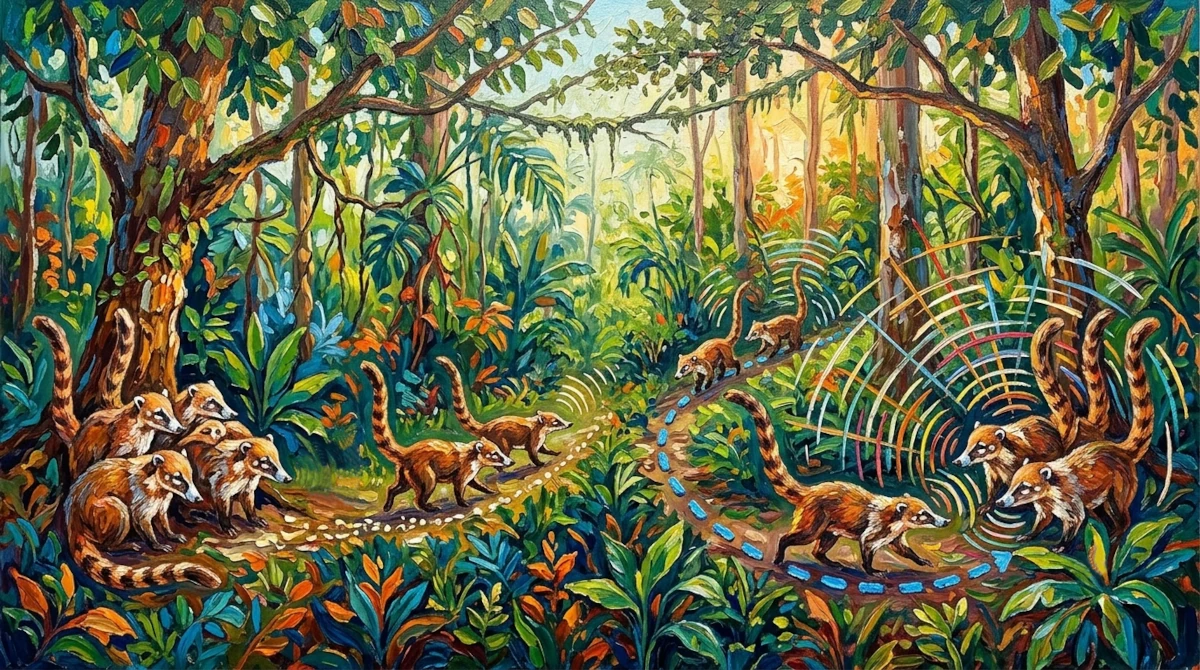
Picture a family reunion that never really ends. Sometimes everyone is together in one big group. Other times, small clusters peel off to do their own thing, only to drift back and merge again later in the day. That’s roughly what life looks like for the white-nosed coati (Nasua narica), a raccoon relative that lives in the forests of Central and South America in groups led by related females.
Scientists call this pattern “fission-fusion dynamics” – and for white-nosed coati social behavior, it’s not occasional, it’s the norm. Groups fission, or split, into smaller subgroups, and later fuse, or merge, back into the larger collective. Many social animals do this – elephants, dolphins, spider monkeys, and hyenas all show similar patterns. What’s been harder to figure out is why it happens at any given moment, and how the animals manage to pull it off without losing track of each other in a dense forest.
A recent study set out to answer exactly that, by watching two wild coati groups in Panama with a level of detail that’s rarely been possible before.
Getting a bird’s-eye view of animal society
A human observer can’t watch fifteen animals at once, especially when they’re moving through thick, visibility-limited forest. So the researchers turned to technology instead of direct observation.
They fitted every member of two coati groups – “Galaxy” (11 animals: mostly adult females, plus a few subadults and a juvenile) and “Presidente” (16 animals, with more subadults and juveniles), with collars that recorded location once every second via GPS and sound continuously via microphone from 06.00 AM to 09.00 AM, the early-morning period when groups are most active. That meant researchers could reconstruct, second by second during that window, where each animal was and what it was saying. Galaxy was tracked for 17 days and Presidente for 15.
The animals produced enormous amounts of sound – over 240,000 individual calls across the two groups – far too many for a human team to label by ear. So the researchers used a machine-learning tool called animal2vec, built specifically for classifying animal sounds, to automatically sort the recordings into two categories: friendly “contact calls” (chirps, grunts, clicks used to stay in touch) and “aggression calls” or chitters (short, sharp sounds used during conflict).
To determine exactly when a group counted as “together” versus “split,” the researchers used a spatial method nicknamed “sticky DBSCAN.” Rather than a single distance cutoff – which would cause the data to flicker every time an animal ducked behind a tree – they used two thresholds: a smaller one (15 meters) to mark when a split had begun, and a larger one (50 meters) to mark when it was complete, creating a buffer zone that kept the measurements stable.
Understanding White-Nosed Coati Social Behavior: Why do groups split up in the first place?
Three competing explanations were on the table going in.
Idea 1: They just walk at different speeds. This “activity budget hypothesis” holds that faster coatis simply outpace slower ones until the group is split by distance. The data mostly ruled it out: in both groups, the overwhelming majority of splits (10 out of roughly 16 fission events in Galaxy, and 12 in Presidente) began while the entire group was standing still, not while it was moving. If mismatched walking speed were the real cause, splits should mostly happen during travel. They largely didn’t.
Idea 2: They disagree about timing. This turned out to be the best-supported explanation. When a group is resting or feeding at some spot, not every animal wants to leave at the same moment – some are ready to go, others want to keep foraging. One subset (the “leavers”) gets up and moves off while the rest (the “remainers”) stay put. The split isn’t about physical ability to keep pace; it’s a disagreement over when to move on.
Idea 3: Active fighting drives animals apart. Coatis are significantly more likely to have aggressive interactions when the whole group is together than when split into smaller subgroups – crowding is more tense than a small party. But aggressive vocalizations were actually less frequent right before, during, and after a split than during ordinary “everyone’s together” baseline periods. Coatis weren’t leaving because a fight had just happened. If anything, they seemed to be leaving to avoid one.
Together, these findings suggest fission is a pre-emptive, timing-based decision rather than a reactive one. Coatis appear to anticipate that staying in a big group will eventually mean more competition and friction, and they split off – often along family lines, with closer relatives grouping together – before that tension boils over. It’s a bit like leaving a party a little early because you can sense it’s about to get crowded and testy, rather than waiting for an actual argument.
How do they coordinate a split without a group chat?
Splitting cleanly, without genuinely losing members in dense forest, still requires coordination – which is where contact calls come in.
The “leaver” subgroup called noticeably more than the “remainer” subgroup, both leading up to the split and during it, while remainers stayed relatively quiet. This suggests calling is used to organize the exodus: the animals that have decided to go essentially talk each other through the process, keeping their own faction cohesive as they move off.
There’s a broader pattern here too – whenever the full group traveled together, faster movement was consistently linked to more frequent contact calls. Calling isn’t only a “we’re splitting up” signal; it’s a general tool coatis use to stay in touch when the pace picks up. The leavers’ extra calling during a fission looks like a specialized, amplified version of this same basic behavior.
Researchers describe the overall effect as reaching “partial consensus.” Instead of getting every member of an 11- or 16-animal group to agree on a single decision, the group allows a faction to form, coordinate vocally, and depart – resolving disagreement through separation rather than negotiation.
Coming back together
Coatis don’t stay separated forever. The dominant pattern was a subgroup on the move (the “joiners”) approaching one sitting still (the “stationary” group), rather than both sides wandering toward some middle point.
What’s notable is what happened vocally as the approach unfolded. The moving “joiner” subgroup ramped up its contact calls as it got closer – unsurprising, as a way of announcing its approach. But the stationary subgroup also increased its own calling. If coatis were only being pulled toward a shared resource, like both groups converging on the same fruit tree, you wouldn’t necessarily expect the stationary group to call more. The fact that both sides picked up their vocal activity points toward genuine social attraction – the animals appear to actively want to find and rejoin each other, not just end up in the same place because of food.
Since coatis are strongly scent-oriented, the researchers also raised the possibility that smell plays a role in reunions the microphones can’t capture – following scent trails to relocate other members where sound and sight both fall short. Another hypothesis: the loud aggressive “chitters,” which carry farther than gentler contact calls, might act as unintentional beacons, letting a joining subgroup home in on where the rest of the group currently is.
The catch: reunions come with a cost
Fusions aren’t purely happy events. Once two subgroups merge, the study found a small but real uptick in aggressive calls right afterward – consistent with the “resource attraction hypothesis,” in which subgroups converging on the same good foraging spot also means more mouths competing for the same food. Reuniting has an upside – safety in numbers, social bonding – and a real downside: renewed competition. The data captured that trade-off playing out in the animals’ own vocalizations.
The big picture
Fission-fusion behavior isn’t a breakdown of group cohesion – it’s an active management strategy. Coatis weigh the benefits of a big group (protection from predators, strength against rival males) against its costs (competition for food, the friction of getting everyone to agree on what to do next). Splitting lets them dodge that friction before it turns into open conflict, often by peeling off with close relatives. Merging lets them cash back in on the safety and social benefits of the crowd, accepting a bit more tension as the price of admission. Running through both processes is a layer of vocal communication that lets the animals coordinate these transitions without anything like a formal decision-making process.
What makes this study notable isn’t the conclusion that coatis balance the costs and benefits of group life – animal behaviorists have suspected something like that for a while. It’s that combining second-by-second GPS tracking with automated sound classification let researchers watch these decisions unfold in real time, rather than inferring them after the fact from occasional headcounts. That kind of fine-grained, simultaneous audio-and-movement data is a fairly new capability in field biology, and the authors suggest the same approach could be turned on other fission-fusion species – spider monkeys, hyenas, elephants – to see whether the same basic rules hold up more broadly across the animal kingdom.
Think you’ve mastered it? Test yourself with the 5-question quiz below – it only takes a minute.
Quiz: Are You Ready to Leave Like a Coati – Before the Rest of the Group?

Source
Study: Vocal coordination and conflict avoidance shape fission-fusion dynamics in white-nosed coatis
Authors: Emily M. Grout, Odd T. Jacobson, Jack C. Winans, Gabriella E. C. Gall, Josué Ortega, Julian C. Schaefer-Zimmermann, Margaret C. Crofoot, Ben T. Hirsch, Ariana Strandburg-Peshkin (2026)
Read the full paper: https://www.biorxiv.org/content/10.64898/2026.05.26.727854v1


Leave a Reply