

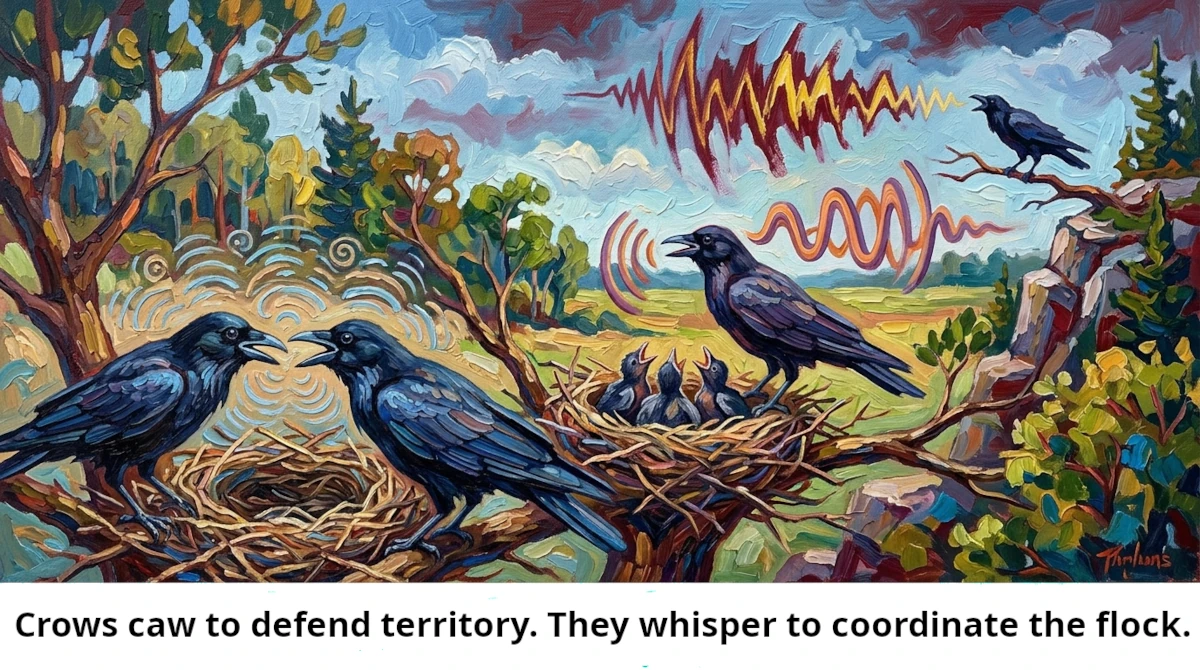
New research using AI and bird-worn microphones has revealed that one of nature’s most familiar birds has a far richer inner life – and social world – than anyone suspected.
Think of the last crow you heard. Chances are, it was making that familiar, rasping “caw” – harsh, loud, a little annoying. You probably assumed it was doing what crows do: making noise. But according to a landmark new study of carrion crow vocalizations in northern Spain, that loud “caw” represents only a small slice of what these birds are actually saying to each other. For every boisterous caw ringing across the countryside, there are hours of quiet conversation happening just beneath our ability to hear – whispered coordination, subtle check-ins, and intimate family announcements that science has been missing for decades.
Researchers have now identified at least 40 distinct call types in the crow’s vocal repertoire, and discovered that more than half of all crow communication is so quiet that it falls below the volume of a baby chick’s begging cry. That discovery alone rewrites what we thought we knew about one of the world’s most recognizable birds.
A Village of Crows
To understand why crows have so much to say, you first have to understand how these particular crows live.
In most of Europe, carrion crows form simple pairs. A male and female find each other, breed, raise chicks, and go about their business. But in northern Spain, something unusual happens. Here, crow society looks less like a nuclear family and more like a multigenerational household. Groups of crows – often including grown offspring from previous years – live together, cooperate in building nests, jointly defend territory, and all pitch in to raise the next generation’s chicks. This system, called cooperative breeding, is relatively rare in the bird world and gives these crows a level of social complexity more comparable to primates than to typical songbirds.
This matters because of a well-supported idea in biology called the Social Complexity Hypothesis: the more complex a species’ social life, the richer and more varied its communication system needs to be. Managing a household where multiple adults share childcare duties, coordinate territorial patrols, and maintain harmonious relationships requires, essentially, a bigger vocabulary.
The new research was designed to test whether that’s actually true for these crows – and to find out exactly what that vocabulary looks like.
The Problem With Watching Crows From a Distance
For most of scientific history, studying animal communication has meant standing at a distance with binoculars and a directional microphone. This works reasonably well for animals that make loud, obvious sounds. But it has a fundamental flaw: it only tells you about the communication you can easily hear.
Imagine trying to understand human social life by only listening to people shouting. You’d learn something – you’d hear arguments, announcements, calls across crowded rooms – but you’d miss nearly everything about how people actually relate to each other day to day. The quiet conversations, the murmured agreements, the gentle nudges that keep families running.
That’s essentially what scientists had been doing with crows. The “caw” was well studied. Everything quieter was invisible.
To fix this, the research team took a radically different approach: they attached miniature recording devices directly to the birds themselves. Fifty-one individual crows across 24 social groups were fitted with tiny tail-mounted loggers – no bigger than necessary, carefully kept under three percent of each bird’s body weight to avoid disrupting natural behavior. These devices recorded continuously for up to six days at a time, capturing audio and movement data from the bird’s own perspective.
At the same time, cameras were installed at the nests, and individual birds were marked with colored wing tags so researchers could identify who was doing what when.
The result was an enormous dataset: over 114,000 vocalizations, more than 36,000 flights, and more than 6,000 recorded nest visits – all timestamped and synchronized so that every sound could be matched to a specific bird, a specific moment, and a specific behavior.
No human team could make sense of that raw data alone. So the researchers turned to machine learning.
Teaching a Computer to Hear Like a Crow
The machine learning component of this study didn’t “translate” crow language – it sorted it. Using algorithms trained on acoustic patterns, the system automatically detected and grouped vocalizations by their acoustic similarities, essentially doing the first round of cataloguing that would have taken human researchers years to complete by hand.
Once the machine had done its sorting, human experts stepped in to refine the categories, listen to examples, and define what made each type distinct. This hybrid approach – machine speed, human judgment – produced a final taxonomy of 40 distinct call types organized into three broad families.
Forty Words: Mapping the Full Range of Crow Vocalizations
Exceptional calls are the strangest and most varied group – 22 different types including trills, harmonic whistles, clicks, and sounds that don’t fit neatly into any familiar category. These calls are relatively rare in day-to-day crow life, but they punch above their weight in importance. They are the only calls that appear to be “social-category specific,” meaning that certain exceptional calls are used almost exclusively by breeding females, others almost exclusively by breeding males. They function a bit like specialized professional jargon – most group members understand them, but only certain individuals routinely produce them.
Caws are what most people think of when they think of crows – loud, harsh vocalizations. But even here, there’s more complexity than meets the ear. The researchers identified six distinct types of caw, graded by duration and amplitude. A short caw means something different from a long caw. Generally, caws serve the crow’s public-facing functions: territorial announcements, long-distance coordination, and warning signals. They’re the crow’s outdoor voice.
Grunts are the revelation of this research. Accounting for 43 percent of all vocalizations, grunts are quiet, close-range sounds that were almost entirely invisible to traditional science. They come in 12 varieties, again distinguished by duration and amplitude. Shorter grunts are strongly associated with flight; longer ones with resting states. These are the indoor voices of crow society – the sounds of family members communicating across short distances in the intimacy of shared daily life.
And here is the most striking finding of all: 59 percent of crow vocalizations fall into this quiet category, with average amplitudes lower than the volume of a chick begging for food. More than half of everything a crow says is essentially a whisper.
Who Says What, and When
The real power of the research comes from mapping these 40 call types to specific behaviors and social roles. Three domains of crow life turned out to be especially rich with coordinated vocal activity.
Running the Nest
Cooperative chick-rearing is a logistical puzzle. Multiple adults need to visit the nest, bring food, manage the needs of competing chicks, and avoid getting in each other’s way – all without a calendar or a group chat.
The breeding female turns out to be the orchestrator of this system, and she does it largely through a specialized call called E67. This is an exceptional call used almost exclusively by breeding females, and its usage rate increases steadily as chicks grow older. Researchers interpret this as the female effectively broadcasting status updates to the rest of the group: chicks are growing, demands are increasing, the nest needs attention. Because she spends the most time at the nest, she has the most accurate information about what’s needed – and E67 appears to be how she shares it.
Once an adult actually arrives at the nest, a different call takes over: E4. This call peaks during nest visits and seems to prompt chick begging behavior, helping siblings negotiate food distribution. Think of it as the signal that dinner is being served – and the chicks respond accordingly.
Interestingly, E4 also shows up away from the nest, in adult-to-adult contexts, where it appears to have a more general calming, affiliative function. It may help group members learn each other’s individual “signatures” – recognizing who is who within the family.
Staying Together on the Move
Crows regularly travel between feeding sites, roosting spots, and nest locations. Keeping a social group coordinated during these transitions – so that everyone ends up in the same place – requires constant communication.
Grunts appear to be the main tool for this. They are produced at high rates during flight, they are used by all members of the social group regardless of role, and they frequently trigger matching grunts from nearby birds. They’re contact calls in the classic sense: the crow equivalent of “I’m here, where are you?” These signals are quiet enough to be useless for long-distance communication, which further supports the idea that they’re designed for intimate group coordination rather than broadcasting.
Interestingly, the research found that certain types of caws – the louder calls – also precede flights unrelated to the nest, suggesting they may serve as departure announcements for longer-range movements.
Defending the Territory
Territorial communication is where crows get loud. All six caw types, plus several exceptional calls, show a striking pattern: they peak in the early morning hours and fade away by midday. This “dawn chorus” of territorial signaling is the crow version of a perimeter check – a daily announcement to neighboring groups that this territory is occupied and defended.
E74 is the territorial call most closely associated with breeding males. These are the individuals who spend the most time in flight, patrolling the group’s boundaries. E74 is complex, time-varying in its amplitude, and almost certainly designed to be heard at a distance.
One of the more fascinating findings is what happens as chicks grow older: territorial call rates increase. The older the chicks, the more loudly and frequently the group defends its borders. This makes evolutionary sense. The more time and energy a group has invested in a brood – the older and more developed the chicks – the more valuable the territory becomes, and the more worth defending.
Also notable is what the researchers didn’t find: chorusing. You might expect that when a territorial threat appears, all group members would join in with the same call, creating a unified sonic wall of defiance. In fact, that rarely happens. Instead, group members tend to respond to each other’s territorial calls with different call types. This may actually be more effective – by showcasing a variety of voices and call types, the group advertises its size and composition to outsiders more accurately than a uniform chorus would.
What This Changes
The findings challenge several deeply held assumptions about corvid communication.
First, they reveal that the traditional “caw-centric” view of crow communication is a profound distortion – as if you tried to understand human language by only studying shouting. The majority of what crows say to each other is quiet, intimate, and invisible without the right technology.
Second, they demonstrate that crow communication is not a collection of discrete signals with fixed meanings. Context determines meaning. Call E4 at the nest means something different from E4 among resting adults. Short grunts during flight mean something different from long grunts while perching. The crow’s vocabulary is dynamic and context-dependent in ways that parallel, in simplified form, the flexibility of human language.
Third, the study provides strong support for the Social Complexity Hypothesis. These Spanish crows, with their unusually rich cooperative social lives, have a correspondingly rich communication system. The 40 call types are not random noise – they are functional tools, each serving specific roles in the management of shared tasks.
The Bigger Picture
This research matters beyond crows. It establishes a new methodological template for studying animal communication – one that combines continuous bio-logging with machine learning analysis to capture the full range of a species’ signals rather than just the ones humans can easily hear.
Applied to other species with complex social lives – elephants, dolphins, primates, other corvids – this approach could reveal similarly rich communication systems hiding below the threshold of traditional observation.
It also speaks to a broader philosophical point about how we understand animal intelligence. We tend to judge the richness of an animal’s inner life by the signals we can easily perceive. But if 59 percent of crow communication has been invisible to us all along, how much of the inner social lives of other species have we been missing?
The crow’s world, it turns out, is far noisier – and far quieter – than we ever imagined.
Think you’ve mastered it? Test yourself with the 5-question quiz below – it only takes a minute.
Quiz: Are You Fluent in Crow?

Source
Study: Repertoire-behavior mapping reveals signal functions in cooperatively breeding crows
Authors: Maddie Cusimano, Benjamin Hoffman, Carlos Guzón-García, Angela Mcenerey, Margaret Bezrutczyk, Jen-Yu Liu, Logan S. James, Sara C. Keen, Louis Mahon, Olivier Pietquin, Milad Alizadeh, Damián E. Blasi, Matthieu Geist, Marius Miron, David Robinson, Marta Vila, Eva Trapote, Christian Rutz, Emmanuel Chemla, Daniela Canestrari and Vittorio Baglione. (2026)
Read the full paper: https://www.biorxiv.org/content/10.64898/2026.04.02.715916v2








Leave a Reply