

The Quiet Revolution in Reptile Research
For most of scientific history, turtles have been considered loners – ancient, silent creatures going about their lives without much interest in one another. They bask, they forage, they mate, and otherwise they keep to themselves. This view was so deeply ingrained that researchers rarely bothered to look for social behavior in turtles at all.
That assumption is now crumbling. A 12-year study conducted in a coastal wetland on the north shore of Lake Erie in Ontario, Canada, has produced some of the most compelling evidence yet that freshwater turtles are far more socially aware than anyone gave them credit for. By tracking 823 individual turtles across hundreds of trapping events, scientists have revealed that these animals make deliberate choices about who they spend time with – and, perhaps more tellingly, who they avoid.
The Challenge of Watching Underwater Animals
Before diving into what the researchers found, it’s worth understanding why turtle social behavior has been so difficult to study. Unlike birds, which can be watched with binoculars, or lions, whose interactions play out in the open on a savanna, turtles spend most of their lives submerged in murky, turbid water. A marsh on Lake Erie is not a place where you can simply peer in and observe. The water is dark, visibility is almost nil, and the animals are small, quiet, and cryptic.
Basking aggregations – groups of turtles piled on a log in the sun – have been documented and studied for years, precisely because they are visible. But feeding, resting, and general underwater movement? Those have remained largely a mystery. Researchers knew turtles were down there doing things; they just couldn’t see what those things were.
The solution in this study was elegant in its simplicity: use the turtles’ own behavior against them. If you put food somewhere, turtles will come to it. And if they come to it inside a trap, you can see exactly who arrived and who they arrived with.
Sardines, Nets, and Twelve Years of Patience
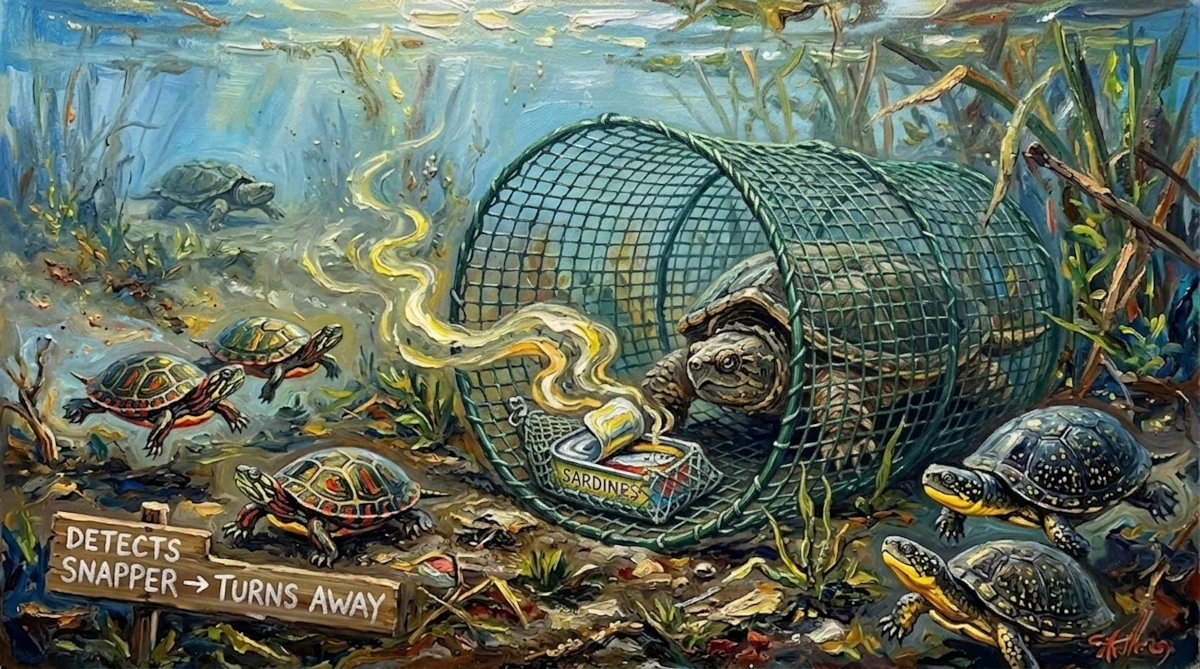
The core methodology involved baited hoop traps – cylindrical nets 91.4 centimeters in diameter, submerged in the wetland with an attractant inside. The bait of choice was sardines canned in oil, a pungent and irresistible target for aquatic foragers. These traps were set across an 8.3 square kilometer marsh and checked at least twice a day, roughly every 12 hours, to minimize the time any captured animal spent confined.
When a turtle entered the trap to investigate the sardines, the design of the net kept it inside until a researcher came along to release it. Over 12 years – spanning 2009 to 2019, with an additional season in 2022 – the team accumulated 423 trap-days and 491 capture events involving three focal species: midland painted turtles (Chrysemys picta), Blanding’s turtles (Emydoidea blandingii), and snapping turtles (Chelydra serpentina).
Upon checking a trap, researchers followed a consistent protocol. Each turtle was given a permanent, unique identification by filing a specific pattern of notches into the marginal scutes – the small bony plates that run along the outer edge of the shell. Snapping turtles were sometimes also fitted with PIT tags, small microchips injected under the skin, for additional tracking reliability. The curved carapace length (CCL) of each turtle was measured along the shell from front to back as a standard estimate of body size. Sex was determined using species-specific physical traits: for Blanding’s turtles, the shape of the plastron (the flat underside of the shell); for painted turtles, the length of the foreclaw; for snapping turtles, tail morphology. All data recorded, the turtle was released on the spot.
By the end of the study, 823 unique individuals had been documented – 128 Blanding’s turtles, 256 painted turtles, and 432 snapping turtles – with 115 individuals captured more than once, providing a rich longitudinal record of individual animals across years.
The Three Species
Before examining the results, a brief introduction to the three animals at the center of this story.
The midland painted turtle is the smallest of the three and the second most abundant species in the study. Sleek and colorful, with red-and-yellow markings along the edges of their shells, painted turtles are a familiar sight basking on logs across eastern North America. In this study, 256 unique individuals were tracked.
The Blanding’s turtle is a medium-sized species with a notably domed shell and a distinctive bright yellow chin and throat that makes identification straightforward in the field. They are a species of conservation concern across much of their range, including Ontario, which makes understanding their behavior particularly important. The study tracked 128 Blanding’s turtles.
The snapping turtle is in a class of its own. The largest of the three, snappers are formidable animals with powerful jaws, rough shells, and a reputation for aggression when handled. They are also the most common turtle in many Ontario wetlands, and the most abundant species in this study with 432 individuals. Where a painted turtle might fit comfortably in your hands, a large snapping turtle is a creature you approach with genuine caution.
All three species shared the same continuous marsh with no physical barriers – meaning any turtle, in principle, could end up anywhere within the study area. When two of these animals turned up in the same trap, it wasn’t because geography forced them together. They each made their own way there.
The First Surprising Finding: Turtles Cluster More Than They Should
If turtles were purely solitary and moving independently through the marsh, responding only to the scent of sardines, you would expect them to arrive at traps more or less randomly. Some traps would catch one turtle, some would catch none, and occasionally two might happen to arrive at the same time – but the distribution would follow a predictable statistical pattern, where clustering is minimal and largely accidental.
That is not what happened.
The researchers used a measure called the Index of Dispersion (IOD), which compares the actual spread of turtle numbers across traps to what random chance would predict. A perfectly random distribution produces an IOD of 1.0. The observed IOD in this study was 1.68 – nearly twice as clustered as chance alone would produce, and that difference was statistically overwhelming (p < 0.0001, meaning the probability of this result occurring by random chance is less than one in ten thousand).
In concrete terms: 45% of all capture events contained more than one turtle. That’s not a coincidence. The turtles were arriving together far more often than independent random movement would explain.
This alone was interesting. But the more important question was who was showing up together.
10,000 Ghost Marshes
Finding turtles together could just mean that the sardine smell drew everyone to the same spot, and proximity was coincidence. To move beyond that, the researchers needed to rule out a simpler explanation: perhaps certain areas of the marsh simply attracted more turtles in general, and the clustering was just a byproduct of habitat quality rather than any social preference.
Their solution was to build what statisticians call null models – mathematical simulations of what the data would look like in a world without social behavior. Starting from the actual 12 years of trapping records, they ran 10,000 simulations in which turtle identities were randomly shuffled among traps. Everything else stayed the same – the total number of turtles, the number caught per event, the locations, the seasons – but the question of which specific animal was in which specific trap was randomized. To keep the simulations biologically realistic, swaps were only allowed between turtles caught within 3 kilometers of each other (matching typical home range sizes) and within the same year.
The result was, in effect, 10,000 versions of the marsh as it would look if turtles moved purely by chance. The researchers then compared the real data to this distribution. Wherever the real data fell outside the range produced by 10,000 random simulations, they had evidence of something more than chance at work.
Almost everywhere they looked, the real data was different from the ghost.
The Main Finding: Turtles Prefer Their Own Kind
The headline result is a strong pattern of species assortment: turtles were significantly more likely to be caught with members of their own species than the null models predicted. The overall assortment coefficient – a single number summarizing how strongly “like groups with like” – was 0.47 on a scale from -1 to 1, where 0 means random and 1 means perfect sorting by species. A value of 0.47 is a substantial departure from randomness, and it exceeded every one of the 10,000 simulated random marshes.
Breaking it down by species:
Painted turtles showed the strongest signal. They appeared in traps with at least one other painted turtle far more often than expected (p < 0.0001). Fully 65% of painted turtles in the study were captured with at least one conspecific – a member of their own species.
Blanding’s turtles showed a similar pattern, with 53% captured alongside at least one other Blanding’s turtle. The statistical significance was high (p = 0.006), indicating that this wasn’t noise.
Snapping turtles were also frequently caught with other snappers – 65% of the time – but statistical analysis showed this rate was entirely consistent with what you’d expect given their high abundance alone (p = 0.32). There were simply a lot of snapping turtles around, and they bumped into each other by chance. There was no evidence of active attraction to their own kind, but also no evidence of deliberate avoidance.
The important distinction is this: for painted and Blanding’s turtles, their rate of co-occurrence with conspecifics exceeded what their numbers alone would predict. For snapping turtles, it did not. The smaller species appear to be choosing each other; the big ones are simply often present.
The Avoidance: Small Turtles Steer Clear of Snappers
Perhaps the most striking finding – and the one with the most obvious ecological explanation – was the active avoidance of snapping turtles by the two smaller species.
Painted and Blanding’s turtles appeared in traps together with snapping turtles far less often than the null models predicted (p < 0.0001 for both). This wasn’t a mild underrepresentation. In a marsh with hundreds of snapping turtles, these smaller animals were somehow consistently managing not to end up in the same confined space as them.
The most likely explanation is risk management. Snapping turtles are large, aggressive, and known to be at least occasionally predatory toward other turtles, particularly smaller ones. A painted turtle or Blanding’s turtle that enters a trap already occupied by a snapper is potentially entering a dangerous situation. The sardines might be appealing, but not appealing enough to risk sharing a net with an animal that could injure or kill you.
This kind of avoidance behavior is not passive – it requires the smaller turtles to somehow detect or recognize the presence of the larger species and make a decision to stay out. Whether they do this through chemical cues, vibrations in the water, or some other sense isn’t yet known, but the behavioral outcome is clear.
Notably, this avoidance wasn’t reciprocal. Snapping turtles did not show any consistent tendency to avoid the smaller species. Their behavior remained consistent with the null model regardless of what else was in the area. The asymmetry makes sense: if you are the largest, most aggressive animal in the marsh, you probably don’t need to worry about who else shows up at the food pile.
What Turned Out Not to Matter
One of the valuable aspects of this study is that it didn’t just find things that matter – it rigorously ruled out things that don’t.
Sex turned out to be irrelevant. For all three species, the researchers found no statistically significant tendency for turtles to group with or avoid members of the same sex. Males weren’t clustering together to compete for status, and females weren’t avoiding males. Turtles weren’t using sardine-baited traps as a dating pool. The assortment that was observed was purely about species, not gender.
As a specific example: snapping turtles might be expected to show male-male aggression or avoidance, since males of many species compete aggressively. But in 22% of snapping turtle capture events – 40 separate occasions – multiple males were caught together in the same trap with no evidence that this was unusual or actively avoided.
Body size was similarly uninformative. Carapace length did not significantly predict which turtles ended up together for Blanding’s or snapping turtles. For painted turtles, there was initially a weak suggestion that smaller individuals tended to group together, but further analysis revealed this was driven almost entirely by a single unusually large painted turtle – one individual measuring 218 mm in curved carapace length, well above the typical range – an outlier whose presence was skewing the analysis. Remove that one animal and the size effect vanished entirely.
The conclusion is clean: in the context of freshwater turtle feeding aggregations, the only trait that reliably organizes who shares space with whom is species identity.
A Hidden Problem for Conservation
The practical stakes of these findings become clear when you consider how turtle populations are actually monitored.
For species of conservation concern like the Blanding’s turtle, regular population surveys are a legal and management necessity. Biologists need to know how many animals are present, where they are, and whether their numbers are stable. In practice, baited hoop traps are one of the main tools for this – the same kind of traps used in this study.
But if Blanding’s turtles actively avoid entering traps that already contain snapping turtles, then any survey conducted in an area with high snapper density will systematically undercount Blanding’s turtles. A researcher finds a snapping turtle in a trap, no Blanding’s turtle, and records an absence. But perhaps a Blanding’s turtle approached, detected the snapper inside, and turned away. The absence is false. The animal was there; it just didn’t come in.
This kind of “false absence” can have cascading consequences. In environmental impact assessments – the processes that determine whether a construction project or development will affect critical habitat – failing to detect a Blanding’s turtle population can mean that habitat goes unprotected. The Blanding’s turtle is a species at legal risk in Ontario. A methodology that consistently underestimates its presence – because it doesn’t account for this social dynamic – is a liability the monitoring community didn’t know it had.
The researchers suggest several responses: adjusting occupancy models to account for the probability of snapper-driven exclusion; deploying PIT tag readers or underwater cameras near traps to capture animals that approach but don’t enter; and treating apparent absences in high-snapper areas with heightened skepticism. These aren’t complicated interventions – but they require knowing the problem exists.
Why This Matters: Rethinking the “Solitary Reptile”
The assumption that reptiles are fundamentally solitary has shaped decades of research and conservation planning. It has also been steadily unravelling.
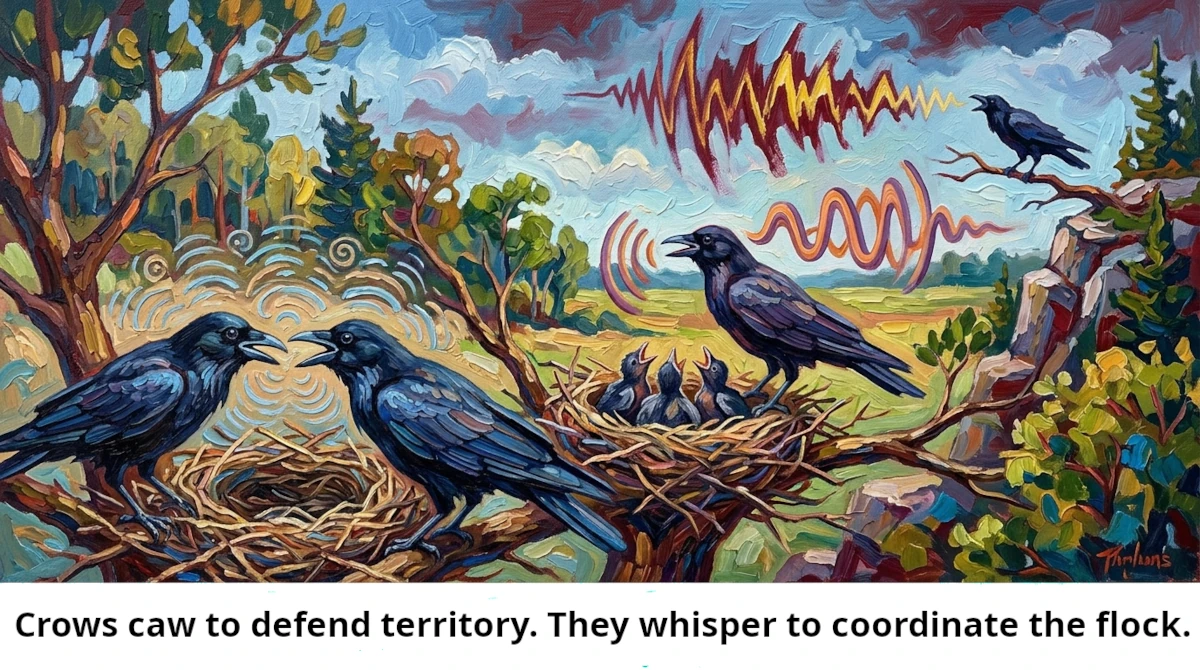
Turtles have been recorded using complex vocalizations underwater, possibly to coordinate group movements. Some species show communal nesting, with females returning to the same sites and sometimes appearing to synchronize laying. There is evidence of kin recognition in at least some reptiles. And now there is 12 years of quantitative trapping data showing that freshwater turtles structure their feeding aggregations along clearly social lines.
What the researchers describe as the “social-non-social dichotomy” – the clean binary of either-you’re-social-or-you’re-not – increasingly fails to describe the world as it actually is. A snapping turtle appears indifferent to its neighbors at a food source. That doesn’t mean it has no social behavior whatsoever; it means that in this context, around this kind of resource, the social filter isn’t operating. The painted turtle, meanwhile, shows strong conspecific preference at feeding sites but presumably doesn’t spend its entire life in a tightly bonded group.
Sociality, it turns out, is contextual and species-specific. It exists in different forms and different intensities across situations that we are only beginning to understand for animals we thought we already knew.
The Bigger Picture: Mining Old Data for New Answers
One of the most practically valuable aspects of this study is what it suggests about the research that can be done without setting foot in the field. The 12 years of trapping data used here was originally collected for standard population monitoring – counting turtles, tracking their growth and survival. It wasn’t designed with social network analysis in mind. But by reanalyzing it with new methods, the researchers extracted an entirely different category of insight.
Social Network Analysis, the toolkit borrowed here from sociology and applied to animal behavior, represents a growing area in ecology. By treating each turtle as a node in a network and each co-capture event as a connection between nodes, the researchers could quantify the strength and structure of social associations across the entire population over more than a decade. The same approach could, in principle, be applied to any species that gets captured in communal traps or monitored in shared spaces – fish, amphibians, reptiles, small mammals, and beyond.
For researchers working with conservation-relevant species that are hard to observe directly, this is an encouraging message: the data you already have may contain answers to questions you haven’t thought to ask yet.
The sardine in the net is doing more work than anyone expected.
Based on a 12-year longitudinal study of freshwater turtle feeding aggregations in a coastal wetland on Lake Erie, Ontario, 2009-2019 and 2022. Total dataset: 823 unique individuals across three species, 491 capture events, 423 trap-days.
Source
Study: A look inside the net: freshwater turtles assort with conspecifics in feeding aggregations
Authors: Caitlin Menzies, Remus James, Julia Riley, Christina M. Davy, Roslyn Dakin (2026)
Read the full paper: https://www.biorxiv.org/content/10.64898/2026.04.13.718235v1



Leave a Reply