

There is a common assumption baked into how we think about stress: that more of it is always worse, and that the body keeps a running tab of every threat it has ever faced, eventually presenting a bill in the form of burnout, illness, or cognitive decline. A study on a small, sociable fish from one of Africa’s great lakes suggests this picture is incomplete – and that under the right conditions, repeated stress can do something quite different from wearing an animal down. That is the idea behind this cichlid fish stress resilience study.
Why Cichlid Fish Stress Resilience Research Starts With Neolamprologus pulcher
Neolamprologus pulcher lives in the rocky shallows of Lake Tanganyika, one of the oldest and deepest lakes on Earth. It is a cooperative breeder, meaning it lives in organized groups where subordinate individuals help raise offspring that are not their own – a level of social complexity unusual in the fish world. It also lives with real danger. The predatory cichlid Lepidiolamprologus elongatus hunts it regularly, and the threat of attack shapes much of its daily behavior.
These qualities – social sophistication, ecological realism, and a well-documented stress response – make N. pulcher an unusually good model for asking questions about how repeated environmental challenges affect both body and mind.
How the Experiment Tested Diet and Predator Threat
Researchers took 126 adult fish and manipulated two things over the course of nine weeks. The first was diet. Some fish were fed generously, receiving 1.5 food sticks per day, while a second group received just 0.5 – a third of that amount. Over time this produced two meaningfully different physical states: fish with comfortable energy reserves, and fish running noticeably closer to empty.
The second manipulation was predator exposure. Using carefully standardized video playbacks of an attacking L. elongatus – the fish’s genuine natural predator – combined with water that carried the chemical signatures of predation, researchers exposed different groups of fish to threat at three different frequencies. Some fish encountered the predator not at all. Some saw it three times a week. Others faced it three times a day, every day, for weeks.
By separating these two variables cleanly, the design allowed the researchers to ask not just what each factor did on its own, but how the two interacted – whether being well-fed changed what frequent stress actually did to an animal.
Measuring Cortisol Without Drawing Blood
Stress hormones were measured without drawing a single drop of blood. Fish were placed individually into small holding containers, and after a set period the water itself was tested for cortisol – the primary glucocorticoid fish release under threat, directly equivalent to the cortisol humans produce in stressful moments. This non-invasive approach allowed the team to track each animal’s hormonal profile repeatedly over time, capturing not just whether cortisol rose after a stressor, but how quickly it came back down.
That recovery speed turned out to be the crux of everything. Fish whose cortisol spiked sharply and then fell back to baseline within two hours were classified as brief responders. Those who remained in an elevated state well past that window were prolonged responders. The difference between these two profiles, it emerged, was not just physiological – it tracked almost perfectly with how well each fish could think.
Testing Cognitive Flexibility With Reversal Learning
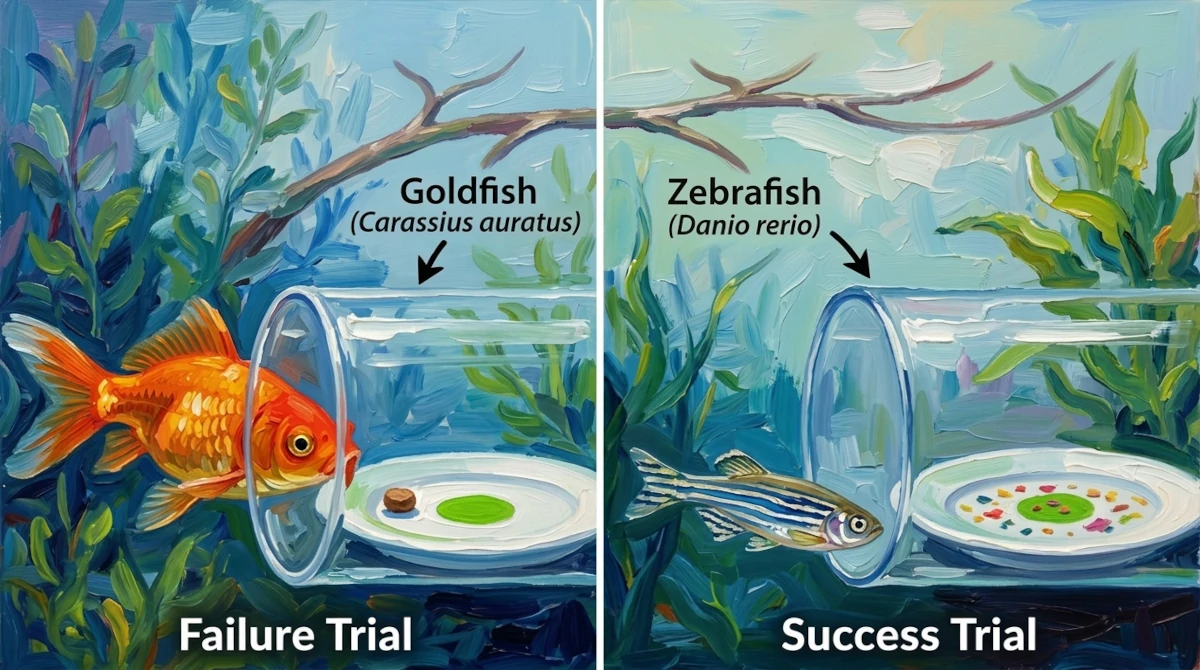
The cognitive component of the study used a reversal learning task, a classic tool in behavioral research. Each fish first learned a simple rule: one colored disc hid food, another hid nothing. Once the animal had reliably mastered that association – consistently choosing correctly – the researchers flipped it. The previously rewarded color now led to nothing, and the previously ignored color now delivered food.
This is harder than it sounds. The fish had to do two things simultaneously: suppress a behavior that had been consistently rewarded, and replace it with the opposite behavior. That combination of inhibition and relearning is a sensitive probe of cognitive flexibility – the ability to update mental models when the world changes. How many trials each fish needed to reach reliable performance on the reversed task became the primary measure of adaptive thinking.
What the Data Said About Stress Recovery
The researchers had entered the study expecting the allostatic load model to be confirmed. This framework, influential across biology and medicine, holds that repeated or chronic stress accumulates as wear and tear on the body – depleting resources, dysregulating hormonal systems, and ultimately impairing the brain’s ability to function at full capacity. The expectation was that fish facing frequent predators, especially well-fed ones whose physiology might already be under metabolic strain, would show the worst outcomes: the most prolonged stress responses, the slowest reversal learning.
The data disagreed almost completely.
Well-nourished fish exposed to frequent stress were not the most impaired group. They were the most resilient. Every single high-condition fish in the frequent-exposure condition qualified as a brief responder – cortisol up, cortisol back down, quickly and cleanly. And in the reversal learning task, this same group outperformed all others, mastering the new rule significantly faster than fish who had seen the predator only occasionally, or not at all.
The leaner fish presented a starker picture. Across all levels of predator exposure, their nutritional deficit appeared to impose a ceiling on adaptation. Frequent stress neither helped nor harmed their cognitive performance in any statistically meaningful way. They were simply unable to extract any benefit from the experience – and given how costly repeated stress responses are to mount, it is reasonable to suspect the experience quietly cost them something even when the numbers did not show it dramatically.
How Nutrition Shapes Cichlid Fish Stress Resilience
Two theoretical frameworks help make sense of these results, and they complement each other neatly.
The first is the preparative hypothesis. Rather than treating each stressor as a pure cost, this view holds that glucocorticoids – the hormone class that includes cortisol – do something more sophisticated than simply sounding an alarm. They also prepare the system for the next alarm. Repeated moderate exposure may gradually recalibrate the threshold at which a threat registers as genuinely alarming, and may train the hormonal machinery to respond more efficiently: faster onset, faster shutdown, less collateral physiological disruption. The organism is, in a meaningful sense, practicing.
The second is the concept of energetic buffering. A stress response is metabolically expensive at every stage – mobilizing fuel, activating the hormonal cascade, and then actively restoring baseline all require resources. An animal with generous reserves can absorb those costs repeatedly without degradation. An animal already running lean cannot. The well-fed fish had the biological equivalent of a financial cushion; they could invest in adaptation without risking insolvency. The lean fish had no such margin.
These two ideas together suggest that the relationship between stress and resilience is not linear but conditional. Frequent moderate stress, in a well-resourced animal, may function more like training than trauma. The same stressors, hitting an under-resourced animal, may achieve neither benefit nor neutral outcome – just quiet attrition.
The Brain’s Off-Switch: Glucocorticoid Receptors
There is a molecular detail worth dwelling on. The brain contains receptors for glucocorticoids – structures called glucocorticoid receptors, or GRs – and one of their key functions is to detect when cortisol has risen sufficiently and signal the hormonal system to stand down. They are, in effect, the stress response’s off-switch, the mechanism through which the body recognizes that the alarm has been heard and begins the return to calm.
When these receptors are blocked experimentally, cortisol stays elevated long past its useful window, and behavioral flexibility degrades. This suggests that the brief-response pattern seen in the well-nourished, frequently stressed fish is not merely a passive reflection of good health – it may represent an actively well-regulated system, one in which the off-switch is working with particular efficiency. Whether frequent, manageable stress actually sharpens that regulation over time is a question the study raises but does not fully resolve – and it is one worth pursuing.
What the Findings Mean Beyond the Lake
The researchers are appropriately cautious about extrapolating too far. Their well-fed fish were not obese in any clinical sense, and genuine obesity – a qualitatively different metabolic state – might well produce the harmful allostatic outcomes the original model predicts. The stressors used were moderate and naturalistic, not uncontrollable or extreme; the latter are known to cause harm regardless of nutritional status. And fish, while valuable models, are not people.
But the broader resonance of the findings is hard to ignore entirely. In conservation contexts, the implications are fairly direct: animals in degraded or food-scarce habitats may face a compounding vulnerability, where environmental threats arrive at the same time the body’s capacity to handle them has been silently diminished by poor nutrition. A predator encounter is not simply one problem for a hungry animal – it is a problem the system may genuinely be unable to resolve without a cost that accumulates.
For human biology, the picture is more complex but no less interesting. The interaction between chronic stress and nutrition is a live question in medicine, relevant to understanding burnout, cognitive resilience, and the long-term effects of economic deprivation on mental health. Animal models cannot answer those questions directly, but they can sharpen them – and findings like these complicate the simple story that stress is uniformly destructive and that eating well is a luxury rather than a prerequisite for coping.
What Stays With You
The most enduring insight from this study may be about the conditions under which challenge becomes growth rather than damage. Those conditions are not guaranteed. They are not available to every animal. They depend on something as basic and as unequally distributed as having enough to eat.
The cichlids that thrived under repeated predatory threat were not simply tougher than their leaner counterparts. They had the resources to make experience count. The ones who lacked those resources were not failing to be resilient – they were being asked to be resilient on credit, and credit, eventually, runs out.
Stress, it turns out, is a teacher. But like most teachers, it works best when the student has already had breakfast.
Source
Study: Fat fish stay cool: Stress recovery and behavioral flexibility vary with nutritional state and predator exposure in the cichlid Neolamprologus pulcher
Authors: Stefan Fischer, Katharina Hirschenhauser, Barbara Taborsky, Leonida Fusani, Virginie Canoine, Sabine Tebbich (2026)
Read the full paper: https://www.biorxiv.org/content/10.1101/2025.04.02.646863v2







Leave a Reply