

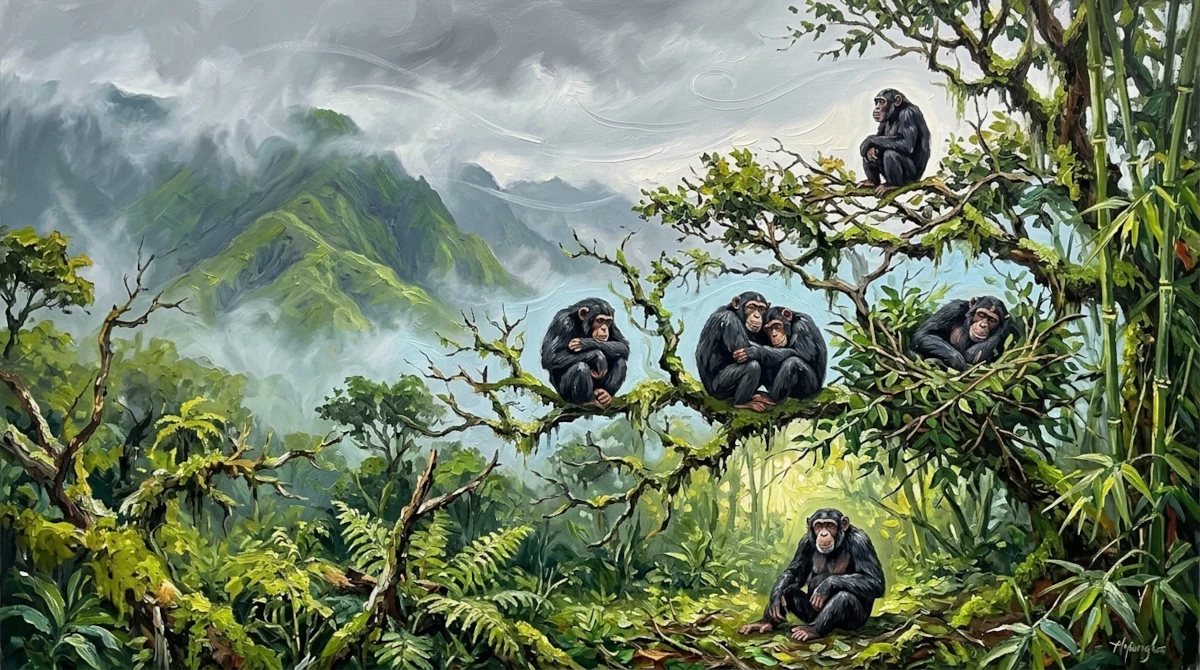
Picture a chimpanzee and you probably picture heat: thick jungle, blazing sun, an ape panting in the shade. High in Rwanda’s mountains, a community of eastern chimpanzees faces the exact opposite problem, raising an unexpected question: how do chimpanzees stay warm when their home looks nothing like a typical rainforest? A new study of their thermoregulation – the set of behaviors animals use to keep body temperature in a livable range – shows exactly how they solve it.
How Chimpanzees Stay Warm in an Atypical Habitat
The Mayebe community lives in Nyungwe National Park, on slopes running from about 1,600 meters up to nearly 2,950 meters – among the highest elevations any chimpanzee population is known to inhabit. It’s cool, misty, windswept, and often deeply chilly. Most chimpanzees spend their lives trying to cool down. The Mayebe spend theirs trying to stay warm.
Over one full year, researchers logged almost 5,700 behavioral observations, isolating the moments when these chimpanzees rested to cross-reference each one against the temperature, wind, humidity, and rainfall at that exact moment. The result: a rare, granular look at how an animal with no winter coat pulls off survival – and even comfort – in the biting mountain air.
Why Watch Chimps Do Nothing?
It sounds like a strange place to look for answers, but rest is exactly where the thermal signal comes through cleanest. Active behaviors generate metabolic heat as a byproduct – muscles working, blood pumping – which muddies the data. Strip that away, and a chimpanzee’s internal heat production drops to its lowest baseline. What’s left is a powerful lens: whether to curl up tight, huddle with a partner, seek out a sunbeam, or descend to the cooler forest floor becomes a strategic, deeply calculated response to both their social world and the changing weather.
Body Language: Posture as a Thermostat Dial
Shape is a cheap, fast way to control body heat. Curl up and you shrink the surface exposed to cold air; stretch out and you lose warmth faster. The study found four resting postures, each telling its own temperature story:
- Huddling. Two or more chimps pressed together was the single strongest cold-weather signal in the entire dataset. It’s a double win: less exposed surface per animal, plus a direct transfer of body heat between neighbors – like people crowding together to keep warm.
- Curling up. Limbs pulled in, back rounded forward. The second-strongest cold-weather posture, shielding the thinly furred belly and chest.
- Lying down. More common as temperatures fell, likely because stretching out on a stable surface is preferred to sitting when temperatures drop, though curling and huddling remain their primary cold-weather defenses.
- Sitting. The default. The posture chimps fall back on when the weather isn’t pushing them either way – and it becomes even more common as things warm up.
One twist: humid air actually discouraged huddling, even in the cold. The researchers’ tentative read is that heavy moisture in the air blunts the body’s ability to shed heat through evaporation, so pressing against another warm body starts to feel less like comfort and more like overheating. But they’re careful not to oversell this – huddling in primates often tracks social bonds and partner preference as much as weather, and a chimp might huddle with a favorite grooming partner no matter what the thermometer says. Wind, notably, had no effect on posture at all. Its fingerprints show up somewhere else entirely.
Sun, Shade, and the Ground Beneath Their Feet
Posture was only half the game. Where chimps chose to rest tracked temperature just as tightly. As days warmed, shade-seeking climbed sharply – no surprise there. In cooler weather, chimps happily parked themselves in direct sun, treating it as free heat. Humidity and wind barely mattered here; this decision belonged almost entirely to temperature.
The same logic played out between trees and ground. Cooler weather kept more chimps up in the canopy. As it warmed, more came down to the forest floor – which sounds backwards until you remember that under a closed canopy, the ground is often shadier, stiller, and more thermally stable than an exposed perch above. It’s a natural refrigerator, not a cold, damp liability.
Climbing Down From the Wind
Nyungwe’s canopy isn’t one layer – it’s stacked, floor to crown, each level with its own microclimate, not unlike different floors of a building running warmer, cooler, or breezier than the rest. The top catches the most sun and the most wind; the lower layers stay calm and shaded.
As temperatures rose, chimps abandoned the middle and top layers for cooler branches below. Wind added a separate, sharper push: regardless of temperature, higher wind speeds meant less time at the very top of the canopy. Makes sense – an exposed perch in a stiff breeze bleeds heat fast through convection, the same effect that makes windy cold days feel colder. Dropping into denser branches cuts that loss. One caveat, though: relatively few observations came from the top canopy to begin with, so the researchers treat this as suggestive of wind-avoidance, not proof of it.
The Day Nest: An Unexpected Cold-Weather Tool
The most surprising finding in the whole study involves something usually filed under “just for comfort”: the day nest.
A day nest is a quick, temporary structure chimpanzees build purely for daytime rest – distinct from the elaborate nests built each night for sleep. A chimp piles leaves, twigs, and small branches beneath itself before settling down, and that simple act does real physiological work. It cushions the body against hard, rough, or damp branches and bark. And it insulates: the gathered vegetation traps warmth around the body – functioning much like bedding – which matters most during rest, exactly when metabolic heat production has already bottomed out. Day-nest building rose sharply in the cold and fell off as things warmed, a pattern that fits a heat-conservation function far better than a purely comfort-driven one.
There was good reason to expect wind might factor in here too. A much older study at Taï National Park in Ivory Coast – a completely different chimpanzee population – found chimps built more day nests on the ground during the Harmattan, a dry, windy season, apparently to dodge the extra heat loss of a nest exposed high in a gusty tree. That result is exactly what motivated the Nyungwe researchers to test for the same pattern here. It didn’t show up: wind speed had no measurable link to day-nest use in Nyungwe, and neither did rainfall. Temperature alone called the shots – reinforcing that in this montane forest, day nests function as insulation against cold, not shelter from wind or rain. Different forest, different rules.
Two Factors That Turned Out to Matter Less: Rain and Fruit
Rainfall showed only weak, inconsistent links to posture or habitat choice, though lower canopy layers may offer some incidental rain cover simply by being more enclosed. Fruit availability clearly shapes where chimps travel to forage – but once they stop to rest, it has essentially no bearing on how or where they do it. Across nearly every behavior measured, temperature beat every other variable, by a wide margin.
That’s a useful negative result. It rules out the tempting alternative explanations – that chimps rest on the ground because that’s where the fruit is, or build nests mainly to stay dry.
The Takeaway: A Forest Built for Thermal Survival
| Condition | Chimpanzee response | Strength of evidence |
| Cold | Curl up, huddle, lie down, seek sun, stay in trees, build day nests | Strong, consistent |
| Warm | Sit normally, seek shade, move to ground or lower canopy, skip nest-building | Strong, consistent |
| Windy | Somewhat less likely to use the very top of the canopy | Suggestive, based on limited top-canopy data |
| Humid | Somewhat less likely to huddle, even when cold | Present but described by researchers as tentative |
Put it together and a clear picture forms: the Mayebe chimpanzees aren’t just enduring a harsh mountain climate – they’re actively managing it, moment by moment, with every tool available. Curl to trap heat. Huddle to share it. Chase the sun when it’s needed, retreat to shade or ground when it’s not. Drop out of the wind. Build an insulated nest when the cold sets in.
None of this requires special fur or unique biology – it’s pure behavioral flexibility, the kind that lets chimpanzees survive at nearly 3,000 meters, right at the outer edge of where the species is known to live. And because so much of that flexibility depends on a structurally rich forest – shaded lower canopy, an accessible forest floor, enough material to build nests from – protecting these chimpanzees means protecting the entire vertical architecture of their home, not just the parts easiest to see from above.
The researchers themselves are careful to note these are correlations, not proof of a single mechanism. Rest behavior can also be shaped by habitat structure, predation risk, social dynamics, and whatever an animal was doing right before it sat down – factors this study couldn’t fully rule out. Still, temperature stood out as by far the most consistent predictor across every behavior they measured, from posture to nest-building – the clearest thread running through how these mountain chimpanzees get through their day.
Think you’ve mastered it? Test yourself with the 5-question quiz below – it only takes a minute.
Quiz: Can You Stay Warm In the Clouds Like a Mountain Chimp?

Source
Study: Temperature modulates resting posture, microhabitat use, and day nesting in chimpanzees in a cool montane forest
Authors: Hassan Al-Razi, Fidele Muhayeyezu, Felix Mulindahabi, Protais Niyigaba, Drew Arthur Bantlin, Beth A. Kaplin, Shane K. Maloney, Cyril C. Grueter (2026)
Read the full paper: https://www.biorxiv.org/content/10.64898/2026.08.18.745634v1









Leave a Reply