

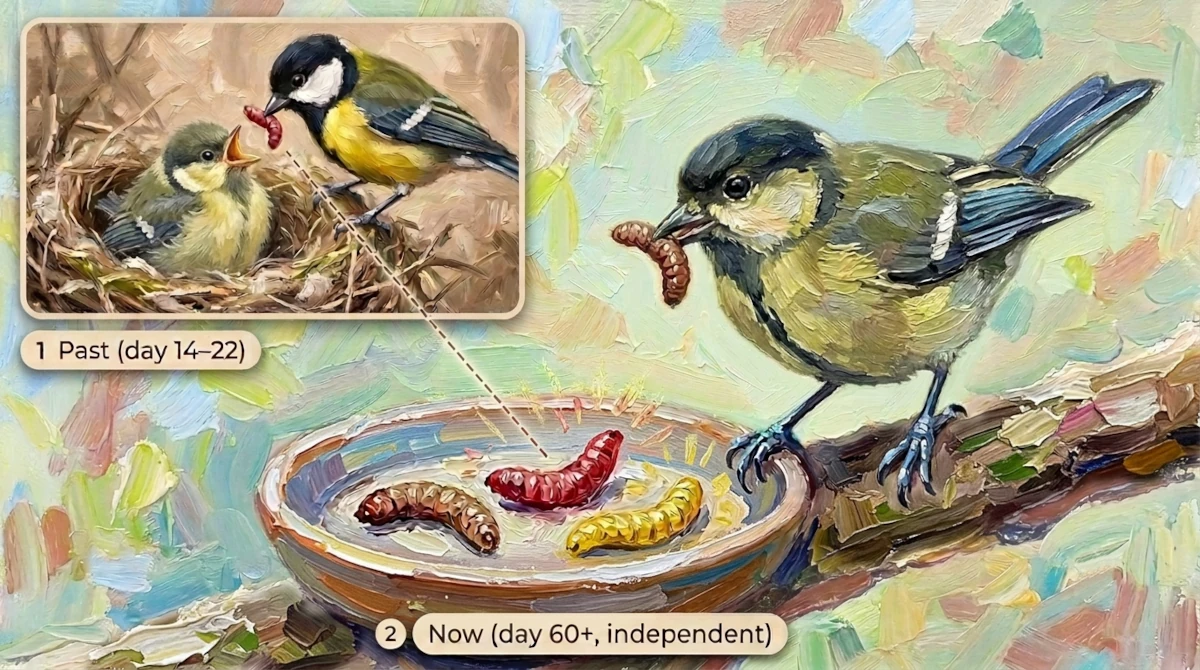
Picture a nest full of great tit chicks in a Finnish forest. Every day, their parents fly back and forth, stuffing beaks with food. The chicks have no idea what’s safe and what isn’t – they just eat what they’re given and trust that mom and dad know best. But what if, for over a week straight, a parent kept bringing home food in a color that nature usually treats as a red flag – literally? Would the chicks grow up believing that color is fine to eat, simply because their parents fed it to them?
A team of scientists decided to find out, and the answer revealed just how innate great tit fear of red really is.
The Setup: A Battle Between Two Teachers
Every young animal that has to find its own food faces the same basic problem: some things are good to eat, and some things will make you sick or kill you, and there’s no label to tell you which is which. Over the course of evolution, two very different “teachers” have emerged to help animals solve this problem.
The first teacher is instinct – a kind of pre-installed software passed down genetically. Many toxic insects have evolved bright warning colors like red and yellow specifically so that predators learn, or are simply born knowing, to leave them alone. This is called aposematism.
The second teacher is experience, and for a young bird still dependent on its parents, the most obvious source of experience is watching what its parents do. If a parent repeatedly brings home a particular kind of food and the chick eats it and survives, that should be a fairly strong signal that the food is fine – right?
Researchers studying great tits (Parus major) in central Finland set out to pit these two teachers against each other under tightly controlled conditions, to see which one a young bird actually listens to.
Building an Experiment Where Nothing Is Left to Chance
The team started by monitoring 39 wild nests, tracking exactly when each brood of chicks hatched. At 14 to 15 days old, they brought 90 nestlings, along with 30 adult birds, into large outdoor aviaries. This age wasn’t chosen at random. Great tit chicks open their eyes around day 8 or 9, but a nestbox is dark, so they don’t get a clear look at their food until later. Day 14 marks the point where the chicks are alert enough to actually register what color their food is, while still being completely reliant on their parents to bring it to them.
To keep genetics out of the picture, the researchers shuffled the chicks: 15 “foster nests” were created, each holding six chicks pulled from two to four different biological families, with one adult pair assigned to raise each group. That way, if a preference showed up later, it could only be explained by the feeding experience, not by which birds a chick happened to be biologically related to.
The aviaries themselves were built to prevent cheating. Each cage was walled off from its neighbors by four layers of wire mesh and hidden behind tree branches, so a chick in one cage had no way of seeing or learning from a chick in the cage next door. Any lesson the birds learned had to come specifically from their own parents – not from copying nearby siblings-in-spirit.
Eight Days That Were Supposed to Shape a Lifetime
For eight days, from age 14 to 22, each foster brood’s parents were handed 10 grams of maggots daily to feed their chicks. The maggots were entirely harmless and nutritious – but they came dyed in one of three colors:
- Brown, fed to 3 broods (18 chicks) – the color of camouflage, the “safe” default in nature.
- Red, fed to 6 broods (36 chicks) – one of the most common warning colors in the animal kingdom.
- Yellow, fed to 6 broods (36 chicks) – another classic warning color, though generally considered less alarming than red.
Every maggot, regardless of its natural color, was coated in a dye with no smell or taste, so color was the only thing distinguishing the groups. After the eight-day window closed, the colored maggots disappeared entirely from the aviaries. The young birds spent the following weeks growing up, gradually starting to forage on their own, while their parents were eventually released back into the wild. By the time the real test rolled around, a full month had passed since any bird had seen a colored maggot.
The Test: Nine Maggots, One Big Question
At 60 to 65 days old, 65 of the birds went through a preference test. Each bird sat alone in a cage in front of a small dish holding nine maggots – three brown, three red, three yellow – laid out on a plain white background. Researchers filmed the trial and logged the exact order in which each maggot was eaten, then converted that order into a “preference score” from 2 (eaten first, most preferred) to 8 (eaten last, least preferred).
This was the moment where the two teachers – instinct and parental example – would either agree or clash. A bird raised for eight days on red maggots by its own parents now had brown, red, and yellow all sitting in front of it at once. Would it reach for the color it grew up trusting, or would something deeper take over?
The Results: Great Tit Fear of Red Held Firm
The pattern was consistent, though the researchers are careful about how much weight it can bear (more on that below). No matter which color a bird had been raised on, the birds behaved in largely the same way:
- Fifty-two of the sixty-five birds went for a brown maggot first, and this held across every treatment group.
- A ranking showed up repeatedly: brown was preferred most, yellow came next, and red was avoided most of all.
- Statistically, the color a bird had been fed as a nestling made no detectable difference to how it behaved as an independent adult. Neither did sex, nor a separate antibiotic/plant-toxin treatment layered into the same study.
Notably, birds whose parents had spent over a week actively feeding them red maggots still treated red as the most alarming option once tested independently. Whatever trust a parent might seem to build by repeatedly offering a food, it didn’t show up in how the grown chick behaved a month later.
Digging Into the “Why”
Why would a young bird apparently disregard a full week of direct, personal evidence from its own parents? The researchers offer a handful of explanations, and more than one could be true at once.
One possibility is that the information simply expired. A month is a long time in a young bird’s life, and if animals are wired to trust recent, personal experience over something observed weeks earlier as a helpless nestling, the parental lesson may have faded into irrelevance by test time.
Another possibility is that the instinct is just hard to override. Eating a genuinely toxic insect can be a one-time, fatal mistake, so there’s a plausible evolutionary logic in building stubborn, hard-to-shift caution into the brain from birth. Eight days of contrary evidence, even from a parent, may not be enough to outweigh that.
There’s also a chance that once a bird becomes independent, it starts looking to different role models – peers and siblings its own age, rather than parents from its nestling days. If so, the parental lesson might not have failed so much as gotten replaced.
And the design of the test itself matters here: because a “safe” brown option was always available next to the red and yellow maggots, no bird was ever forced to choose between eating something scary-looking or going hungry. The researchers point out that a tougher test – one where the only food available was a warning-colored maggot – might tell a different story, since real desperation could push a bird to lean more on whatever social information it had.
There’s also a wrinkle in the experiment’s timeline worth flagging: the researchers had no control over what chicks were fed in their first two weeks in the wild nest, before the study began. Since roughly 85 percent of the caterpillars and larvae in the Finnish countryside are naturally brown and camouflaged, it’s plausible that a preference for brown was already forming before the colored maggot treatments even started – which complicates how cleanly this result can be attributed to instinct alone.
Not All Warning Colors Are Created Equal
One more detail stands out: red and yellow weren’t avoided to the same degree. Red consistently ranked as the more strongly avoided color, suggesting birds may interpret it as a more urgent or severe warning than yellow. This is consistent with (though doesn’t prove) the idea that different warning colors may have been shaped by different evolutionary pressures – perhaps red-colored prey have historically carried more dangerous defenses, leaving a deeper mark on avoidance behavior.
Why It Might Matter Beyond the Aviary
If this pattern holds more broadly, it would have some interesting implications for how scientists think about predator-prey dynamics.
For one, it would help explain why warning colors persist as an effective survival strategy generation after generation: if young predators start out cautious of bright colors regardless of what their parents feed them, toxic prey species get a layer of protection that doesn’t erode just because one generation of predators had unusual feeding habits.
It also hints that parental influence might still matter – just not in the way researchers expected going in. Rather than teaching chicks which colors are dangerous, parents might instead help chicks get faster and better at spotting camouflaged prey, since most of what’s actually out there to eat is cryptic rather than conspicuously colored. In other words, parents may shape foraging efficiency more than risk tolerance.
The strength of this innate caution, if it holds up, could also help keep predator-prey relationships more stable over time – since a population where social learning routinely overrode instinct might occasionally “figure out” a warning-colored species is harmless and start targeting it, causing swings in prey numbers that a more instinct-driven population wouldn’t show.
Honest Limitations
The researchers are upfront about the study’s limits, and they’re worth taking seriously rather than treating as a formality. They couldn’t fully account for what chicks ate before day 14 in the wild, so some of the brown preference could have already been established before the experiment began. The eight-day exposure period, while carefully chosen, might not line up with whatever window (if one exists) actually matters for locking in food preferences – a longer or differently timed exposure might have produced different results. And because a safe alternative was always on the table during testing, the study can’t say what would happen if a bird had no easy way out.
The Bottom Line
Under these particular conditions, chicks who were personally fed red or yellow food by their own parents for over a week grew up to treat those colors with about as much suspicion as chicks who’d never encountered them before. Brown won out consistently, and red – the boldest warning signal of the three – was avoided most, even by birds whose own parents had gone out of their way to feed it to them.
The broader takeaway, with the caveats above in mind, is that evolution doesn’t always leave survival decisions up to trial, error, or example. For choices where a single mistake can be fatal, nature may prefer to hard-wire the answer in from the start – and in this study, at least, a week of parental reassurance wasn’t enough to talk these young birds out of their instincts.
Think you’ve mastered it? Test yourself with the 5-question quiz below – it only takes a minute.
Quiz: Are You Born Wary Like a Great Tit Chick?

Source
Study: The effect of parental provisioning on the development of prey preferences in great tit (Parus major)
Authors: Linda Nevala, Christopher J Irving, Rose Thorogood, Suvi Ruuskanen, Liisa Hämäläinen (2026)
Read the full paper: https://www.biorxiv.org/content/10.64898/2026.07.03.736371v1




Leave a Reply