

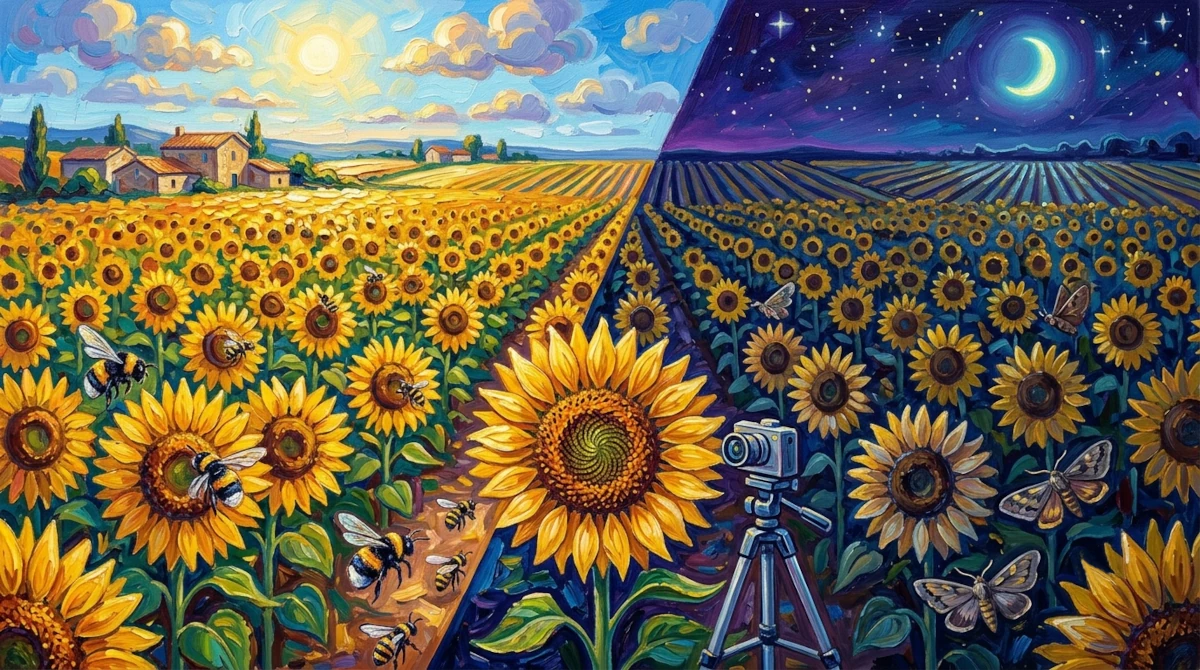
Picture a sunflower field at 2 a.m. No one is there. No one has ever really been there at that hour, at least not with a notebook and a stopwatch. And yet, according to a new AI pollinator monitoring system called PolliCrop, that’s exactly when a whole cast of moths shows up to feed – not pollinating the flowers, as it turns out, but quietly relying on them as a nocturnal food source in a way decades of daytime research never noticed.
That single fact says a lot about why PolliCrop was built in the first place, and what it’s starting to reveal.
The work was carried out at INRAE’s research station in Auzeville-Tolosane, France, across two settings: a sunflower field nursery and Heliaphen, an outdoor high-throughput phenotyping platform. Researchers collected data there over three consecutive growing seasons – July through September of 2022, 2023, and 2024 – in a collaboration that also included teams from the University of California, Berkeley, Germany’s Julius Kühn Institute, and the Technische Universität Braunschweig.
A Quiet Crisis, and a Flawed Way of Measuring It
Flower-visiting insects – bees, moths, butterflies, and their many relatives – have been declining since the 1990s. Intensive agriculture has stripped away much of the wild vegetation these insects once relied on for food, leaving fewer and fewer places for them to forage. One response from plant breeders has been to ask: what if we could breed crops that are simply more attractive to pollinators, giving them more resources while also improving pollination outcomes for the crop itself?
That idea depends on being able to measure attractiveness accurately, and that’s where things get difficult. The standard method – a person standing in a field, watching a plant, and counting visits – has three built-in flaws. It’s slow and expensive to do at scale. It only works in daylight, so it misses anything nocturnal. And a person’s mere presence can spook insects or otherwise change how they behave, contaminating the very data being collected.
PolliCrop was built to remove humans from the equation entirely.
Cameras That Never Blink
The setup is refreshingly low-tech at its core: a commercial time-lapse camera (a Wingscapes TimelapseCam Pro) mounted on a tripod about 30 to 50 centimeters from a sunflower’s head, taking a photograph every five minutes, day and night, for the entire six-to-twelve day blooming period. That’s 288 photos a day, roughly 3,000 over the life of one flower.
Sunflowers turn out to be an almost ideal test subject for this kind of monitoring. Because each plant produces a single, large flower head, one camera can capture the entire “landing zone” for insects in a single frame – no need to juggle multiple small blooms scattered across a plant.
The one modification made to the stock camera: its flash was taped over with light-tight material. This prevents the camera from blowing out nighttime images with too much light, but more importantly, it means the camera isn’t announcing itself to moths and other night-flying insects, whose behavior could otherwise be thrown off by a sudden flash every five minutes.
Why not just use a motion-sensor camera, the kind used to photograph deer or foxes? Because those sensors work by detecting body heat, and insects are cold-blooded – their body temperature simply matches the air around them. To an infrared sensor, a bee is invisible. Time-lapse photography, dumb and simple as it is, was the only reliable way to catch everything.
Handing 150,000 Photos to a Machine
Even a modest monitoring effort generates a staggering number of images – in this case, about 150,000 of them, gathered across the three field seasons. No research team could review that volume by hand in any reasonable amount of time. So the second half of PolliCrop is a deep-learning model, built on an object-detection architecture called YOLO11x, trained to scan each photo and flag any insects it finds.
Rather than trying to pin down exact species – a nearly hopeless task from a single still photo – the model was trained to sort insects into three broader groups, based on shared visual traits:
- Non-Bombus bees, covering honey bees, mining bees, sweat bees, and leafcutter bees – generally similar in size, often with striped abdomens.
- Bumble bees, the various fuzzy, larger-bodied Bombus species.
- Lepidopterans, covering both moths and butterflies together.
Before trusting the AI’s counts, researchers first had humans manually verify a sample of images, creating a “ground truth” – a known-correct answer key – that the model’s predictions could be checked against.
The Push and Pull Between Two Kinds of Mistakes
Here’s where the project gets genuinely interesting from a technical standpoint. The team trained two versions of the model, and comparing them illustrates a tension that shows up in almost every real-world AI system: the trade-off between precision and recall.
Think of it this way. A model can make two different kinds of mistakes. It can cry wolf – flagging a shadow or smudge as an insect when nothing is really there (a false positive, which drags down precision). Or it can miss the real thing entirely – an actual bee sitting right there in the frame, unflagged (a false negative, which drags down recall).
Since well over 85% of field images from a project like this are simply empty – no insect in sight – the team wondered whether training the model on more empty images would teach it to stop “hallucinating” insects that weren’t there.
- PolliCrop1 trained on a dataset with about 20% empty images.
- PolliCrop2 trained on a larger dataset with 45% empty images.
The results were a lesson in trade-offs. PolliCrop2 did get somewhat better at avoiding false alarms, but it paid for that by missing far more real insects – bumble bee detections took the hardest hit, and in some tests PolliCrop2 missed nearly half of the moths and butterflies that were genuinely present in the frame. The team’s conclusion: PolliCrop1 is the better real-world tool, because it’s much less work for a human to skim through a batch of the model’s positive detections and toss out a few false ones than it is to comb an entire dataset looking for insects the model overlooked. Both models technically scored 96-100% on overall accuracy, but that number is deceptive – it’s inflated by how many images are empty, and it obscures the real story that precision and recall tell.
One Flower That Kept Fooling the Machine
The system performed impressively on two sunflower varieties, XRQ and IR, landing within about 10% of human-verified counts. But a third variety, called CI, gave it real trouble, with bee visits underestimated by more than half.
Three things seem to explain why. CI sunflowers have a darker, more visually complex head with prominent stigmas – the flower structures that receive pollen – which apparently resemble insects closely enough to confuse the model, a problem researchers describe as “background confusion.” CI images also had more blur than average, which degrades any computer vision system’s accuracy. And CI simply had less total monitoring time logged than the other varieties, giving the model less to work with. It’s a useful reminder that an AI tool’s blind spots often trace back to a mix of biology, photography, and plain sample size.
What the Cameras Caught That No Human Ever Would Have
Strip away the technical details, and what’s left is a surprisingly rich picture of insect life around a sunflower.
There’s a clear division of labor by time of day. Bees – both bumble bees and the broader non-Bombus group – worked the day shift, active from roughly 8 a.m. to 9 p.m. and busiest in the middle of the day. Then, as the bees wound down, the moths took over the flower – not to pollinate it, but to feed – active from about 8 p.m. to 8 a.m., with the heaviest activity in the earlier part of the night. Those moths turned out to be far from a footnote: they showed up in roughly 30% of all images containing a flower-visiting insect, a scale of nighttime feeding activity that any daylight-only survey would have missed completely.
Weather mattered too, and not always in an intuitive way. Both bees and moths showed a bell-shaped response to temperature – busier as it warmed up, until a point, after which activity dropped off again. Bees peaked around 30.1°C; moths, being nocturnal, preferred a noticeably cooler 20.0°C. Bumble bees didn’t follow the same curve – their activity tended to decline as temperatures rose, possibly tied to how heat affects their ability to fly efficiently. Humidity, meanwhile, was bad news across the board: all three groups foraged less as humidity climbed, likely because damp air dilutes the sugar concentration in nectar, making a visit less worth the trip. Interestingly, once temperature and humidity were accounted for, raw sunlight intensity didn’t add much – suggesting these insects are following an internal biological clock more than simply reacting to how bright it is outside.
From Camera Data to Breeding Decisions
All of this technical and ecological detail serves one practical purpose: helping breeders figure out which sunflower varieties pollinators actually prefer. In this study, XRQ and IR both drew strong, comparable visitation, while CI consistently lagged behind – a gap that held up even after statistically adjusting for weather differences between when each variety happened to bloom.
That adjustment matters more than it might seem. If one variety happens to flower during a stretch of humid, rainy weather, it could look unfairly “unattractive” for reasons that have nothing to do with genetics. By modeling out weather’s influence, researchers can be more confident that what they’re measuring is a genuine, heritable trait of the plant itself.
Lessons for the Next Round of Monitoring
The team closed with a set of practical recommendations, mostly born from watching where their own system stumbled:
- Monitor a solid number of plants per variety – CI’s problems were made worse by having too few.
- Keep the camera focus sharp; blurry images were one of the biggest sources of AI error.
- Mix different varieties within the same planting row, since bees tend to forage in straight lines and could otherwise skew comparisons between separately-planted blocks.
- Make sure each variety has enough blooms for insects to actually learn and remember it’s worth visiting.
- Broaden the training data to cover more crop types, different sunflower shapes, and other geographic regions – particularly North America, where wild bee diversity runs even higher than in the areas already studied around Auzeville-Tolosane.
The Future of AI Pollinator Monitoring
Right now, PolliCrop still involves storing tens of thousands of photos and running them through a model after the fact. The team’s stated goal is to eventually skip that step entirely, moving toward cameras that identify insects on the spot and record only the resulting counts – cutting storage needs dramatically and opening the door to truly continuous, long-term monitoring, potentially linked all the way through to something breeders care about most directly: seed yield.
The bigger takeaway, though, isn’t really about sunflowers. It’s that a fairly ordinary camera, combined with a well-trained model, can hand ecologists a kind of data they’ve never really had before – an honest, uninterrupted record of what’s happening in a field at 2 a.m., when nobody’s watching.
Think you’ve mastered it? Test yourself with the 5-question quiz below – it only takes a minute.
Quiz: Do You Know What’s Visiting Your Sunflowers After Dark?

Source
Study: PolliCrop: A high-throughput computer vision pipeline for pollinator monitoring in agroecosystems
Authors: Stan Chabert, Jordan Bernigaud-Samatan, Benjamin K. Blackman, Nicolas Blanchet, Olivier Catrice, Cécile Donnadieu, Marianne Gani, Rémi Grousset, Salena Husband, Guillaume Tueux, Silvio Erler, Nicolas B. Langlade (2026)
Read the full paper: https://www.biorxiv.org/content/10.64898/2026.07.08.737348v2


Leave a Reply