

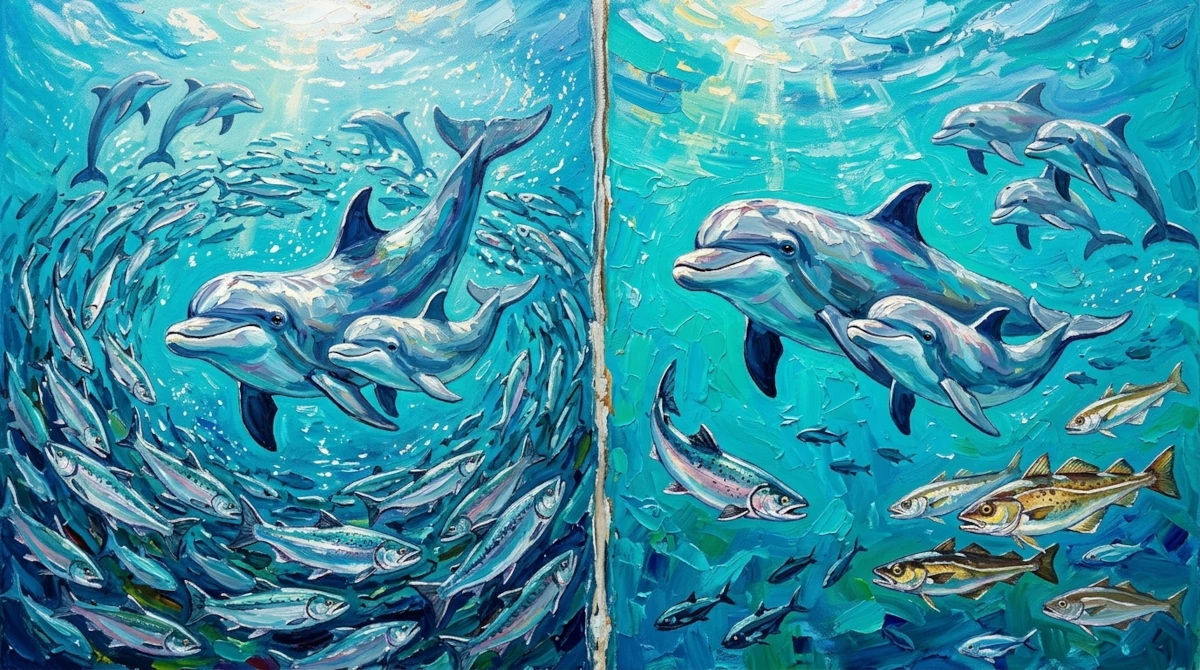
Picture a mother dolphin off the coast of Scotland’s Moray Firth. Some years, salmon run thick through the rivers that feed the firth where she lives. Other years, the fish barely show up at all. Common sense says she should lean harder on her social circle when times are lean, the way people lean on friends during a hard month. Scientists call that dolphin social plasticity, turning sociability up or down as salmon abundance rises and falls. For 35 years, researchers tracked hundreds of dolphins to test if it works. The answer was not what anyone expected.
A Question as Old as the Ocean
Wild animals cope with an unpredictable world in two basic ways. Some adjustments are slow and built into the body – a brown trout can quietly slow its own metabolism when food runs low, conserving energy until conditions improve. Others are fast and behavioral – a flock of goldcrests will crowd together on a freezing night, trading body heat to survive until dawn. Because behavior can shift almost instantly, scientists often call it an animal’s first line of defense against a harsh environment.
One of the more intriguing behavioral tools an animal has is its social life. The idea that animals lean on relationships to get through hard times – becoming more or less social as conditions demand – is known as social buffering. Think of it as a kind of friendship savings account, drawn on when the environment turns against you.
This idea has real support in some species: rhesus macaques and spotted hyenas that are more socially connected tend to survive better. But that evidence mostly shows that being social helps a species in general. It’s a harder, and rarer, thing to show that an individual’s ability to flex – dialing sociability up or down as conditions change – actually earns that individual more surviving offspring. That’s the specific question this study set out to settle, using one of the richest wildlife datasets in the world.
Thirty-Five Years of Watching One Population
Since 1990, researchers have tracked wild bottlenose dolphins (Tursiops truncatus) in Scotland’s Moray Firth, a Special Area of Conservation on the North Sea coast. Every dolphin’s dorsal fin carries a unique pattern of nicks and scars, letting scientists recognize the same individual across decades of sightings – a marine biologist’s version of a fingerprint.
By 2024, the project had produced:
- 35 years of continuous data (1990-2024)
- 13,259 individual sightings, across roughly 2,500 encounters
- Records covering more than 220 dolphins
- A pool of 100 known females for broad reproductive analysis
- A refined subset of 62 females, chosen for the most complete sighting histories, used for the detailed social analysis
Few wildlife studies run long enough to capture full animal lifetimes. This one did – which is what made it possible to ask not just “are social dolphins more successful,” but “does changing how social you are, as the world around you changes, actually pay off?”
Salmon Crash: The Test for Dolphin Social Plasticity
The environmental pressure driving the whole investigation is the Atlantic salmon (Salmo salar) – a calorie-rich meal for these dolphins, and a species in serious decline. Salmon numbers across the North Atlantic have dropped by roughly 70% over the past 25 years.
To measure how much salmon was actually available at any given time, researchers used rod-catch records from five rivers feeding the Moray Firth – the Alness, Beauly, Canon, Ness, and Nairn – building both a monthly and a yearly index of abundance. The monthly data could reveal quick behavioral reactions to a good or bad stretch. The yearly data mattered for a different reason: dolphin pregnancies last about a year, so a female’s reproductive success could plausibly depend on food conditions across her entire pregnancy, not just the month her calf was born.
Defining Success
Before asking whether social behavior affects reproduction, researchers needed a rigorous measure of reproductive success itself. They used calving success: the number of a female’s calves that survived past age two, divided by the number of years she spent as a reproductively active adult.
A birth was confirmed by watching for the “echelon position,” where a newborn calf surfaces tucked tight against its mother’s flank. But a birth alone didn’t count – since dolphin calves stay dependent on their mothers for at least two years, a calf only counted as a success once confirmed alive past that mark. Researchers used standardized rules to define each female’s reproductive window – generally starting at age eight, or the year of her first observed calf, whichever came first – so that dolphins with very different sighting histories could be compared fairly.
Mapping Who Swims With Whom
Bottlenose dolphins live in fission-fusion societies – groups constantly splitting apart and reforming, unlike a stable wolf pack or primate troop. That fluidity makes their social lives hard to map, so researchers used an approach called the “Gambit of the Group”: any two dolphins photographed in the same group counted as associated, with the strength of that bond scored by the Simple Ratio Index, from 0 (never seen together) to 1 (always seen together).
From thousands of these associations, two measurements emerged for each female:
- Strength – overall gregariousness, the sum of all her social bonds, weighted by how strong each one is.
- Closeness – how well-integrated she is into the entire population’s network, based on how many social “hops” separate her from any other dolphin, even ones she’s never directly associated with.
The population’s social structure wasn’t static, either: network maps from 2011 show a tightly interconnected community, while by 2021 that same community had visibly fractured into smaller sub-groups. A shift that large is exactly the kind of pattern that makes researchers suspect an environmental driver – like food scarcity – is reshaping social life behind the scenes.
Personality vs. Flexibility
A key move in this study was separating “how social a dolphin is” into two distinct traits.
Baseline sociability is a dolphin’s typical, average social behavior across her life – essentially her personality. Some dolphins are just naturally more outgoing than others, salmon or no salmon.
Plasticity is different: how much a dolphin changes her social behavior specifically as salmon abundance rises and falls. If baseline sociability is a dial permanently set to a level, plasticity is how far that dial swings as conditions shift. A highly plastic dolphin adjusts sharply as conditions change; a low-plasticity dolphin stays roughly the same regardless.
Social buffering theory makes a specific prediction about which direction that dial should swing: animals should lean harder on their social groups when times are hard, and ease off when food is plentiful – drawing on the “friendship savings account” precisely when they need it most. As it turns out, the Moray Firth dolphins do the opposite of what buffering theory predicts, a wrinkle the data revealed later on.
The study’s central bet was that plasticity – the flexible dial, not the fixed personality – would be the trait most closely tied to reproductive success.
To test that, researchers turned to a statistical approach called multivariate mixed-effect modeling, run through a Bayesian tool called MCMCglmm. The method mattered because it let them separate individual-level patterns from population-wide noise – avoiding a classic trap in ecology where a relationship that looks true for a population as a whole doesn’t actually hold for the individuals inside it. Practically, the model estimated three things for every dolphin at once – her baseline sociability, her personal degree of plasticity, and her lifetime calving success – and tested whether those three numbers moved together across the population.
The Verdict: Silence Across the Board
The results came back quiet, three separate ways.
Salmon abundance had no effect on reproduction. Despite the 70% crash in their primary prey, neither the current year’s nor the previous year’s salmon numbers had any detectable influence on whether a female successfully raised a calf. The one thing that did reduce her odds of calving again was simply having had a calf within the past two years – a biological recovery window, unrelated to food.
Sociable dolphins were no more successful than solitary ones. Females with high Strength or high Closeness scores showed no calving-success advantage over more reserved dolphins.
Flexible dolphins were no more successful than consistent ones. Dolphins who ramped their sociability up and down with salmon levels didn’t out-reproduce dolphins who kept a steady social routine regardless of conditions. The trait the study was built to test – plasticity – showed no measurable payoff.
One exception is worth flagging – and it’s the wrinkle mentioned earlier. Dolphins did become somewhat more social during especially salmon-rich months, not leaner ones. That’s the opposite of what social buffering would predict: rather than leaning on the group when food was scarce, these dolphins socialized more when food was plentiful and pulled back when it wasn’t. Short-term behavioral flexibility clearly exists in this population – it just runs the wrong direction for buffering, doesn’t show up at the yearly scale where it would need to operate to matter for long-term survival, and didn’t translate into a single extra surviving calf.
Could the Study Even Have Heard the Signal?
Faced with three null results, the researchers pushed further and asked a harder question: could their dataset have detected a real effect, if one existed?
To find out, they calculated the Minimum Detectable Correlation (MDC) – the smallest true relationship their data was capable of noticing, given its size and structure. The results were humbling.
For baseline sociability, the dataset could reliably detect only medium-to-strong relationships – roughly a correlation of 0.5 or higher. Anything weaker would likely have gone unnoticed whether or not it was real.
For plasticity specifically – the trait at the heart of the study – the picture was worse. In three of four comparisons, the detectable range fell entirely outside the normal statistical bounds of -1 to 1. In plain terms, the test wasn’t capable of confirming any realistic relationship between flexibility and fitness, strong or weak, even if one were genuinely there.
That’s a meaningful limitation. It reframes the null result: not proof that social plasticity doesn’t matter, but proof that proving it matters is extraordinarily difficult – even with one of the largest, longest-running datasets of its kind. It’s also a caution worth extending to the wider field: some past “no relationship found” conclusions about behavioral flexibility and fitness may reflect a limit of the math rather than a fact about the animals.
Why the Dolphins Might Not Need a Social Safety Net
Setting the statistics aside, the researchers offered ecological reasons why social flexibility might simply be unnecessary for this population.
They have other things to eat. When salmon run low, Moray Firth dolphins appear to switch to other prey – whiting, saithe, and cod. A dolphin with a backup dinner plan may not need to restructure her social life to survive a bad salmon year. Dietary flexibility, not social flexibility, may be doing the real buffering work here.
Nothing is hunting them. A major benefit of group living in many species is protection from predators – more eyes, more bodies, diluted risk. The Moray Firth is largely predator-free for dolphins; transient killer whales and other threats rarely appear in these waters. Remove the danger, and one of the classic incentives for tight grouping goes with it.
They don’t hunt as a team. Cooperative hunting boosts foraging success in some social species, but Moray Firth dolphins are frequently observed catching salmon alone. If teamwork doesn’t improve the odds of a meal, there’s little practical reason to seek out more company when food gets scarce.
Together, these point to a population whose resilience comes from ecological versatility – a flexible diet, a safe habitat – rather than social adaptability.
Two Kinds of Flexibility
A null result isn’t a failed study – ruling out a plausible explanation clears the way toward better questions. One promising direction lies in a distinction the researchers draw between two kinds of plasticity:
- Reversible plasticity – the kind measured here, where an adult dolphin adjusts her social behavior back and forth throughout life.
- Developmental plasticity – traits shaped early in life that lock in and persist, largely unchanged, into adulthood.
Research on a related species, the Indo-Pacific bottlenose dolphin (T. aduncus), suggests developmental plasticity can carry real, lasting consequences for lifetime fitness. That raises a genuine possibility: a dolphin’s reproductive fate may not hinge on how she adjusts her social life as an adult, but on patterns set once, early on, that quietly shape everything that follows. If so, this study – and much of the field – may simply have been looking in the wrong chapter of a dolphin’s life.
For conservation managers, that points toward two practical shifts. First, monitor the fuller mix of prey species – whiting, cod, saithe – that these dolphins actually rely on, rather than tracking salmon alone. Second, direct future research toward how young dolphins develop their social habits, rather than how adults adjust theirs in real time.
The Bottom Line
Thirty-five years of meticulous observation on one of the best-documented wild dolphin populations on Earth quietly refused to confirm a widely held assumption: that flexibility is automatically an advantage. A 70% collapse in the dolphins’ favored prey barely registered in their reproductive rates. Neither a dolphin’s natural sociability nor her willingness to adjust it predicted how many calves she successfully raised.
What the study did deliver, instead, is a sharper map of where to look next – toward diet, toward safety from predators, and toward the possibility that some of the traits shaping a dolphin’s life were set in motion long before she ever became a mother. Even an exceptional 35-year dataset, it turns out, may not be enough to catch a subtle fitness effect if one exists – a limitation worth remembering the next time a study claims to have ruled flexibility out.
Think you’ve mastered it? Test yourself with the 5-question quiz below – it only takes a minute.
Quiz: Do You Know Why a 70% Salmon Crash Didn’t Hurt Dolphins in the Moray Firth?

Source
Study: Examining the fitness benefits of social plasticity to prey availability in bottlenose dolphins
Authors: David N. Fisher, Barbara J. Cheney (2026)
Read the full paper: https://www.biorxiv.org/content/10.1101/2025.08.21.671441v3




Leave a Reply