

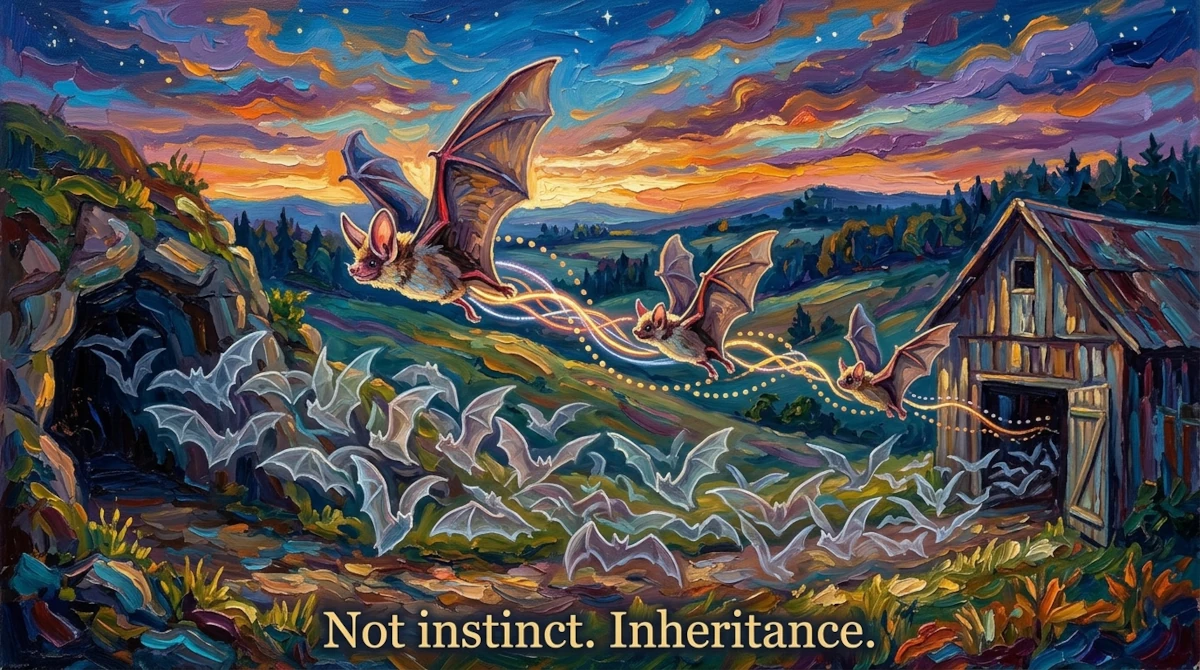
Picture a bat that has never once hibernated. It’s a few months old, born in a summer roost in Berlin or Brandenburg, Germany, and winter is coming. Somewhere out there, up to 246 kilometers away, is a cave or bunker with exactly the temperature and humidity it needs to survive the next several months. How does it find that place?
For a long time, nobody really knew. Now, after 38 years of tracking one of Europe’s largest bats – the Greater mouse-eared bat, or Myotis myotis – researchers have an answer: young bats don’t find these sites on their own. They’re shown the way by older, more experienced bats. And thanks to some clever detective work combining old-fashioned banding with modern electronic sensors, scientists finally have direct proof of it.
Two Theories on How Bats Find Hibernation Sites
Biologists had long debated two explanations for how bats find hibernation sites.
One idea was independent search: yearlings simply explore the area around their birth site on their own, gradually discovering suitable caves through trial and error, the way you might find a good coffee shop by wandering a new neighborhood.
The other idea was social transmission: young bats learn the locations from other bats – a kind of passed-down cultural knowledge, similar to how some birds learn migration routes by flying with experienced flockmates.
Telling these two apart required watching an enormous number of bats over an enormous stretch of time, because the behaviors in question are subtle and rare on any given night. That’s exactly what happened, starting in 1985.
Four Decades, Nearly 14,000 Bats
The data behind this research is staggering in scope. Researchers – many of them volunteer citizen scientists working with Germany’s Saxon State Office for Environment, Agriculture and Geology – banded and tracked bats for 38 straight years, generating:
- 30,882 observations
- 13,852 individually identified bats (7,369 females, 6,377 males, 106 of unknown sex)
- 351 roost sites, including 227 winter hibernacula, 103 summer maternity colonies, 122 other summer roosts, and 15 fall “swarming” sites – with 65 sites serving more than one of these purposes across the year
- 6,412 bats re-sighted more than once, including 184 individuals seen ten or more times – the repeat sightings that made it possible to trace individual bats’ choices across their lives, not just guess at population-wide averages
Because Myotis myotis can live up to 37 years, this timescale wasn’t overkill – it was necessary. A single bat’s lifetime can span nearly the entire length of the study, which means researchers could actually watch individual bats learn, switch locations, and pass information to the next generation.
Clue #1: The Girls Aren’t Searching Nearby
The first sign that something more than random exploration was going on came from a simple comparison: how close was a yearling’s first hibernaculum to where it was born?
If bats searched independently, you’d expect them to try nearby sites first. That’s roughly what happened with males – 72% of male yearlings picked the closest available hibernaculum. But female yearlings told a completely different story: only 29% chose the nearest site. Even more telling, female yearlings ended up hibernating farther from home than they would later on as adults – backwards from what a simple expanding search would predict.
Something was pulling young females toward specific, distant locations. That something turned out to be other bats.
Clue #2: Yearlings Travel With Their Elders
Researchers tracked 931 cases of yearlings moving from their summer birth colony to their very first winter hibernaculum. In 39% of those cases, the yearling ended up at the exact same site as an adult bat from its home colony – a striking overlap that vastly exceeds what you’d expect if each bat were choosing independently.
Clue #3: Even Adults Keep Learning From Each Other
Social learning isn’t something bats grow out of once they survive their first winter. Researchers specifically looked for “co-switches”: cases where two adult bats were seen roosting together at one hibernaculum, then – in a later winter – turned up together again at a different hibernaculum, as if one had learned about a new site and brought the other along. They found 34 such cases, roughly double the rate you’d expect if each bat in the pair had simply relocated on its own by chance.
That matters for two reasons. First, it means the flow of information isn’t strictly top-down, from old to young – grown bats are still trading tips with roost-mates their own age, updating their mental maps as sites open up, degrade, or become unsuitable. Second, it hints at how new discoveries might spread through a population in the first place: an adult that stumbles onto a previously unknown site doesn’t just benefit personally – it can become a new source of knowledge for others, including the yearlings who may later follow it.
Clue #4: Summer Friendships Predict Winter Addresses
Here’s a number that captures the whole pattern in one comparison: bats that were never seen together in a summer roost had roughly a 4.7-5% chance of sharing a winter hibernaculum. Bats that were seen roosting together in summer had a 12% chance – more than double.
Whatever social bonds or associations formed during the summer were carrying over into decisions about where to spend the winter.
Clue #5: Caught on Sensor, Mid-Flight
The clearest evidence of all came from a 2022 experiment using modern tracking technology. Researchers attached small sensors to 40 bats and installed automatic tracking stations at seven hibernacula. What they recorded reads almost like a nature documentary: a mother, her own yearling pup, and a third, unrelated yearling repeatedly showed up at the same hibernacula within seconds of each other – sometimes as little as 4 seconds apart, never more than about 90. The trio would linger at each site for 6 to 72 minutes, then leave together, often departing within 33 seconds of one another.
And crucially, this was happening in late July and early August – months before any of these bats actually needed to hibernate. They weren’t scrambling for shelter. They appear to have been on a preview tour, learning the map well ahead of time.
The fact that an unrelated yearling was part of these trips is a key detail. It means this knowledge isn’t just staying within family lines – it’s spreading more broadly through the colony, available to any young bat that happens to be along for the ride.
It’s worth being clear-eyed about the scale of this particular piece of evidence: it comes from 40 tagged bats at seven sites over one season, not the full 38-year dataset. It’s the most vivid evidence in the study – the moment a statistical pattern becomes something researchers could watch happen in close to real time – but it’s a small, targeted snapshot layered on top of the much larger banding dataset, not a large-sample result in its own right.
So What Are Maternity Colonies, Really?
Put all five of these findings together, and a new picture of the summer maternity colony emerges. It’s not simply a nursery where mothers raise pups until they’re old enough to fly. It functions as something closer to a library or a school – a place where decades of accumulated knowledge about the surrounding landscape gets stored in the bodies and memories of long-lived adults, and where that knowledge gets handed down to the next generation almost automatically, just by growing up in that social environment.
Researchers call this the Information Center Hypothesis, and this study is described as the first clear, compelling evidence for it in this species.
Worth noting: most of the evidence here is correlational rather than experimental. Researchers observed which bats roosted, traveled, and hibernated together – they didn’t (and, practically, couldn’t) run controlled trials where some yearlings were deliberately isolated from adults to see if they failed to find a site. The patterns are consistent and mutually reinforcing across five independent lines of evidence, which is what makes the case strong, but alternative explanations (like unmeasured environmental factors that happen to draw related or familiar bats to the same places) are hard to fully rule out with observational data alone.
A Quick Note on “Swarming”
You may have heard of bat “swarming” – the dramatic gatherings of bats flying around cave entrances in autumn. In many species, this is tied to mating. But Myotis myotis mates in a different system entirely, with males holding separate territories that females visit specifically for that purpose. That frees swarming up to serve mostly as a final, late-season refresher course – reinforcing site locations that yearlings, as it turns out, had already begun learning back in July.
Why This Actually Matters
This isn’t just a neat behavioral discovery – it has real stakes for how these bats survive a changing world. Hibernation sites aren’t guaranteed to last forever. Caves collapse, buildings get renovated, climates shift, and human development alters the landscape. A species that only “knew” its hibernation sites through blind instinct would be stuck if a site vanished.
But a species that continuously shares and updates knowledge – where adults find new sites and bring others along, where yearlings get scouted through multiple options before they ever need them – has something like a built-in backup system. Researchers describe this social knowledge as a kind of “second inheritance system,” working alongside genetics to help populations adapt faster than evolution alone could manage.
The Conservation Angle
This has a direct implication for how we protect bats. Conservation efforts have traditionally zeroed in on hibernacula – they’re easy to find and count, since you can walk into a cave in winter and tally sleeping bats. But if the findings here are right, that’s only half the job. Destroying or disturbing a summer maternity colony doesn’t just cost that year’s crop of pups – it potentially breaks a chain of learning that took years to build, cutting off future generations from knowledge they’d otherwise have inherited for free.
Protecting bats, in other words, may mean protecting classrooms as much as bedrooms.
The Takeaway
Thirty-eight years of patient, mostly volunteer-driven fieldwork – plus a few years of high-tech sensor tags – answered a question that had puzzled naturalists for a very long time. Young mouse-eared bats aren’t wandering blindly into winter. They’re being shown the way, sometimes by their mothers and sometimes by bats they’re not even related to, on scouting trips that happen months before they’re needed. The summer colony isn’t just where bats are born. It’s where they learn how to survive.
Think you’ve mastered it? Test yourself with the 5-question quiz below – it only takes a minute.
Quiz: Do You Know How Baby Bats Find Their First Hibernation Cave?

Source
Study: Socially transmitted knowledge of hibernation sites in bats
Authors: Simon Ripperger, Gerald G. Carter, Lutz Ittermann, Jörg Harder, Brigitte Kaltofen, Robert Henning, Karsten Dedek, Paul Voigt, Ahana Aurora Fernandez (2026)
Read the full paper: https://www.biorxiv.org/content/10.64898/2026.08.06.743314v1







Leave a Reply