

A Question About Growing Up in Chaos
Every parent worries about how their children’s social environment will shape who they become. Will changing schools hurt their development? Does growing up with constantly shifting friendships affect their ability to manage emotions and control impulses? These aren’t just human concerns – they’re fundamental questions about how social experiences wire the developing brain.
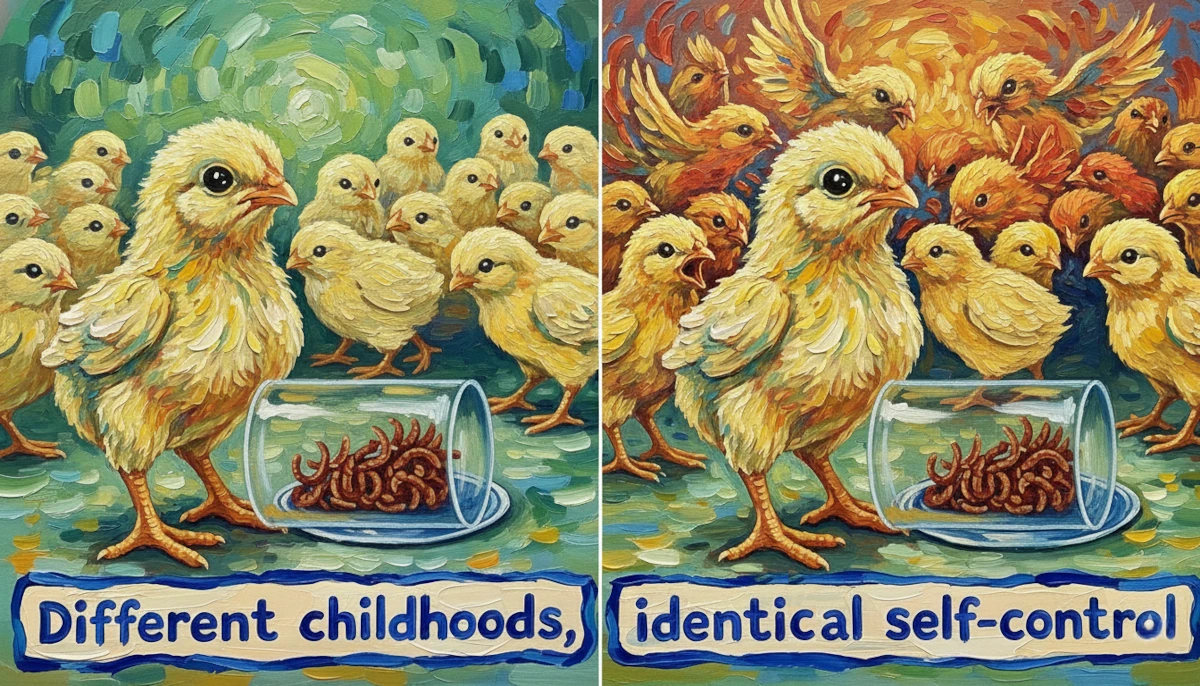
Scientists recently explored this question by studying chicken social instability. By deliberately creating social chaos in the lives of young chicks, they hoped to understand whether an unstable social world affects not just behavior, but the very architecture of self-control in the brain. What they discovered challenges some basic assumptions about how social life shapes the mind.
The Setup: Creating Chicken Social Instability
The experiment was elegantly simple in design but profound in its implications. Researchers took 144 slow-growing broiler chicks and, starting when they were just over a week old, divided them into two fundamentally different social worlds.
The Stable Path: Half the chicks experienced what we might call a “normal” childhood for chickens. They were housed in groups of nine, and while they moved to clean enclosures every four days (for hygiene and experimental control), they always moved with the same eight companions. Day after day, they woke up to the same faces. They learned who to avoid, who would share food peacefully, and where they stood in the social hierarchy. By the end of three weeks, these were chickens who knew their world.
The Unstable Path: The other half experienced something quite different. Every four days – about five times over the course of the experiment – their entire social world was scrambled. Each time, they were placed with eight completely unfamiliar individuals. Just as they began to figure out the pecking order in one group, they’d be thrust into another group of strangers where the whole process had to start over. These chicks encountered dozens of different individuals, living in a state of perpetual social flux from day 8 to day 28 of their lives.
This manipulation created an extreme version of something that happens naturally in many species, where group composition shifts regularly as animals move between subgroups throughout the day or season. But for chickens – who naturally prefer stable flocks – this was genuine social disruption.
Three Concepts That Connect Social Life to the Mind
To understand what the researchers were really testing, we need to grasp three interconnected ideas:
Social Complexity and Instability
When scientists talk about “social complexity,” they’re referring to environments where individuals encounter lots of different social interactions and scenarios. One major form of complexity is instability – when the cast of characters keeps changing. The hypothesis driving much recent research is that complex social worlds demand more from the brain, potentially driving the evolution and development of enhanced cognitive abilities. It’s called the “social intelligence hypothesis,” and it suggests that the challenges of group living make us smarter.
Aggression as Social Currency
Among chickens, aggression isn’t random violence – it’s a tool for social organization. When chickens establish dominance hierarchies (the famous “pecking order”), they’re actually creating a system that reduces future conflict. Once everyone knows who’s in charge, there’s less need to fight. But getting to that point requires some aggression: pecking, chasing, and occasionally full-blown fights where birds jump at each other with flapping wings.
The catch is that aggression is costly. It burns energy, risks injury, and creates stress. So animals need to be able to regulate it – to turn it on when necessary and turn it off when it’s not.
Response Inhibition: The Brain’s Brake System
Here’s where cognition enters the picture. Response inhibition is the technical term for impulse control or self-control. It’s your brain’s ability to suppress an automatic or inappropriate action. When you stop yourself from blurting out something rude, resist checking your phone during a conversation, or avoid eating that entire cake – that’s response inhibition at work.
Scientists consider it a cornerstone of executive function, the set of mental skills that let us plan, focus, and regulate our behavior. And here’s the key connection: many researchers believe that response inhibition is especially important for managing aggression in social situations. If you can’t inhibit the impulse to attack when challenged, you’re going to have trouble living in a group.
The Central Question: Does Social Chaos Break the Brain’s Brakes?
The researchers had good reasons to predict that growing up in social instability would impair response inhibition. Their reasoning went like this:
The unstable social environment would create constant challenges – new hierarchies to establish, new individuals to evaluate, unpredictable social dynamics. This should elevate aggression. And if managing all that aggression doesn’t strengthen impulse control, it might actually erode it. In a chaotic, competitive world where resources are uncertain, maybe being impulsive – grabbing what you can when you can – is actually adaptive. Maybe the brain learns that hesitation means hunger.
There was an alternative prediction too: perhaps social complexity would enhance response inhibition, strengthening the brain’s brakes to help manage all that social conflict. Different studies in different species had found evidence for both possibilities.
The only way to know for sure was to test it directly.
Measuring Self-Control in a Bird: Two Ingenious Tests
You can’t give a chicken a questionnaire about its impulse control, so the researchers designed two behavioral tests that reveal self-control through actions:
The Frustration Test (Thwarting Task)
Picture this: a chicken can see a bowl of delicious food through a wire mesh barrier. The food is visible, tantalizingly close, but completely inaccessible. There’s no solution to this problem – no clever way to reach the food. A chicken with good self-control will quickly recognize the futility and stop trying. An impulsive chicken will keep pecking at the barrier, wasting time and energy on an impossible task.
The researchers measured how long each bird spent pecking at that barrier. Less time meant better inhibition – better ability to recognize a dead end and move on.
The Detour Test (Cylinder Task)
This test is more sophisticated because there actually is a solution. Researchers placed mealworms (a chicken delicacy) inside a transparent cylinder that was open at both ends. When a chicken looks straight at the food, the obvious move is to peck directly at the clear wall where the worms are visible. But that doesn’t work – you just peck plastic.
The smart strategy requires inhibiting that direct, impulsive peck and instead taking a small detour to reach through one of the open ends. It’s not physically difficult once you figure it out, but it requires overriding your first instinct.
Each chicken got ten attempts at this task, so the researchers could track whether they learned to improve their self-control over time. Would the birds get better at resisting the direct peck? And would birds from different social backgrounds learn at different rates?
First Result: Chicken Social Instability Increases Aggression
When the researchers observed the chickens on the final day of the social manipulation – day 28 – they saw exactly what common sense would predict, at least initially.
In observation sessions conducted immediately after the groups were mixed for the last time, the unstable groups were significantly more aggressive than the stable groups. They showed:
- More frequent pecking attacks aimed at other birds’ heads and necks
- More time spent chasing each other around the enclosure
- More time engaged in mutual fighting – that jumping, wing-flapping, pecking combat that chickens do when both parties are committed to battle
This pattern made perfect sense. The unstable birds were facing unfamiliar individuals yet again. They needed to quickly establish a new pecking order, to figure out who was dominant and who was subordinate. Aggression is the mechanism through which chickens sort this out.
But here’s what’s remarkable: when the researchers returned just two hours later to observe the same groups, the aggression had evaporated. The unstable groups’ aggression levels had dropped precipitously and were now statistically indistinguishable from the stable groups.
In other words, despite all that social chaos, despite encountering unfamiliar individuals dozens of times over three weeks, these chickens were remarkably efficient at establishing order. They’d fight it out briefly, then settle down and coexist peacefully. The spike in aggression was intense but fleeting.
This finding was interesting on its own, but it was really just setting the stage for the main question.
The Stunning Result: Social Chaos Doesn’t Touch Self-Control
Over the two weeks following the end of the social manipulation, every chicken was tested on both the thwarting task and the cylinder task. The researchers carefully analyzed the data, looking for any hint that the social environment had shaped cognitive abilities.
The result was unequivocal: there was no effect whatsoever.
What the Data Showed
Thwarting Task: Birds from stable groups and unstable groups spent exactly the same amount of time pecking at the barrier to the inaccessible food. The social environment hadn’t made them any more or less able to recognize and abandon a futile effort.
Cylinder Task: The results here were even more detailed, and they all pointed in the same direction – no difference:
- Both groups achieved the same rate of successful trials (getting the food without pecking the cylinder)
- Both groups spent the same amount of time pecking at the transparent walls
- Both groups showed learning across the ten trials – they got better with practice
- The rate of learning was identical between the two social conditions
The researchers checked for other influences. Perhaps sex mattered – were male chickens different from females? No. Perhaps physical condition mattered – were bigger, healthier birds better at the tasks? No. Perhaps motivation mattered – were hungrier birds more impulsive? No.
No matter how they sliced the data, the social instability that had clearly affected aggression had left no trace on cognitive performance.
Going Even Deeper: What About Individual Differences?
Maybe the group-level comparison was masking something important happening at the individual level. Perhaps within each group, the most aggressive chickens would show poor impulse control while the peaceful ones would show good control, regardless of whether they came from stable or unstable groups.
To test this, the researchers created detailed behavioral profiles for each individual chicken, categorizing them based on:
- How often they initiated aggression (pecks given, chases initiated, fights started)
- How often they received aggression (pecks received, times chased, times attacked)
- Their overall role in the social dynamics
Then they checked whether these individual aggression profiles correlated with performance on the self-control tasks.
The answer, once again, was no. A chicken that was highly aggressive – frequently pecking others and starting fights – performed no differently on the inhibition tasks than a chicken that was passive and frequently victimized. Individual variation in social behavior simply didn’t predict individual variation in cognitive control.
Explaining the Unexpected: Why Didn’t Social Life Shape the Brain?
This finding poses a genuine puzzle. Based on theory and previous research in other species, there were good reasons to expect an effect. So why didn’t it appear? The researchers propose several thoughtful explanations:
1. Species Matter More Than We Thought
The broiler chickens used in this study, even the slower-growing variety bred for higher activity levels, are relatively socially tolerant birds. That rapid decline in aggression – from fighting to peace in just two hours – reveals this tolerance. They’re good at quickly establishing hierarchies and then coexisting.
Compare this to other species where links between social complexity and cognition have been found. In some fish, birds, and primates with more rigid or aggressive social structures, social instability might create longer-lasting stress and conflict. In those species, the pressure to manage aggression might be strong enough and sustained enough to actually shape brain development.
The lesson: we can’t assume that findings from one species will apply to another. The chicken’s particular brand of sociality – tolerant, quick to organize, efficient at conflict resolution – may mean they simply don’t need enhanced response inhibition to navigate social instability.
2. Social Smarts Don’t Transfer to Non-Social Problems
This is perhaps the most conceptually important finding. The study provides strong evidence for what scientists call “domain-specificity” – the idea that abilities developed in one context don’t automatically transfer to other contexts.
The social manipulation clearly affected behavior in the social domain. Chickens from unstable groups showed different aggression patterns when interacting with other chickens. It’s very likely their brains had adapted to the unstable environment, possibly becoming better at:
- Quickly assessing unfamiliar individuals
- Rapidly determining their place in a new hierarchy
- Flexibly adjusting social strategies to different group compositions
- Reading subtle social cues and responding appropriately
But these potential enhancements to social cognition didn’t transfer to the non-social tasks. When tested individually, with no other chickens present, solving a purely physical problem about how to get food past a barrier, the chickens from different backgrounds performed identically.
Think about it in human terms: becoming excellent at reading people, navigating office politics, and managing complex social relationships doesn’t automatically make you better at solving math problems or resisting the urge to check your phone. These are different mental systems, and they can develop somewhat independently.
The researchers’ tests measured response inhibition in a non-social context. If they had tested social response inhibition – say, the ability to inhibit aggression in specific social situations – they might have found effects.
3. The Challenge May Have Been Too Brief
Because the chickens resolved their conflicts so efficiently, the unstable environment may not have created sufficient pressure to drive changes in fundamental, domain-general cognitive abilities like response inhibition.
The aggression spikes lasted hours, not days. The social challenges, while frequent, were brief. Perhaps in a less socially tolerant species, or with an even more extreme manipulation (changing groups daily instead of every four days, or extending the manipulation for months instead of weeks), the cognitive effects would emerge.
Alternatively, maybe there were cognitive effects that dissipated over time. The inhibition testing began after the social manipulation ended and continued for two weeks. Perhaps temporary impacts on cognitive control had already faded by then.
4. Different Types of Self-Control Matter in Different Ways
Response inhibition isn’t the only form of self-control. There’s also delayed gratification (waiting for a better reward), attentional control (maintaining focus despite distractions), and what some researchers call “strategic self-control” – the ability to regulate behavior to achieve longer-term social goals.
Some research suggests that these strategic, social forms of self-control are more tightly linked to social demands than the kind of response inhibition measured in these tasks. Perhaps social instability does affect self-control, just not the particular type these tests measured.
What This Means for Our Understanding of Development
This study matters because it challenges a seductive, simplifying narrative about brain development. The popular version of the social intelligence hypothesis suggests that social complexity generally makes animals smarter, strengthening cognitive abilities. This study shows that reality is more nuanced.
The Complexity of Cognitive Development
Development isn’t a single process that makes the brain uniformly “better” or “worse” in response to environmental conditions. The brain is a collection of specialized systems, each potentially responding differently to the same experiences. Social experiences may sharpen social abilities without affecting non-social cognition, or vice versa.
This has profound implications for how we think about enrichment, education, and development – in animals and potentially in humans too. Experiences matter, but they matter in specific ways that depend on:
- The species’ natural social system: Chickens aren’t guppies aren’t primates
- The specific nature of the environmental challenge: Brief conflict versus sustained stress
- The domain of ability being measured: Social versus non-social tasks
- The timing of both exposure and testing: Early versus late, temporary versus permanent effects
Resilience and Robustness
There’s another way to interpret these findings that’s equally important: they reveal remarkable resilience. Despite experiencing significant social disruption during a critical developmental period (the first month of life), these chickens maintained healthy cognitive functioning. Their brains developed normally in terms of basic executive functions like response inhibition.
This speaks to the robustness of development – the fact that organisms have buffering mechanisms that protect essential functions from environmental perturbations. Not every environmental challenge leaves a permanent mark on every system.
Practical Implications for Chicken Management
While this was a basic science study aimed at understanding fundamental principles, it has practical takeaways for anyone who raises chickens:
Expect a Brief Storm: When you need to mix flocks or introduce new birds, aggressive behavior is normal and predictable. The chickens aren’t being unreasonably violent – they’re doing what they need to do to establish social structure.
But It Passes Quickly: At least in young broiler chickens during their first month of life, that aggressive period is brief. Within a couple of hours, you can expect things to calm down substantially. This rapid resolution suggests that occasional mixing during this early developmental period isn’t causing sustained distress or harm to the birds.
No Cognitive Damage: The unstable environment didn’t impair the chickens’ cognitive development or learning abilities. While frequent mixing does cause repeated social challenges, it doesn’t appear to damage their brains or mental functioning.
Context Matters: These findings come from young chicks (days 8-28 of life), groups of nine birds, and slow-growing broilers. Different results might emerge with adult birds, different group sizes, or other breeds with different temperaments – especially more aggressive or less socially tolerant breeds.
The Broader Lesson: When Science Surprises Us
This study began with a clear hypothesis derived from solid reasoning and previous research. The fact that the hypothesis wasn’t supported doesn’t make the study a failure – it makes it valuable. Negative results, when they’re carefully documented and clearly explained, advance science by showing us where our theories need refinement.
The chickens taught us that:
- Correlation doesn’t imply causation across contexts: Just because social complexity relates to cognitive abilities in some species doesn’t mean it will in all species
- Domain-specificity is real: Changes in social behavior don’t automatically imply changes in non-social cognition
- Species differences matter profoundly: The particular social system of a species shapes how they respond to social challenges
- Resilience is as important as plasticity: Organisms can maintain healthy development despite environmental challenges
Conclusion: Embracing Complexity
The relationship between early-life experiences and brain development is one of the most important questions in biology, psychology, and neuroscience. Simple answers are appealing: “Social complexity makes you smarter” or “Early stress damages the brain.” But biology rarely offers simple answers.
This study of chickens living through social chaos reveals a more intricate truth. Yes, the social environment matters – it shaped aggressive behavior in clear and predictable ways. But its influence was bounded, specific to the social domain, and didn’t cascade into every cognitive system.
Understanding development means grappling with this complexity. It means recognizing that the brain isn’t a single organ that gets uniformly upgraded or damaged by experience, but rather a collection of specialized systems that each have their own developmental trajectories and sensitivities.
The chickens and their cylinders have given us a gift: they’ve shown us where our theories fall short and pointed us toward more sophisticated questions. Not “does social life shape the brain?” but “which aspects of social life shape which aspects of the brain, in which species, under which conditions, and with what lasting effects?”
That’s a much harder question to answer. But it’s also much closer to the truth.
Think you’ve mastered it? Test yourself with the 5-question quiz below – it only takes a minute.
Quiz: Can You Survive the Pecking Order?

Source
Study: Early-life social instability affects aggression, but not response inhibition, in chickens
Authors: Kathryn Willcox, Alizée Vernouillet, Birgit Szabo, An Martel, Luc Lens, Frederick Verbruggen (2025)
Read the full paper: https://www.biorxiv.org/content/10.1101/2025.10.29.685273v1








Leave a Reply