


Every summer, the same family of plants – apples, roses, cherries, blackberries – faces the same brutal math: pull water up from the ground fast enough to survive, without breaking the very pipes that carry it. New research into eight of these relatives shows they’ve arrived at two very different answers, and that the trick isn’t just in the wood, but in a hidden partnership with the bark wrapped around it.
So how do trees survive drought, exactly? The answer, it turns out, isn’t found in the wood alone. A new study of eight species in the rose family reveals that wood and bark function as a single, coordinated system – one tuned specifically to the daily stress of dry air, not just dry soil.
A Tree Is More Than a Pipe With Bark On It
For a long time, scientists trying to understand how trees survive drought mostly looked at one thing: the wood. Specifically, they studied the xylem – the internal network of tiny tubes that hauls water up from the roots to the leaves, fighting gravity the whole way. That focus made sense, since a tree that can’t move water can’t survive. But new research on eight temperate woody species in the rose family (Rosaceae) shows that this story is incomplete. Bark isn’t just a passive wrapper protecting the wood underneath. It’s an active partner, and the two tissues are tuned together as a single coordinated system.
The study looked at five tree species and three shrub species:
Trees: Apple (Malus domestica), Sweet Cherry (Prunus avium), Cherry Plum (Prunus cerasifera), Bird Cherry (Prunus padus), and Rowan (Sorbus aucuparia).
Shrubs: Blackthorn (Prunus spinosa), Dog Rose (Rosa canina), and Blackberry (Rubus fruticosus).
Comparing these eight species side by side is what let researchers see that wood and bark aren’t evolving independently – they’re evolving as a matched set. This matters because it changes how we think about which trees and shrubs can handle a hotter, thirstier climate, and why some very “vulnerable-looking” species turn out to be remarkably resilient.
The Basic Plumbing Problem
Think of the xylem as a bundle of drinking straws running from root to leaf. Water is pulled up under tension, almost like sucking a milkshake through a very long straw. That tension is risky: if it gets too strong – which happens when the air is hot and dry – the water column can literally snap, letting an air bubble form inside the tube. This is called an embolism, and it’s the tree equivalent of an air lock in a fuel line. Once a tube is blocked by an air bubble, it stops carrying water. Enough blocked tubes, and branches start dying back; enough of that, and the whole tree can die.
Every tree faces a basic trade-off inside its wood. It can move water quickly and efficiently, which helps it grow fast – but efficient plumbing tends to be more fragile. Or it can build tougher, safer wood that resists damage under stress – but that safety usually comes at the cost of speed. Trees have to choose somewhere on that spectrum.
Scientists measure the safety side of that trade-off with a number called P50: how much tension the water inside the wood can withstand before the stem loses half its water-carrying capacity. The more negative the P50, the more tension the wood can take before it starts to fail – meaning tougher, more drought-resistant wood, but usually at the cost of how fast it can move water.
Two Ways Trees Survive Drought: Avoidance vs. Tolerance
Faced with the risk of embolism, plants have evolved toward one of two broad strategies.
Embolism avoidance species build extra-tough xylem and close their pores (stomata) early to avoid ever getting close to the danger zone. Think of this as playing it safe – armor over speed.
Embolism tolerance species accept that some air bubbles will form, but they’re built to recover fast – using efficient plumbing to grow quickly, and relying on rapid rehydration and stored sugars to refill or regrow blocked tubes once conditions improve.
Here’s where the story gets interesting: the new research shows that the bark’s structure is not decided independently of this choice. It’s built to match it.
Bark: The Tree’s Skin, Insulation, and Water Tank All in One
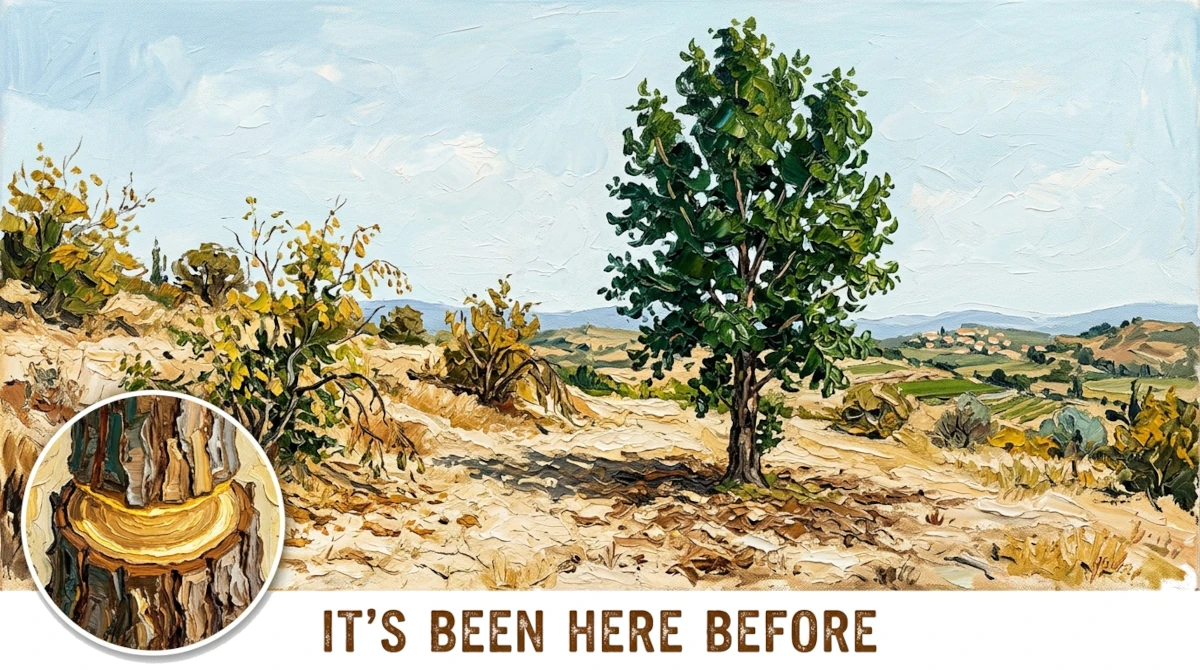
Bark is actually a stack of several different tissues, all produced by two growth layers. The vascular cambium, the main growth engine, produces new wood (xylem) on the inside and new inner bark (secondary phloem) on the outside. Further out, a second growth layer called the phellogen (or cork cambium) produces the phellem, better known as cork – the tree’s outermost, waterproofing shield. The phellem is soaked in a waxy substance called suberin, which makes it nearly waterproof, with small pores called lenticels acting as “breathing windows” so the living tissue underneath can still exchange gases.
Because wood and bark both originate from tissue that has been evolving together since plants first grew cambium layers – roughly 400 million years ago – it turns out their properties evolved in lockstep, not independently.
Bark matters for drought in two main ways. First, insulation: thicker cork acts like a diffusion barrier, slowing the rate at which water vapor leaks out of the stem into the air. Scientists measure this leakiness as bark water vapor conductance, or G-bark. Thicker phellem means lower G-bark – a stem that holds onto its water better. Second, storage: thicker bark overall (cork plus the layers beneath it) can act like a built-in water tank, buffering the tree against daily dips in water pressure. The catch is that a bigger tank takes longer to refill.
The Surprising Discovery: Leaky Bark Pairs With Risky Wood
Across the eight species studied, researchers found that stems with more efficient but more embolism-vulnerable xylem (higher, less-negative P50) tend to also have more permeable bark (higher G-bark). In other words, the “riskier” the plumbing, the “leakier” the outer shield – and this isn’t a coincidence, it’s a coordinated package.
Why would a plant pair vulnerable plumbing with leaky insulation, which sounds like the worst of both worlds? The answer lies in a second bark superpower: hygroscopic rehydration – the ability to absorb water vapor directly from humid night air, without going through the roots at all. Researchers found a clear pattern: species with leakier bark also rehydrate faster. Two shrubs in the study, Dog Rose (Rosa canina) and Blackthorn (Prunus spinosa), can refill most of their bark’s water storage in under 10 hours overnight. That absorbed moisture doesn’t just sit in the bark; it can be shuttled inward to help repair the very embolisms that vulnerable xylem is prone to forming, or to fuel new xylem growth.
So the “leaky, risky” combination is really a recovery-focused strategy: lose some ground during the day, and win it back at night.
Why Cork Cells Look So Different Between Species
Under the microscope, this same split shows up in the physical structure of the cork itself. The Prunus species – Sweet Cherry, Cherry Plum, Bird Cherry, and Blackthorn – tend to grow lots of thin-walled cork cells, which are cheap to build and quick to let vapor pass in and out. That’s the anatomical basis for the fast overnight recharge described above, and it’s most pronounced in Blackthorn. Apple and Rowan instead grow fewer, thick-walled cork cells packed with phenolic compounds (natural, protective plant chemicals), which raises resistance to water loss – a good match for the avoidance strategy. Blackberry (Rubus fruticosus) is an interesting outlier: it grows its cork deeper within the cortex layer, giving it a distinct twist on the recovery-focused approach even though it’s a shrub like Dog Rose and Blackthorn.
Notably, bark traits vary far more between species than xylem safety does. Researchers measured this using a statistic called the coefficient of variation (how spread out values are relative to their average): xylem vulnerability (P50) barely varies between the eight species, while traits like how fast bark rehydrates, how thick the cork is, and how leaky the bark is vary substantially. Bark, in other words, is where a lot of the fine-tuning to local conditions happens.
It’s Not About Rain – It’s About Thirsty Air
Perhaps the most counter-intuitive finding involves what’s actually driving these differences between species. The traditional assumption has been that plants in drier soil evolve the toughest, safest wood. This study found something different: the strongest predictors of both xylem and bark traits weren’t measures of rainfall at all – they were temperature, vapor pressure deficit (VPD), and isothermality.
Vapor pressure deficit (VPD) is essentially a measure of how “thirsty” the air is – the gap between how much moisture the air could hold and how much it actually holds. High VPD pulls water out of leaves and stems more aggressively. Isothermality compares how much temperatures swing during a single day to how much they swing across the whole year. High isothermality means big day-to-night temperature (and humidity) swings relative to the seasonal pattern.
Here’s the surprising part. You’d think plants in drier soil would evolve the safest, toughest wood. But some of the warm-climate species in this study actually grow in places that get more rain than the cooler-climate species do – and they still evolved the riskier, faster-recovering strategy anyway.
That tells researchers something important: it’s not how much water is in the soil that matters most. It’s how hard the air pulls water out of the plant each day. Warm air with low humidity does this aggressively, even where rain is plentiful. This pattern is called “VPD-filtered”: species aren’t evolving to avoid ever losing water. They’re evolving to survive the daily grind of dry air pulling at them, no matter how wet the ground beneath them is.
The logic connects back to isothermality specifically: where days are hot and nights are cool and humid, there’s a reliable nightly window for hygroscopic recovery. That reliable window is what makes the “leaky bark, efficient-but-risky wood” strategy pay off – and it helps explain why the three shrub species in the study (Dog Rose, Blackthorn, and Blackberry) lean toward the tolerance end of the spectrum, while the tree species tend to sit closer to the avoidance end. In steadier, cooler climates without that daily swing, there’s less to be gained from a recovery-based strategy, and more benefit from simply not losing water in the first place – hence thick, insulating bark and tough, safe wood.
Some Traits Are Deeply Ancestral, Others Are Flexible
The study also asked a deeper question: how much of this variation comes from shared ancestry, and how much is each species adapting fresh to its own environment? To find out, the researchers used a statistical measure called Pagel’s λ, which shows how closely related species resemble each other on a given trait.
Some traits turned out to be strongly inherited – closely related species tend to share similar values. These include xylem vulnerability (P50), bark leakiness (G-bark), and hygroscopic capacity. Other traits are far more flexible, varying a lot even between close relatives. These include hydraulic conductivity, how fast bark rehydrates, and raw bark thickness. In fact, even within the Prunus genus alone – which contributed four of the eight species (Sweet Cherry, Cherry Plum, Bird Cherry, and Blackthorn) – these flexible traits differ a great deal from one species to the next.
This tells us that while the overall avoidance-versus-tolerance body plan tends to run in the family tree, individual species can still fine-tune specific dials – like exactly how thick their bark is, or how quickly it drinks in moisture – to match their particular home climate.
Two Strategies, Not Two Rulebooks
It’s tempting, looking at this study, to draw a simple line: trees play it safe, shrubs take risks. And in this particular set of eight species, that pattern does hold – the five trees (Apple, Sweet Cherry, Cherry Plum, Bird Cherry, Rowan) sit closer to the avoidance end, while the three shrubs (Dog Rose, Blackthorn, Blackberry) sit closer to the tolerance end. But it’s worth being careful here: it’s the underlying physiology – xylem safety, bark permeability, rehydration speed – that’s doing the causal work, not growth form itself. Tree versus shrub is a correlation the researchers observed in this dataset, not the mechanism driving the strategy. A shrub growing in a cooler, steadier climate, or a tree adapted to a hot, high-VPD one, could in principle land anywhere along the spectrum.
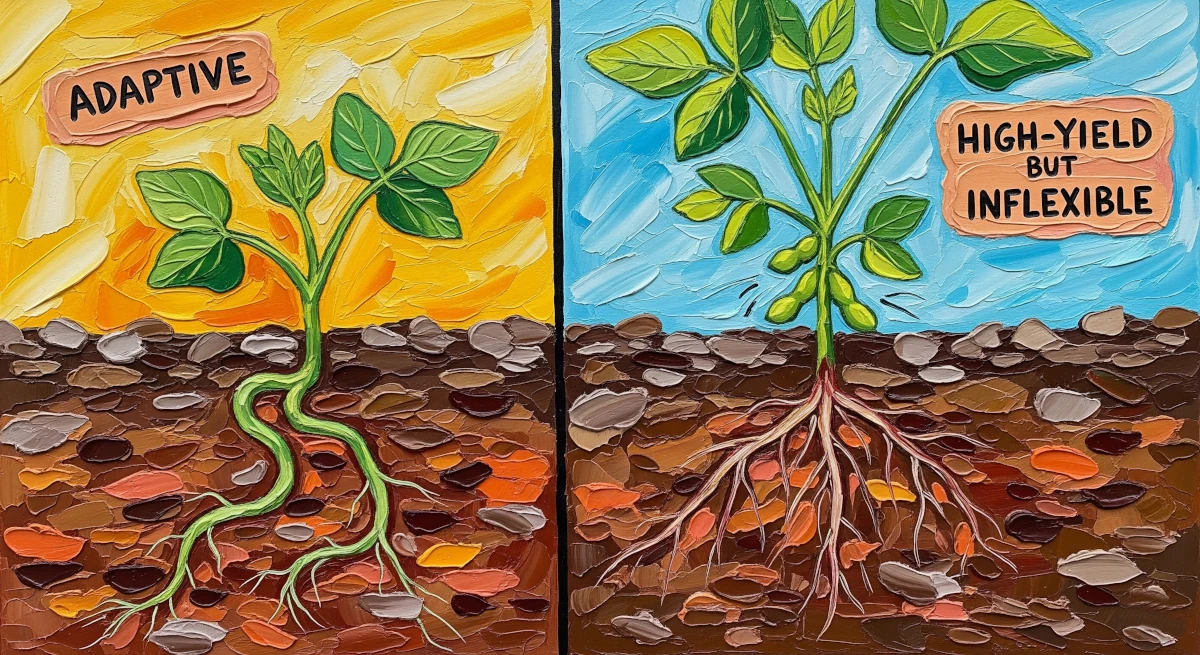
Neither strategy is objectively “better” – they’re two different bets on how to survive in a world where water is sometimes scarce. The avoidance strategy bets on never getting into trouble. The tolerance strategy bets on efficient recovery once trouble arrives.
Why This Matters Beyond the Lab
This shift in understanding has real, practical implications. Species selection for forestry and urban planting can move beyond simple drought “rankings” and instead match a plant’s whole hydraulic package – wood and bark together – to a site’s actual climate pattern, especially its VPD and day-night temperature swings, not just its rainfall totals. Climate change modeling for forests may need to weight atmospheric dryness and heat variability more heavily, since these appear to be stronger evolutionary drivers of drought strategy than soil moisture alone. And conservation and restoration efforts can use simple field-visible proxies – bark thickness, how corky or leathery the bark feels, lenticel density – as quick indicators of a species’ underlying hydraulic strategy, without needing lab equipment.
The Big Picture
The takeaway from this research is a genuinely new way of thinking about a tree’s stem: not as a pipe wrapped in a protective sheath, but as one integrated system where the plumbing (xylem) and the shield (bark) evolved together, trait by trait, to solve the same underlying problem – surviving a thirsty atmosphere. Wood tells you how a plant moves water. Bark tells you how it loses, saves, and wins water back. Understanding drought resistance means reading both halves of that story together.
Source
Study: The coordination between xylem and bark hydraulics in temperate Rosaceae species
Authors: Radek Jupa, Terezie Pátková, Jan Binter, Jiří Doležal, Michael Peter Nobis, Stefan Mayr, Vít Gloser (2026)
Read the full paper: https://www.biorxiv.org/content/10.64898/2026.06.06.730605v1

Leave a Reply